NFT Scams and Safety: Risks, Red Flags, Prevention Tips and Safety Checklist
1. Quick Answer
NFT scams are tricks designed to steal your NFTs, cryptocurrency, wallet access, personal information, or money. The most common risks include phishing links, fake NFT mints, wallet drainers, fake customer support, impersonators, rug pulls, fake giveaways, malicious smart contract approvals, and market manipulation such as wash trading. The safest approach is to slow down, verify every link and project, never share your recovery phrase, read wallet prompts carefully, use a separate minting wallet, keep valuable NFTs in a hardware wallet, and revoke approvals you no longer need.
2. What Are NFT Scams?
NFT scams are fraudulent schemes that use non-fungible tokens, crypto wallets, marketplaces, social media, or fake investment promises to deceive people. An NFT is a blockchain token that usually points to a digital item, membership, collectible, game asset, ticket, or other unique record. Because NFTs are often bought with cryptocurrency and controlled through self-custody wallets, scammers target both the NFT and the wallet behind it.
The important beginner lesson is simple: owning an NFT usually means you control a blockchain token through your wallet. If someone tricks you into signing the wrong transaction, approving the wrong contract, or revealing your recovery phrase, they may be able to move your assets without asking again.
3. Why NFT Scams Are So Common
NFT scams happen because NFT transactions are fast, global, and usually difficult to reverse. Scammers also exploit confusion. Beginners may not understand wallet permissions, smart contracts, minting websites, gas fees, or marketplace verification. That knowledge gap creates opportunities for fake links, fake urgency, and fake authority.
Regulators and law-enforcement agencies regularly warn that crypto-related scams use promises of high returns, urgency, impersonation, and pressure. The FTC warns consumers to be skeptical of crypto investments that promise guaranteed profits or require crypto payment, while the FBI advises victims of cryptocurrency investment fraud to stop sending money and report the crime through IC3.gov. Sources used for this guide include the FTC, FBI, OpenSea safety guidance, Chainalysis market-manipulation analysis, Reuters reporting on crypto scams, and TRM Labs crypto crime research.
4. How NFT Scams Usually Work
Most NFT scams follow a predictable pattern: the scammer creates attention, builds trust or urgency, asks the victim to take a wallet action, and then drains assets or disappears. The details vary, but the psychology is often the same.
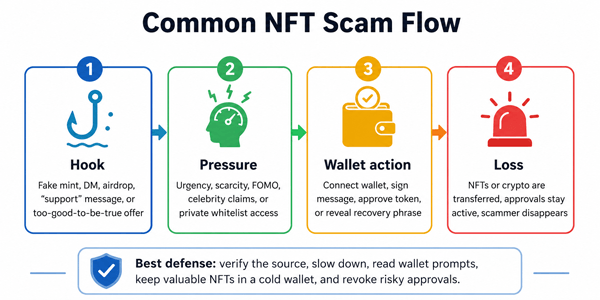
Figure: A simplified NFT scam flow, from hook to loss.
5. Common NFT Scams and How to Spot Them
| Scam type | How it works | Main red flags | Best prevention |
|---|---|---|---|
| Phishing links | A fake site imitates a marketplace, mint page, wallet app, or project website. The goal is to make you connect your wallet, sign a malicious transaction, or reveal sensitive information. | Misspelled domains, sponsored ads, random DMs, urgent “claim now” messages, links from Discord or X replies. | Type URLs manually, use bookmarks, check official social links, and avoid connecting your main wallet to unknown sites. |
| Wallet drainer | A malicious website asks you to sign a transaction or approval that lets the attacker transfer NFTs or tokens. | Wallet prompt mentions broad approvals, unfamiliar contracts, or permissions you do not understand. | Use a separate burner wallet for mints, read prompts, simulate transactions when possible, and revoke unused approvals. |
| Fake NFT mint | A scammer launches a fake mint page for a real or invented project, often before or during a popular drop. | Unverified link, copycat branding, countdown pressure, “limited spots,” or price far below the official mint. | Confirm through official website, marketplace profile, and multiple verified channels before minting. |
| Fake support | A scammer pretends to be support staff and asks for your seed phrase, screen share, or wallet connection. | Support contacts you first, asks for recovery phrase, pushes remote access, or sends a private link. | Use only official support pages. Real support should never need your recovery phrase. |
| Impersonation | Scammers copy creators, influencers, marketplaces, or project founders to promote fake links or fake offers. | New account, changed handle, low-quality followers, copied profile image, high-pressure posts. | Check account age, handle spelling, official website links, and announcements across channels. |
| Rug pull | A project sells NFTs, then the team disappears, drains funds, abandons promises, or manipulates the market. | Anonymous team, unrealistic roadmap, no product, aggressive hype, no transparent treasury or contract details. | Research the team, contract, community, delivery history, and whether promises are realistic. |
| Pump and dump | Insiders or promoters hype an NFT collection, push price up, sell to late buyers, then leave. | Sudden hype, paid influencers, no real utility, “next blue chip” claims, rapid price spikes. | Avoid buying only because price is rising. Check holder distribution, sales history, and actual demand. |
| Wash trading | People trade NFTs between related wallets to create fake volume or fake demand. | High volume with few wallets, repeated sales between the same wallets, odd price jumps. | Look beyond floor price. Review unique buyers, holder count, and transaction history. |
| Fake giveaway or airdrop | Victims are told they won or can claim free NFTs, but the claim page steals wallet access. | Unexpected prize, “connect wallet to claim,” request to pay gas for a suspicious asset. | Ignore unsolicited giveaways. Verify claims from official channels only. |
| Counterfeit NFT | Someone mints stolen art, copied assets, or a fake version of a known collection. | Collection name looks similar, low price, missing verification, copied metadata or art. | Buy from verified collections and confirm creator links before purchasing. |
6. NFT Red Flags Beginners Should Never Ignore
A single red flag does not always prove a scam, but several together should make you stop. In NFTs, the safest habit is to pause before connecting your wallet or signing anything.
- Someone asks for your recovery phrase or private key.
- A support agent contacts you first in DMs.
- A link comes from a Discord DM, social media reply, sponsored ad, or shortened URL.
- The website domain is slightly misspelled or uses a different ending.
- The offer promises guaranteed profit, risk-free returns, or “easy passive income.”
- You are told to act immediately or lose your spot.
- The project has anonymous founders with no delivery history.
- The roadmap promises games, metaverse land, revenue sharing, or celebrity partnerships without proof.
- Trading volume is high but the number of real buyers looks low.
- The wallet prompt asks for broad approval instead of a simple purchase or mint.
- You cannot clearly explain what you are signing.
- The NFT is unexpectedly “airdropped” to your wallet and pushes you to visit a claim site.
7. The Biggest NFT Safety Principle: Protect the Wallet First
NFT safety is wallet safety. Your wallet controls your NFTs, crypto, approvals, and signatures. Marketplace filters and project verification can help, but they cannot protect you if you sign a malicious transaction or give away your recovery phrase.
| Wallet safety habit | Why it matters | Beginner-friendly action |
|---|---|---|
| Never share your recovery phrase | Anyone with it can restore your wallet and move assets. | Write it offline and never type it into websites, chats, forms, or “support” pages. |
| Use separate wallets | One compromised minting wallet should not expose everything. | Use a low-value burner wallet for new mints and a separate vault wallet for valuable NFTs. |
| Use a hardware wallet for valuable assets | Private keys stay offline, reducing malware and phishing risk. | Store high-value NFTs and crypto in a cold wallet; only connect it when necessary. |
| Read transaction prompts | Many thefts happen because users approve broad permissions. | Do not sign if you do not understand the action, contract, or permission. |
| Revoke old approvals | Old permissions can remain active and may be abused later. | Review and revoke unnecessary approvals through reputable approval-checking tools. |
| Keep software updated | Browser, wallet, and device vulnerabilities can increase risk. | Update wallet apps, browsers, operating systems, and security tools. |
8. How to Check an NFT Project Before Buying or Minting
Research cannot remove all risk, but it can reduce obvious mistakes. Before buying or minting, run through these checks.
- Verify the official website from more than one source. Do not rely on a random link in a reply, DM, or ad.
- Check the marketplace collection page carefully. Look for the exact collection name, contract address, creator links, and suspicious copycats.
- Review the team. Public founders with relevant history are not a guarantee, but completely anonymous teams require extra caution.
- Read the roadmap like a skeptic. A realistic roadmap explains what exists now, what is planned, who will build it, and what has already been delivered.
- Check community quality. Real communities discuss product, art, utility, and risks. Scam communities often repeat hype, price targets, and “floor is rising” messages.
- Look at holder distribution. A project controlled by a few wallets may be easier to manipulate.
- Review sales history. Watch for repeated trades between the same wallets, sudden volume spikes, or strange price jumps.
- Understand rights and utility. Buying an NFT may not give you copyright, revenue rights, event access, or game benefits unless clearly stated in enforceable terms.
- Start small. Do not risk money you cannot afford to lose, especially on new collections.
9. Safe NFT Buying Process for Beginners
9.1. Before you buy
- Decide your budget before browsing.
- Use a separate wallet for marketplace activity.
- Bookmark official marketplace and project pages.
- Check current floor price, recent sales, number of owners, and collection verification.
- Confirm the NFT is part of the correct contract, not a copied collection.
9.2. During the transaction
- Read every wallet prompt.
- Check that the transaction is a purchase, bid, listing, or mint you actually intended.
- Avoid signing unlimited approvals unless you understand why they are needed.
- Do not rush because of countdown timers or chat pressure.
9.3. After the purchase
- Move valuable NFTs to a vault wallet or hardware wallet.
- Revoke unnecessary approvals.
- Keep records of purchase price, transaction hash, collection page, and project terms.
- Monitor official channels for security alerts, but never trust DMs claiming to help.
10. Fake NFT Mints: A Practical Example
Imagine a popular NFT project announces a mint for Friday. On Thursday night, a scammer creates a nearly identical website and posts, “Mint is live early for whitelist wallets.” The page asks users to connect a wallet and sign. The wallet prompt may look harmless, but it approves the scam contract to move NFTs or tokens. Victims who act quickly because they fear missing out may lose assets before the real mint even starts.
The prevention steps are practical: check the official website, compare the contract address, ignore DMs, wait for confirmation from multiple official channels, and use a low-value minting wallet. Speed is usually the scammer’s advantage. Patience is yours.
11. Marketplace Safety: What Platforms Can and Cannot Do
NFT marketplaces may provide verification badges, reporting tools, suspicious listing filters, and support articles. These are useful, but they are not complete protection. A marketplace cannot guarantee that every project will keep promises, that every NFT has long-term value, or that a user will not sign a malicious transaction on another website.
| Marketplace feature | How it helps | Limitation |
|---|---|---|
| Verified collection badge | Helps identify recognized collections or creators. | A badge does not guarantee investment value or future delivery. |
| Reporting tools | Allows users to report stolen, fake, or suspicious items. | Reports may take time and may not recover stolen assets. |
| Collection statistics | Shows floor price, volume, owners, and sales history. | Stats can be misleading if wash trading or manipulation is present. |
| Official support pages | Provide safety guidance and account help. | Scammers impersonate support in DMs and fake websites. |
12. NFT Scam Prevention Tips
12.1. Technical safety tips
- Use a hardware wallet for valuable NFTs and crypto.
- Create a burner wallet for new mints and unfamiliar websites.
- Keep only the amount needed for a transaction in your active wallet.
- Turn off Discord DMs from server members when joining NFT communities.
- Use bookmarks for marketplaces and wallet sites.
- Check token approvals regularly and revoke permissions you no longer need.
- Avoid signing blind transactions or unreadable messages.
- Do not download files from unknown project teams or “support” agents.
- Enable strong passwords and two-factor authentication on email, exchange, and marketplace accounts.
12.2. Research and behavior tips
- Never buy only because an influencer or celebrity account promoted a project.
- Be skeptical of guaranteed profits, fixed returns, or secret “alpha.”
- Do not confuse high social media activity with real demand.
- Check whether the art, metadata, website, and team information are original.
- Ask what would make the NFT valuable without hype.
- Take screenshots and save links when researching, but do not treat screenshots as proof by themselves.
- Walk away when you feel rushed, confused, or emotionally pressured.
13. What to Do If You Think You Have Been Scammed
Act quickly, but do not panic. The goal is to stop further losses, preserve evidence, and report the incident.
1. Disconnect your wallet from suspicious websites.
2. Move remaining assets from the compromised wallet to a new safe wallet if your recovery phrase was exposed or you signed suspicious approvals. Use caution: if the wallet is actively compromised, get experienced help before moving funds.
3. Revoke suspicious token and NFT approvals using a reputable approval-checking tool.
4. Do not send more money to “recover” your assets. Recovery scams often target people immediately after a loss.
5. Save evidence: wallet addresses, transaction hashes, URLs, screenshots, usernames, emails, Discord IDs, and timestamps.
6. Report the scam to the marketplace, wallet provider, social platform, and relevant law-enforcement reporting channel. In the United States, the FBI directs victims of cryptocurrency investment fraud to IC3.gov. In other countries, use your national cybercrime reporting agency.
7. Warn the community using facts, not accusations you cannot support. Share scam links only in a safe, non-clickable format when possible.
14. NFT Safety Checklist
| Before connecting wallet | Before signing | Before buying | After transaction |
|---|---|---|---|
| Is this the official website from a trusted source? | Do I understand exactly what I am signing? | Is the collection contract correct? | Should I revoke approvals? |
| Did I type the URL or use a bookmark? | Does the prompt request broad permissions? | Is the price realistic compared with recent sales? | Should I move assets to a vault wallet? |
| Am I using a burner wallet for a new mint? | Am I being rushed by a countdown, DM, or fake support agent? | Are sales and holder data natural or suspicious? | Did I save transaction records? |
| Is my recovery phrase offline and private? | Would I still sign if there were no hype or pressure? | Do I understand the rights, utility, and risks? | Did I report suspicious links or fake collections? |
15. Common Misconceptions About NFT Safety
15.1. “A verified collection is always safe.”
Verification can reduce copycat risk, but it does not guarantee price, future utility, team honesty, or smart contract safety.
15.2. “If I only sign a message, I cannot lose anything.”
Some signatures can authorize actions or be used in scams. Treat signatures seriously, especially on unfamiliar sites.
15.3. “A famous person promoted it, so it must be legitimate.”
Celebrity promotion does not equal due diligence. Accounts can be hacked, promotions can be paid, and influencers can be wrong.
15.4. “Free NFTs are harmless.”
Unexpected NFTs can be bait. The danger is often not the NFT itself but the link or contract you are pushed to use in order to claim, sell, or unlock it.
16. NFT Scams vs Normal NFT Risks
| Category | Scam risk | Normal market risk |
|---|---|---|
| Cause | Fraud, deception, impersonation, malicious contracts, or manipulation. | Price volatility, changing demand, weak utility, poor execution, or market cycles. |
| Example | Fake mint drains wallet after user signs approval. | A legitimate NFT collection loses popularity and floor price falls. |
| Prevention | Security habits, verification, wallet separation, approval checks, reporting. | Budgeting, research, diversification, realistic expectations. |
| Can it be eliminated? | Not completely, but many scams can be avoided with careful behavior. | No. Market risk is part of buying speculative assets. |
17. Best Practices for Parents, Students, and New Collectors
Beginners should treat NFTs as high-risk digital collectibles, not guaranteed investments. Parents and teachers should explain that wallet transactions can be permanent, strangers online may impersonate helpers, and free offers can be traps. New collectors should practice with small amounts, learn how wallet prompts work, and avoid using school, work, or family devices for risky crypto browsing.
18. Final Takeaway
NFT safety is less about memorizing every scam name and more about building safe habits. Verify links, protect your recovery phrase, separate wallets by risk, read wallet prompts, avoid pressure, research projects carefully, and keep valuable assets away from daily browsing. When something feels urgent, confusing, or too profitable to be real, pause. In NFTs, slowing down is one of the strongest security tools you have.
19. FAQs
19.1. What is the most common NFT scam?
Phishing is one of the most common NFT scam patterns. It usually involves fake websites, fake mint pages, fake support messages, or links that trick users into connecting a wallet and signing a harmful transaction.
19.2. Can someone steal my NFT if they know my wallet address?
Usually no. A public wallet address alone is not enough to steal NFTs. The danger comes from revealing your recovery phrase, signing malicious transactions, approving bad contracts, or having your device or wallet compromised.
19.3. What is a wallet drainer?
A wallet drainer is a malicious website or smart contract designed to take assets from your wallet after you sign a transaction or approval. It may look like a normal mint, claim, or marketplace page.
19.4. Are NFTs safe for beginners?
NFTs can be used safely, but they are risky for beginners who do not understand wallets, approvals, phishing, and market volatility. Start small, use a separate wallet, and learn security basics before buying expensive NFTs.
19.5. Should I use a hardware wallet for NFTs?
A hardware wallet is strongly recommended for valuable NFTs or crypto. It keeps private keys offline and reduces some risks from malware and phishing, although you still need to read transaction prompts carefully.
19.6. What should I do if a support person asks for my seed phrase?
Stop immediately. A real support person should never ask for your recovery phrase or private key. Do not share it, do not screen share it, and do not type it into a website.
19.7. Can stolen NFTs be recovered?
Sometimes marketplaces, investigators, or law enforcement may help, but recovery is not guaranteed. Blockchain transfers are usually difficult to reverse, so prevention is far more reliable than recovery.
19.8. How can I tell if NFT volume is fake?
Look for repeated sales between the same wallets, few unique buyers, sudden volume spikes, and prices that do not match broader demand. Wash trading can make a collection look more popular than it really is.
19.9. Is every anonymous NFT team a scam?
No, but anonymity increases due-diligence risk. If the team is anonymous, look harder at contract transparency, delivered work, community behavior, realistic promises, and whether you can afford to lose the money.
19.10. Is it safe to click on NFTs that appear in my wallet?
Be careful. Viewing an NFT in a reputable wallet interface is different from visiting external links attached to it. Do not visit unknown claim pages or sign transactions linked to unexpected airdrops.
Sources Consulted and Checked
These sources were consulted and checked while preparing this document to support accuracy and reliability.
- Federal Trade Commission (FTC): What To Know About Cryptocurrency and Scams
- FBI: Cryptocurrency Investment Fraud and reporting through IC3
- OpenSea: Web3 Security Guide and NFT safety guidance
- OpenSea Support: How can I stay safe and protect my NFTs?
- Chainalysis: Market manipulation, wash trading, and pump-and-dump analysis
- Reuters: Crypto scams and AI-driven scam trends
- TRM Labs: 2026 Crypto Crime Report
Reader Advice
This article is provided for educational and informational purposes only and is not personalized financial, legal, investment, cybersecurity, or other professional advice or a recommendation to buy, sell, mint, or hold any NFT or crypto asset. NFT and crypto activity can involve fraud, irreversible transactions, volatile prices, malicious smart-contract permissions, loss of wallet access, and total loss of funds or digital assets. Rules, platform policies, laws, enforcement practices, technology, and statistics can change over time and vary by country or region, so verify important information through current official sources and seek qualified professional help where appropriate before making a decision.