ETF vs Stocks: Which Is Better for Long-Term Investing?
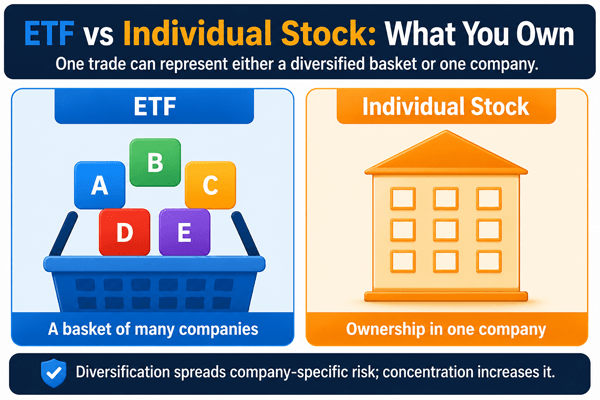
Most beginners start investing with the same question: should I buy ETFs or individual stocks? The honest answer is that both can build wealth, but they do it in very different ways. Stocks give you direct ownership in one company. ETFs give you ownership in a basket of investments through one trade. For long-term investing, the better choice usually depends on your knowledge, time, risk tolerance, and how much control you want.
For many beginners, a low-cost, diversified ETF is often the simpler and more forgiving starting point. It can spread risk across many companies, reduce the pressure to pick winners, and make it easier to stay invested. Individual stocks can still be useful, but they require more research, emotional discipline, and acceptance that a single company can disappoint even when the overall market does well.
1. Quick Answer: ETF or Stocks for Long-Term Investing?
| Investor type | Usually better starting point | Why |
|---|---|---|
| Complete beginner | Broad-market ETF | Simple, diversified, low maintenance, and less dependent on one company. |
| Busy professional | ETF portfolio | Needs less research and fewer decisions than tracking many individual stocks. |
| Investor who enjoys business research | Mix of ETFs and selected stocks | Core ETF portfolio can provide stability while selected stocks add focus. |
| High-conviction investor | Individual stocks, with limits | Can outperform, but only if research, patience, and risk control are strong. |
| Retirement-focused investor | Low-cost ETFs or index funds | Costs, diversification, and consistency matter more than excitement. |
A practical rule many experienced investors use is the core-and-satellite approach: keep most long-term money in diversified ETFs, then use a smaller amount for individual stocks if you want to learn, research, and take extra company-specific risk. This is not the only method, but it helps prevent one bad stock pick from damaging the whole plan.
2. What Is a Stock?
A stock is a small ownership share in a company. When you buy a stock, you are buying a claim on part of that company’s future profits, assets, and growth. If the business grows, earns more money, and investors become willing to pay more for it, the stock price may rise. If the business struggles, the stock price can fall - sometimes sharply.
For example, buying one technology stock means your money is tied to that company’s products, leadership, competition, valuation, and future results. That can be rewarding, but it is concentrated. Even excellent businesses can have long periods of poor stock performance if investors overpaid, growth slows, margins fall, regulation changes, or the market loses confidence.
2.1 How Stocks Work in Simple Words
- You choose a company and buy shares through a brokerage account.
- Your return can come from price growth, dividends, or both.
- Your risk is tied to that specific company and its industry.
- You need to monitor business quality, earnings, debt, competition, valuation, and management decisions.
- One stock can beat the market, but one stock can also lose most of its value.
3. What Is an ETF?
An ETF, or exchange-traded fund, is an investment fund that trades on a stock exchange like a stock. Instead of owning one company, an ETF usually holds a collection of assets, such as hundreds of stocks, bonds, commodities, or a mix of investments. Investor.gov explains that ETFs pool money from many investors and invest that money in a portfolio of securities or assets.
A broad stock-market ETF may own shares of many companies across different industries. A bond ETF may own many bonds. A dividend ETF may focus on companies that pay dividends. A sector ETF may focus on one area, such as technology or healthcare. This means not all ETFs are automatically low risk. A broad-market ETF is very different from a leveraged ETF, crypto ETF, or narrow sector ETF.
3.1 How ETFs Work in Simple Words
- You buy one ETF share through a brokerage account, just like buying a stock.
- The ETF owns many investments inside it.
- The ETF charges an annual cost called an expense ratio.
- Its price moves during the trading day based on the value of the assets it owns and market demand.
- Your return depends on the basket, not one company only.
4. ETF vs Stocks: Main Differences
| Feature | ETF | Individual stock |
|---|---|---|
| What you own | A basket of investments inside one fund. | Shares of one company. |
| Diversification | Usually higher, especially broad-market ETFs. | Low unless you own many stocks across sectors. |
| Research needed | Moderate: check index, holdings, cost, risk, provider, liquidity. | High: study business, valuation, financials, industry, management. |
| Risk type | Market risk plus fund-specific risks. | Market risk plus company-specific risk. |
| Control | Less control over each holding. | Full control over which companies you own. |
| Costs | Expense ratio plus trading costs/spread. | No expense ratio, but possible trading costs/spread. |
| Tax considerations | Often tax-efficient, but taxes still apply. | Tax timing is controlled by when you sell; dividends may be taxable. |
| Beginner friendliness | Generally easier for long-term beginners. | Can be harder because mistakes are more concentrated. |
| Best use | Core long-term portfolio, diversification, passive investing. | Targeted exposure, learning, conviction, potential outperformance. |
5. Which Is Better for Long-Term Investing?
For most beginners, ETFs are usually better as the foundation of a long-term portfolio because they solve three major problems at once: diversification, simplicity, and behavior. You do not need to predict which single company will win. You do not need to read every quarterly report. And you are less likely to panic because one company missed earnings.
That does not mean stocks are bad. Individual stocks can create significant wealth when the investor buys strong businesses at reasonable prices and holds through volatility. The challenge is that beginners often underestimate how hard it is to separate a great company from a great investment. A popular company can still be an overpriced stock. A cheap stock can still be a declining business.
The long-term investor should ask a better question than “Which will make me richer?” The better question is: “Which approach can I follow consistently for 10, 20, or 30 years without making emotional mistakes?”
6. The Practical Case for ETFs
ETFs are popular with long-term investors because they make the boring parts of investing easier. Boring is not bad. In investing, boring often means repeatable, understandable, and easier to stick with.
6.1 Built-in diversification
A broad ETF can own hundreds or thousands of securities. If one company performs badly, it may have only a small effect on the whole fund. Investor.gov highlights asset allocation and diversification as key strategies for managing investing risk. Diversification does not eliminate losses, but it can reduce the damage caused by relying too heavily on one company or sector.
6.2 Lower research burden
With stocks, you must understand the company. With ETFs, you must understand the fund. That is still important, but it is usually easier. A beginner can learn to compare ETF expense ratios, holdings, index methodology, assets under management, bid-ask spread, tax history, and long-term performance pattern faster than learning how to value individual companies.
6.3 Low costs can compound
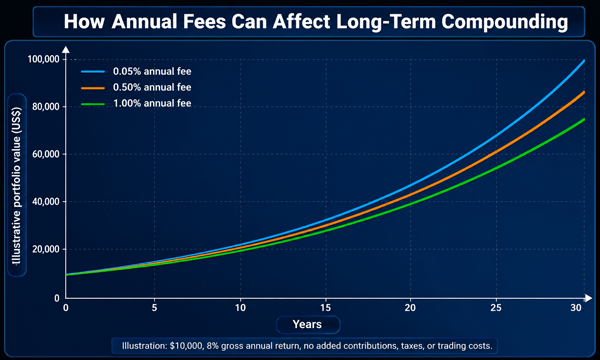
Costs matter because every dollar paid in fees is a dollar that cannot compound for you. Vanguard reports that its average index ETF and mutual fund expense ratio was 0.04% compared with an industry average of 0.17% as of December 31, 2025. The exact fund you choose matters, but the lesson is simple: low-cost investing gives your money a better chance to stay invested and grow over time.
6.4 Easier behavior
Many investors do not fail because they choose the wrong product. They fail because they buy high, sell low, chase trends, overtrade, or abandon the plan during a market decline. Morningstar’s 2025 “Mind the Gap” research found that the average dollar invested in U.S. mutual funds and ETFs earned less than the funds themselves over the prior 10 years, largely because of investor timing behavior. ETFs are not magic, but a simple diversified ETF plan can reduce the number of decisions that lead to mistakes.
7. The Practical Case for Individual Stocks
Individual stocks are not only for experts, but they demand expert-like habits. They can be useful if you want direct ownership, enjoy research, and can handle volatility without reacting emotionally.
7.1 Higher upside if you are right
A single successful company can outperform a broad ETF by a wide margin. This is why some investors buy individual stocks. The reward for being right can be meaningful. But the penalty for being wrong can also be severe.
7.2 Full control over what you own
With an ETF, you accept the whole basket. With stocks, you can choose exactly which companies you want and avoid ones you do not understand or do not like. This control is valuable only if it is supported by good research and patience.
7.3 No fund expense ratio
Stocks do not charge an annual expense ratio. However, “free” does not mean costless. You may still pay through bid-ask spreads, taxes, poor timing, overconcentration, or opportunity cost. The biggest cost for stock pickers is often not a visible fee - it is being wrong.
8. Real-Life Beginner Scenarios
| Scenario | ETF approach | Stock approach | Practical lesson |
|---|---|---|---|
| New investor with $100 per month | Buys a broad-market ETF regularly. | Buys one popular stock because everyone is talking about it. | The ETF investor starts diversified; the stock investor starts concentrated. |
| Market drops 25% | Sees the whole market is down and continues the plan. | Worries the company is broken and sells after the fall. | A simple plan can be easier to hold during stress. |
| Wants dividend income | Chooses a diversified dividend ETF after checking cost and holdings. | Buys three high-yield stocks without studying payout safety. | Yield alone is not safety. Diversification and quality matter. |
| Wants to learn stock analysis | Keeps 80-90% in ETFs and researches stocks with the rest. | Puts all money into five stocks after reading social media. | Learning is good; risking the whole portfolio too early is not. |
9. Beginner Checklist: How to Choose an ETF
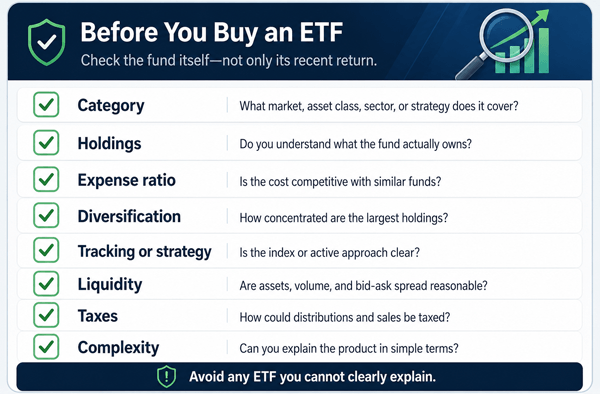
Before buying an ETF, do not only look at past returns. Past performance is not a promise. Use this checklist instead:
- Know the ETF category: broad U.S. stock, international stock, bond, dividend, sector, commodity, thematic, leveraged, or inverse.
- Read the holdings: make sure you know what the ETF actually owns.
- Check the expense ratio: lower is usually better when comparing similar funds.
- Check diversification: how many holdings does it have and how concentrated are the top 10 holdings?
- Check tracking: does it follow a clear index or active strategy?
- Check liquidity: look at trading volume, assets under management, and bid-ask spread.
- Understand taxes: dividends, capital gains, and selling profits may create taxes depending on the account.
- Avoid products you cannot explain: leveraged, inverse, complex option-income, and crypto-related ETFs may not fit beginners.
10. Beginner Checklist: How to Analyze a Stock
Before buying an individual stock, answer these questions in writing. If you cannot answer them, you may not understand the investment yet.
| Question | Why it matters |
|---|---|
| What does the company actually do? | You should understand how it makes money. |
| Is revenue and profit growing? | Long-term stock value often follows long-term business performance. |
| Does the company have too much debt? | Debt can magnify trouble during downturns. |
| What makes the company hard to compete with? | Strong businesses usually have some durable advantage. |
| Is the stock price reasonable? | A great company can be a poor investment if bought at an extreme price. |
| What would make you sell? | Decide before emotions take over. |
| How much of your portfolio will it be? | Position size controls damage if you are wrong. |
11. ETF Portfolio Examples for Beginners
These are educational examples, not recommendations. The right allocation depends on your country, tax rules, income needs, retirement account options, age, and risk tolerance.
| Portfolio style | Example structure | Who may consider it | Important caution |
|---|---|---|---|
| One-fund simple | One broad global stock ETF or target-date fund. | Beginner who wants maximum simplicity. | Make sure the fund matches your risk level and location. |
| Two-fund core | Total stock market ETF + bond ETF. | Investor who wants growth plus some stability. | Bond allocation should reflect time horizon and risk tolerance. |
| Three-fund classic | U.S. stock ETF + international stock ETF + bond ETF. | Long-term investor who wants broad diversification. | Requires occasional rebalancing. |
| Core and satellite | 80-90% broad ETFs + 10-20% selected stocks or themes. | Investor who wants to learn stock picking without risking everything. | The satellite portion should not become the whole portfolio. |
12. When Individual Stocks May Be Better
- You have time to read annual reports, earnings calls, and industry news.
- You can value businesses instead of buying only because the price is rising.
- You can hold through volatility when the business thesis is still intact.
- You limit position size so one mistake does not damage your future.
- You accept that even good research can be wrong.
Individual stocks may also make sense for investors who already have a diversified base through retirement plans, index funds, or ETFs and want a smaller account for direct ownership. The key is to avoid confusing entertainment with investing. If you are buying because it feels exciting, slow down.
13. When ETFs May Be Better
- You are new and want a clean starting point.
- You do not have time to research individual companies.
- You want broad exposure through one or a few funds.
- You are investing for retirement or long-term goals.
- You want to reduce the chance that one company ruins your plan.
- You want a tax-efficient investing structure in a taxable brokerage account, while still understanding local tax rules.
14. Common Beginner Mistakes to Avoid
| Mistake | Why it hurts | Better practice |
|---|---|---|
| Buying what is trending | Trends often become popular after prices already rose. | Build a written plan before buying. |
| Ignoring fees | Small annual costs can become large over decades. | Compare expense ratios among similar funds. |
| Owning too many similar ETFs | You may think you are diversified while holding the same stocks repeatedly. | Check overlap between funds. |
| Confusing dividend yield with safety | Very high yield can signal risk. | Look at business quality, payout sustainability, and total return. |
| Selling after every decline | Market declines are normal but emotionally hard. | Set an allocation you can hold through downturns. |
| Putting all money in one stock | One company-specific problem can damage your portfolio. | Use position-size limits and diversification. |
| Using leveraged ETFs long term without understanding them | They can behave very differently from simple ETFs. | Avoid complex products until you fully understand them. |
15. Taxes: ETF vs Stocks
Taxes depend on your country, account type, income level, holding period, and local rules, so this section is general education only. In many markets, ETFs can be tax-efficient because of their structure, lower turnover, and the way shares are created and redeemed. iShares notes that low turnover and insulation from the actions of other shareholders are key reasons ETFs are often tax-efficient. However, “tax-efficient” does not mean tax-free.
| Tax point | ETF | Stock |
|---|---|---|
| Dividends | May distribute dividends from holdings; taxable depending on account and law. | Dividends may be taxable when received. |
| Capital gains | You may owe tax when selling at a profit; some ETFs may distribute gains. | You generally control when to realize gains by choosing when to sell. |
| Turnover | Index ETFs often have lower turnover than active funds. | Turnover depends on your trading behavior. |
| Record keeping | Usually simpler with fewer holdings. | More trades and dividends can make records more complex. |
16. Costs: Expense Ratio, Spreads, and Hidden Mistakes
ETF investors should understand the expense ratio. It is the annual fund cost expressed as a percentage of assets. For example, a 0.05% expense ratio means $0.50 per year for every $1,000 invested, before considering market movement. A 1.00% cost means $10 per year for every $1,000. The difference seems small in year one, but it compounds over decades.
Stock investors avoid expense ratios, but they can still lose money through poor research, emotional trading, taxes, and concentration. The lowest-cost investment is not always the best investment if it leads to bad behavior. The goal is not simply to pay the lowest fee. The goal is to build a portfolio you understand, can afford, and can hold.
17. Risk Comparison: What Can Go Wrong?
| Risk | ETF example | Stock example | How to reduce it |
|---|---|---|---|
| Market risk | A broad ETF falls during a bear market. | A stock falls with the whole market. | Keep long time horizon and right asset allocation. |
| Company-specific risk | Usually diluted in broad ETFs. | A company loses customers, faces lawsuits, or misses earnings. | Diversify and limit position size. |
| Sector concentration | A tech ETF may fall if tech stocks decline. | A tech company may fall even more. | Check holdings and sector exposure. |
| Behavior risk | Investor sells ETF after a market crash. | Investor panic-sells after bad news. | Use automatic investing and written rules. |
| Complex product risk | Leveraged/inverse ETF behaves unexpectedly. | Speculative stock collapses. | Avoid products you cannot explain. |
18. A Simple Decision Framework
Use this framework before deciding where your next dollar goes:
- Goal: Is this money for retirement, a home, education, income, or learning?
- Time horizon: Can the money stay invested for at least five to ten years?
- Risk tolerance: Would a 30% drop make you sell?
- Knowledge: Can you explain the investment in plain language?
- Diversification: Are you relying too much on one company, country, sector, or theme?
- Cost: What are the fees, spreads, taxes, and behavior costs?
- Plan: When will you buy, rebalance, add money, or sell?
Practical answer:
If you cannot explain a stock clearly, use a diversified ETF while you learn. If you cannot explain an ETF’s holdings and strategy, do not buy it just because it has “ETF” in the name.
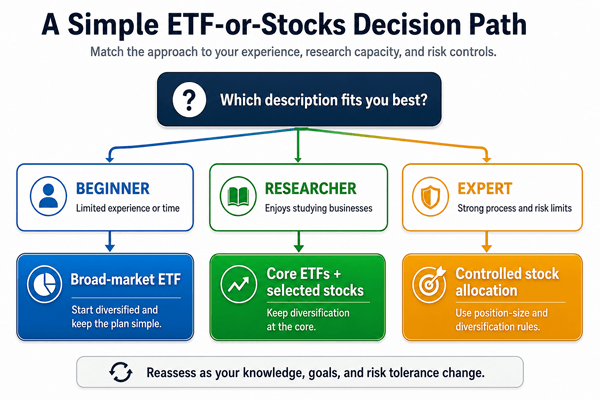
Decision guide: Match the investment approach to your knowledge, research capacity, and risk controls.
19. Sample 12-Month Beginner Action Plan
| Month | Action | Purpose |
|---|---|---|
| 1 | Learn basic terms: stock, ETF, index, expense ratio, dividend, capital gain, brokerage account. | Build vocabulary before risking money. |
| 2 | Open a watchlist, not a large position. Compare 3 broad ETFs and 3 companies. | Learn how prices move without rushing. |
| 3 | Write your investment policy: goal, time horizon, monthly amount, max stock position size. | Create rules before emotions appear. |
| 4-6 | Start small with a diversified ETF if suitable for your goals. | Build the habit of consistent investing. |
| 7-9 | Study one stock deeply: business model, revenue, profit, debt, valuation, risks. | Learn analysis before buying many stocks. |
| 10-12 | Review allocation, costs, overlap, and behavior. Rebalance only if needed. | Improve the plan without overtrading. |
20. ETF vs Stocks: Final Verdict
For long-term beginners, ETFs are usually the better foundation because they are diversified, easier to manage, and more forgiving of limited knowledge. A broad, low-cost ETF can help investors participate in market growth without needing to pick the winning company. This is why many retirement investing strategies, wealth management plans, and passive investing approaches use ETFs or index funds as core holdings.
Individual stocks are better for investors who want control, can research businesses, and can handle company-specific risk. They may create higher returns, but they can also create deeper losses. For many people, the best answer is not ETF or stocks. It is ETFs first, stocks carefully, and a written plan always.
21. FAQ: ETF vs Stocks
21.1 Are ETFs safer than stocks?
Broad ETFs are usually less risky than owning one stock because they spread money across many holdings. But ETFs can still lose money, especially stock ETFs during market declines.
21.2 Can I get rich from ETFs?
ETFs can build wealth over long periods if markets grow, costs stay low, and investors remain disciplined. They are not a quick-rich strategy and returns are never guaranteed.
21.3 Can I lose all my money in an ETF?
With a broad ETF holding many real securities, losing everything is less likely than with a single stock, but losses can still be large. Narrow, leveraged, inverse, or speculative ETFs can carry much higher risk.
21.4 How many ETFs should a beginner own?
Many beginners can start with one to three broad ETFs. More funds do not automatically mean better diversification; they can create overlap and confusion.
21.4 Is an S&P 500 ETF enough?
It can be a strong U.S. large-company core, but it is not the whole global market. Some investors add international stocks, bonds, or other assets depending on goals and risk tolerance.
21.5 Are dividend ETFs better than growth ETFs?
Not automatically. Dividend ETFs may appeal to income-focused investors, while growth ETFs may suit investors seeking higher growth exposure. Total return, risk, valuation, tax treatment, and diversification matter more than the label.
21.6 Should I buy ETFs every month?
Many long-term investors use regular investing to build discipline and reduce timing pressure. The best schedule depends on cash flow, fees, and personal goals.
21.7 Should beginners avoid individual stocks completely?
Not necessarily. Beginners can study stocks and use small position sizes. But it is usually wise to keep the core portfolio diversified while learning.
Sources Consulted and Checked
These sources were consulted while preparing this article and checking its accuracy. Readers should review the latest official information where relevant.
- Investor.gov / SEC: Exchange-Traded Funds (ETFs) and investor bulletins on ETFs.
- Investor.gov / SEC: Beginner’s Guide to Asset Allocation, Diversification, and Rebalancing.
- Vanguard: index fund education and reported average index ETF/mutual fund expense ratios as of December 31, 2025.
- S&P Dow Jones Indices: SPIVA research on active fund performance versus benchmarks.
- Morningstar: 2025 Mind the Gap research on investor return gaps and trading behavior.
- iShares / BlackRock: ETF education and tax efficiency discussion.
Reader Advice
This article is provided for educational and informational purposes only and does not constitute personal financial, investment, tax, or legal advice. It does not recommend any specific ETF, stock, brokerage account, retirement plan, or financial adviser. Investment values can rise or fall, and past performance does not guarantee future results. Before making any decision, consider your goals, financial circumstances, time horizon, risk tolerance, fees, and applicable taxes, and seek advice from an appropriately qualified professional where necessary.
Financial products, market conditions, tax treatment, laws, regulations, fees, and published figures may change over time or differ by country, account type, provider, and personal circumstances. Verify material facts, figures, product terms, and current rules through official and up-to-date sources before acting.