How ETFs Pay Dividends and How Often You Get Paid
1. Quick Answer: Do ETFs Pay Dividends?
Yes. Many ETFs pay dividends or other distributions when the investments inside the ETF generate income. A stock ETF may receive dividends from companies it owns. A bond ETF may receive interest from bonds. The ETF then passes most of that income to shareholders after fund expenses. SEC Investor.gov explains that a fund may earn income from holdings and then pay shareholders nearly all of that income, less expenses, as a dividend payment [1].
But not every ETF pays the same way. Some ETFs pay monthly, many pay quarterly, some pay semi-annually or annually, and some growth-focused ETFs may pay very little. A few ETFs are accumulating funds in certain markets, meaning income is retained and reflected in the fund value instead of paid out as cash.
1.1 The simple version
- An ETF is a basket of investments that trades on an exchange like a stock.
- If the basket earns income, the ETF may distribute that income to investors.
- You receive the payment through your brokerage account.
- You can usually take the money as cash or automatically reinvest it through a dividend reinvestment plan, often called DRIP.
- The payment amount is not guaranteed. It can rise, fall, or disappear depending on the ETF holdings and market conditions.
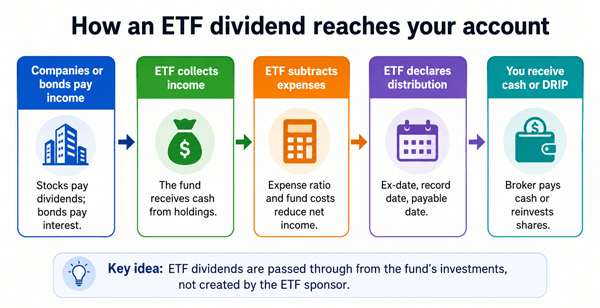
Figure 1: ETF dividend flow. Alt text: Flowchart showing companies or bonds paying income to an ETF, the ETF collecting income, subtracting expenses, declaring a distribution, and paying the investor in cash or reinvested shares.
2. What Is an ETF Dividend?
An ETF dividend is a payment made by an exchange-traded fund to its shareholders. In everyday language, it is your share of the income earned by the ETF portfolio. If you own 20 shares of a dividend ETF and the ETF announces a $0.50 distribution per share, your gross payment is 20 x $0.50 = $10 before any taxes or account-level withholding.
The word dividend is often used casually, but ETF payouts may include different types of distributions: stock dividends, bond interest, real estate investment trust income, return of capital, and capital gains distributions. The source matters because it can affect taxes and whether the payout is sustainable.
| Type of ETF payout | Where it comes from | Common in | Beginner note |
|---|---|---|---|
| Stock dividend income | Companies inside the ETF pay dividends | Equity dividend ETFs, S&P 500 ETFs | May be qualified or ordinary depending on rules |
| Bond interest income | Bonds inside the ETF pay interest | Treasury, corporate bond, municipal bond ETFs | Often ordinary income; municipal income may have special tax treatment |
| Capital gains distribution | ETF sells holdings at a gain and distributes the realized gain | More common near year-end, less frequent in many index ETFs | Taxable in many accounts even if reinvested |
| Return of capital | Some of your payment is classified as a return of invested capital | Certain option-income, REIT, MLP, or specialty funds | Not automatically bad, but must be understood carefully |
3. How ETFs Pay Dividends Step by Step
3.1 The companies or bonds inside the ETF generate income
An ETF does not magically create dividend income. It owns a portfolio. If that portfolio contains dividend-paying stocks, the ETF receives dividends. If it contains bonds, it receives interest. If it contains real estate-related holdings, income may come from REIT distributions.
3.2 The ETF collects income during the distribution period
The fund accumulates income from its holdings. This can happen daily, monthly, quarterly, or on another schedule depending on the fund type and fund provider.
3.3 The fund subtracts expenses
An ETF charges an expense ratio. This fee is not usually taken from your brokerage account as a separate bill. It is reflected inside the fund’s net asset value. Because expenses reduce the fund’s net income, they can also reduce what is available to distribute.
3.4 The ETF announces a distribution
The ETF sponsor announces the distribution amount per share and the relevant dates. For example, iShares describes that ETFs have regularly scheduled distribution dates, but distributions can reflect income from underlying holdings and other factors [10].
3.5 Your broker pays you
On the payable date, the broker credits eligible shareholders. The payment may appear as cash in your brokerage account, or it may be used to buy more ETF shares if dividend reinvestment is enabled.
4. How Often Do ETFs Pay Dividends?
ETF dividend frequency depends on the ETF. The most common payment schedules are monthly, quarterly, semi-annual, and annual. Many broad U.S. stock ETFs pay quarterly. Many bond ETFs and income-focused ETFs pay monthly. Some international ETFs pay semi-annually or annually. The schedule is listed on the ETF provider’s website, prospectus, or distribution calendar.
| Payment frequency | Common examples | Best fit | Beginner warning |
|---|---|---|---|
| Monthly | Often bond ETFs, high-dividend ETFs, covered-call ETFs, income ETFs | Investors who want regular cash flow | Monthly income can still vary; it is not a salary |
| Quarterly | Many U.S. equity ETFs and broad market ETFs | Long-term investors who want occasional income | Quarterly does not mean equal payments every quarter |
| Semi-annual | Some international or regional ETFs | Investors comfortable with less frequent payments | Cash flow can feel uneven |
| Annual | Some funds with low income or year-end distributions | Tax-aware or growth-focused investors | You may wait most of the year for one payment |
| No regular cash distribution | Accumulating share classes or growth ETFs with little income | Investors focused on total return | Return may come mainly from price appreciation |
Real provider schedules show this variety. Vanguard’s 2026 dividend schedule lists many funds with March, June, September, and December distribution dates, while noting that some funds distribute dividends daily and pay monthly [3]. iShares’ 2026 schedule says quarterly distributing equity ETFs intend to go ex-dividend in March, June, September, and December, while semi-annual equity ETFs intend to do so in June and December [4].
4.1 Practical example: quarterly ETF dividend
Suppose you own 100 shares of an ETF. The ETF announces a dividend of $0.60 per share. Your gross dividend is:
| Calculation 100 shares x $0.60 = $60 gross dividend. If your broker reinvests it and the ETF trades at $50, the $60 can buy about 1.2 additional shares, depending on the broker’s fractional-share rules and execution price. |
This example is simple, but it teaches the most important lesson: ETF dividend income depends on shares owned, distribution per share, taxes, and whether you reinvest or spend the cash.
5. The Four ETF Dividend Dates Beginners Must Understand
Dividend dates often confuse new investors. The most important date for eligibility is usually the ex-dividend date. SEC Investor.gov states that if you purchase a stock on or after the ex-dividend date, you will not receive the next dividend; if you purchase before the ex-dividend date, you get the dividend [5]. The same timing concept is widely used when ETF distributions are processed.
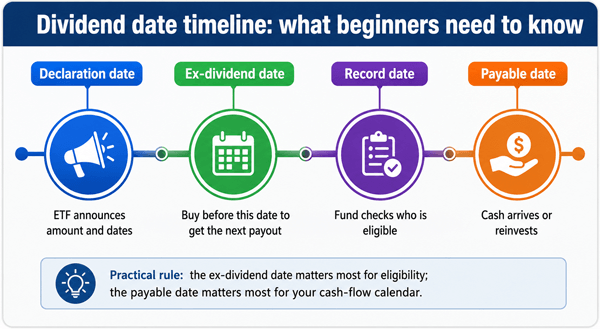
Figure 2: ETF dividend date timeline. Alt text: Timeline showing declaration date, ex-dividend date, record date, and payable date.
| Date | What it means | What beginners should do |
|---|---|---|
| Declaration date | The ETF announces the dividend amount and schedule | Good for planning, but not usually the eligibility cutoff |
| Ex-dividend date | First day shares trade without the right to the next dividend | Buy before this date if your goal is to receive the upcoming payout |
| Record date | The fund checks its shareholder records | Usually handled behind the scenes by the broker and settlement system |
| Payable date | The payment is made | This is when cash or reinvested shares show up in your account |
5.1 Common mistake: buying just for the dividend
Many beginners see a dividend date and think they can buy the ETF right before the payment, collect “free money,” and sell immediately. That is not how it works. On the ex-dividend date, the ETF price typically adjusts downward by roughly the dividend amount, all else equal. Market movement can hide the adjustment, but the dividend itself is not a free bonus.
6. Cash Dividend vs Dividend Reinvestment: Which Is Better?
When an ETF pays a dividend, most brokers let you choose between cash and reinvestment. Neither is always better. The right choice depends on your goal.
| Choice | When it fits | Pros | Cons |
|---|---|---|---|
| Take cash | You want income for spending, bills, retirement withdrawals, or portfolio rebalancing | Easy to use; clear cash flow | Cash that is not reinvested may reduce long-term compounding |
| Reinvest dividends (DRIP) | You are building wealth and do not need current income | Automatic compounding; fewer manual trades | Can create small tax lots and still may be taxable in a taxable account |
| Hybrid approach | You want some income but also want growth | Flexible; practical for retirees and semi-retirees | Requires more tracking and periodic review |
6.1 Beginner-friendly rule
If you are still building your portfolio and do not need the income, reinvesting ETF dividends can help compounding. If you are retired or using ETFs for monthly cash flow, taking cash may make more sense. In a taxable account, remember that reinvested dividends can still be taxable; reinvesting does not automatically avoid tax.
7. ETF Dividend Yield: What It Means and What It Does Not Mean
ETF dividend yield is the income paid by the ETF over a period, usually expressed as a percentage of the ETF price. For example, if an ETF pays $3 per share over a year and trades at $100, the trailing yield is about 3%.
| Formula Dividend yield = annual dividend per share / ETF share price. Example: $3 annual dividend / $100 price = 3% yield. |
|---|
Yield is useful, but it can be misleading. A high ETF dividend yield may mean strong income, but it can also mean the ETF price has fallen, the holdings are risky, or the fund uses a strategy that sacrifices growth for income. Do not choose an ETF only because the yield looks high.
7.1 Yield traps beginners should avoid
- A very high yield after a sharp price drop may signal stress, not opportunity.
- Covered-call ETFs may pay high distributions but can cap upside in rising markets.
- Bond ETF yields can change as interest rates and portfolio holdings change.
- REIT and high-yield bond ETFs can be sensitive to credit risk, rates, and economic cycles.
- A distribution may include return of capital, which needs extra review.
8. How ETF Dividends Are Taxed
Tax treatment depends on your country, account type, ETF structure, and the type of income distributed. For U.S. taxpayers, the IRS says ordinary dividends are included in ordinary income, while qualified dividends may be taxed at lower capital gain rates if they meet IRS requirements [6]. Vanguard similarly explains that qualified dividends meet specific IRS criteria and are taxed at lower capital gains rates rather than ordinary income rates [2].
Schwab notes that ordinary or nonqualified dividends are taxed at ordinary income rates at the federal level, while qualified dividends may be taxed at lower long-term capital gains rates, depending on conditions and income level [8]. Fidelity explains that, from the IRS perspective, ETFs and mutual funds are generally subject to taxation of dividend income and capital gains, although ETF structure can often improve tax efficiency [9].
| Account type | General tax treatment | Practical note |
|---|---|---|
| Taxable brokerage account | Dividends may be taxable in the year received, even if reinvested | Keep 1099 forms, track qualified vs ordinary dividends, watch year-end distributions |
| Traditional IRA / 401(k) | Taxes are generally deferred until withdrawal | Dividend timing usually matters less than withdrawal planning |
| Roth IRA / Roth 401(k) | Qualified withdrawals may be tax-free | High-income ETFs can be useful here, but contribution and withdrawal rules matter |
| Non-U.S. investor account | May face withholding taxes and local tax rules | Check treaty rates, fund domicile, and local tax reporting |
9. ETF Dividends vs Mutual Fund Dividends vs Stock Dividends
ETFs, mutual funds, and individual stocks can all pay income, but they work differently for investors.
| Income source | Who pays you | Frequency | Key difference |
|---|---|---|---|
| ETF dividends | Paid by the fund based on income from the basket | Usually monthly, quarterly, semi-annual, or annual | Trades all day; diversified; may be tax-efficient |
| Mutual fund dividends | Paid by the fund based on portfolio income | Often monthly, quarterly, or annually | Priced once per day; may have more capital gains distributions |
| Individual stock dividends | Paid directly by one company | Often quarterly in the U.S., but varies | No fund fee, but less diversified and company-specific risk |
9.1 ETF vs individual dividend stocks
A dividend ETF can reduce single-company risk because it owns many holdings. But it also gives you less control. You do not choose each company, and the ETF expense ratio reduces net returns. Individual dividend stocks offer control and no fund expense ratio, but one dividend cut can hurt income and confidence.
10. How to Find an ETF’s Dividend Schedule
The most reliable source is the ETF sponsor’s own fund page or distribution calendar. Look for these terms: distributions, dividends, ex-dividend date, record date, payable date, distribution history, 30-day SEC yield, and tax center.
- Go to the ETF provider’s official website.
- Search the ETF ticker and open the fund page.
- Find the distributions or dividends tab.
- Check payment frequency and past distribution history.
- Read the prospectus or summary prospectus for distribution policy.
- Confirm the ex-dividend date and payable date before relying on a payment.
- Compare yield, expense ratio, holdings, risk, performance, and tax characteristics.
10.1 What to check before buying a dividend ETF
| Item | What it means | Beginner question |
|---|---|---|
| Distribution frequency | Monthly, quarterly, semi-annual, annual | Does it match your cash-flow needs? |
| Distribution history | Past payments by date and amount | Are payments stable, rising, falling, or irregular? |
| 30-day SEC yield | Standardized income yield measure for many funds | Better for comparing bond/income funds than a marketing yield |
| Expense ratio | Annual fund cost | Lower fees leave more return for investors, all else equal |
| Holdings | Stocks, bonds, REITs, options, commodities | Do you understand what actually creates the income? |
| Total return | Price change plus income | High income is not helpful if capital loss is worse |
| Tax character | Qualified, ordinary, exempt interest, return of capital, capital gains | What will the after-tax income look like? |
11. Building a Simple ETF Dividend Income Plan
A practical ETF income plan starts with your goal, not with the highest yield. Decide whether you want monthly cash flow, long-term compounding, lower taxes, diversification, or a mix.
11.1 Define the income goal
Example: “I want $300 per month from ETF dividends within five years.” This is clearer than “I want passive income.” Once the goal is specific, you can calculate the portfolio size needed.
11.2 Estimate required portfolio size
| Target income | Annual income needed | Assumed yield | Approximate portfolio needed |
|---|---|---|---|
| $100/month | $1,200/year | 3% | $40,000 |
| $300/month | $3,600/year | 3% | $120,000 |
| $500/month | $6,000/year | 4% | $150,000 |
| $1,000/month | $12,000/year | 4% | $300,000 |
These are simplified estimates before taxes and market changes. They show why realistic planning matters. A $10,000 portfolio at a 4% yield produces about $400 per year, or roughly $33 per month before taxes. That is useful, but it is not enough to replace a salary.
11.3 Balance income and growth
A common beginner mistake is putting everything into the highest-yield ETF. A better approach is to balance income ETFs with broad-market ETFs, bond ETFs, or other diversified assets based on risk tolerance and time horizon. Income is only one part of return. Total return and risk control matter just as much.
11.4 Decide cash or reinvestment
If you are investing for retirement decades away, reinvesting can make sense. If you need current income, cash may be better. Review this choice at least once a year or after major life changes.
12. People’s Real-World Experiences: What Beginners Usually Notice
Beginner investors often expect ETF dividends to feel like a paycheck. In reality, ETF dividends can be helpful but uneven. Payments may arrive on different days, amounts can change, and taxes can reduce what you keep. Many investors also notice that dividend reinvestment feels slow at first but becomes more meaningful as the portfolio grows.
12.1 Experience-based lessons
- Dividend income feels small in the beginning. That is normal; compounding needs time and capital.
- Monthly ETFs feel psychologically rewarding, but quarterly ETFs can be just as useful if the total return and risk profile are better.
- High-yield ETFs can disappoint if the share price declines faster than the income received.
- Reinvested dividends quietly increase share count, which can increase future income over time.
- Tax reporting surprises many beginners, especially when dividends are reinvested but still taxable.
- The best dividend ETF is rarely the one with the biggest headline yield; it is the one that fits the investor’s goal, risk tolerance, tax situation, and time horizon.
13. Monthly Dividend ETFs: Helpful or Overrated?
Monthly dividend ETFs are popular because they match how people think about bills and income. They can be useful for retirees, income investors, and people building a cash-flow system. But monthly payments do not automatically make an ETF better.
| ETF type | Why investors like it | What to watch |
|---|---|---|
| Monthly ETF | More regular cash flow, easier budgeting, motivating for beginners | May have higher fees, lower growth, or more complex strategies |
| Quarterly ETF | Often lower cost and broad diversification in equity ETFs | Cash flow is less frequent |
| Annual or semi-annual ETF | Can be simple and tax-efficient depending on fund type | Poor fit for monthly income needs unless you budget manually |
14. Dividend ETFs for Beginners: A Practical Selection Framework
This is not a list of specific ETF recommendations. Instead, use the framework below to evaluate any dividend ETF before buying.
- Start with the investment objective: Is the ETF built for dividend growth, high current income, bonds, REITs, covered calls, or broad market exposure?
- Check the holdings: You should be able to explain in one sentence where the income comes from.
- Compare expense ratios: High fees reduce net income and long-term return.
- Review distribution history: Look at several years, not just the latest payment.
- Compare yield with risk: Ask why the yield is high.
- Look at total return: Income alone does not tell the full story.
- Understand taxes: Qualified dividends, ordinary income, return of capital, and capital gains are not the same.
- Make position size reasonable: Avoid putting too much money into one fund or one income strategy.
15. Common Beginner Mistakes
| Mistake | Why it hurts | Better habit |
|---|---|---|
| Chasing the highest yield | High yield can signal risk or price decline | Compare yield with holdings, total return, fees, and payout history |
| Ignoring taxes | Reinvested dividends may still be taxable | Know your account type and tax forms |
| Buying after the ex-dividend date | You may miss the next payment | Check ex-dividend date before expecting income |
| Thinking dividends are free money | ETF price usually adjusts around the dividend | Focus on total return |
| Confusing yield with return | A 7% yield does not guarantee a 7% profit | Track price change plus income |
| Not reading the fund page | Marketing summaries can miss important details | Read the provider’s official distribution and tax documents |
| Overconcentrating in one theme | Income strategies can underperform for years | Diversify across asset classes and objectives |
16. Frequently Asked Questions
16.1 Do all ETFs pay dividends?
No. Many ETFs pay dividends or distributions, but some pay very little, some pay irregularly, and accumulating share classes may retain income instead of paying it out as cash.
16.2 How do I know when my ETF will pay dividends?
Check the ETF provider’s distribution calendar or fund page. Look for declaration date, ex-dividend date, record date, and payable date.
16.3 Are ETF dividends guaranteed?
No. ETF dividends depend on the income generated by the underlying holdings and the fund’s distribution policy. Distribution amounts can change.
16.4 Are ETF dividends paid monthly?
Some ETFs pay monthly, especially bond and income-focused ETFs. Many broad stock ETFs pay quarterly. Others pay semi-annually or annually.
16.5 Can I live off ETF dividends?
Possibly, but it usually requires a large portfolio, realistic spending, diversification, and tax planning. A small portfolio can generate useful extra income, but it is unlikely to replace full-time income quickly.
16.6 What happens to an ETF price after a dividend?
On the ex-dividend date, the ETF price generally adjusts downward by roughly the distribution amount, all else equal. Normal market movement can make the change look larger or smaller.
16.7 Do ETF dividends count as passive income?
They are often described as passive income because the investor is not actively working for each payment. But they are not risk-free, guaranteed, or tax-free.
16.8 Should beginners buy dividend ETFs or growth ETFs?
It depends on goals. Dividend ETFs may help investors who want income or lower-volatility equity exposure. Growth ETFs may fit investors seeking long-term capital appreciation. Many portfolios can use both, but allocation should match time horizon, risk tolerance, and tax situation.
17. Final Takeaway
ETF dividends are simple once you understand the flow: the ETF earns income from its holdings, subtracts expenses, declares a distribution, and pays eligible shareholders through their brokerage accounts. The important beginner questions are not just “How much is the yield?” but “Where does the income come from?”, “How often is it paid?”, “What are the risks?”, “How is it taxed?”, and “Does it fit my actual goal?”
The smartest ETF dividend strategy is honest and practical: use official fund documents, avoid yield chasing, focus on total return, understand taxes, and build a plan that you can follow through different markets.
Sources Consulted and Checked
The following sources were consulted and checked while preparing this document to support accuracy, clarity, and verification of key facts. Readers should consult the latest official versions because schedules, rules, and guidance may change.
- [1] SEC Investor.gov, “Exchange-Traded Funds (ETFs)” - explains ETF income, dividend payments, and capital gains distributions.
- [2] Vanguard, “How are dividends taxed?” - explains ordinary and qualified dividends.
- [3] Vanguard, “2026 Dividend schedule” - shows real fund record, ex-dividend/reinvest, and payable dates and notes some daily-accrual/monthly-payment funds.
- [4] iShares/BlackRock, “2026 distribution schedule” - explains intended quarterly and semi-annual ETF ex-dividend months.
- [5] SEC Investor.gov, “Ex-Dividend Dates: When Are You Entitled to Stock and Cash Dividends” - explains eligibility around ex-dividend dates.
- [6] IRS Topic No. 404, “Dividends and other corporate distributions” - explains ordinary and qualified dividends.
- [7] State Street Global Advisors, “ETF Funds Dividend Distributions” - defines record date and payable date.
- [8] Charles Schwab, “ETFs and Taxes: What You Need to Know” - discusses ETF dividend and capital gains taxation.
- [9] Fidelity, “ETFs vs. mutual funds: Tax efficiency” - compares ETF and mutual fund tax treatment and tax efficiency.
- [10] iShares, “Understanding ETF Distributions” - explains ETF distributions, scheduled distribution dates, and RIC distribution requirements.
Reader Advice
This article is for educational and informational purposes only and does not constitute personalized investment, legal, accounting, or tax advice. ETF income, share prices, yields, distribution amounts and schedules, tax treatment, laws, regulations, and market conditions can change. Before making any financial decision, readers should assess their own objectives, risk tolerance, time horizon, and circumstances; review the ETF’s latest prospectus, fund page, distribution history, tax documents, and other official disclosures; verify facts and figures from current official sources; and, where appropriate, consult a qualified financial, legal, or tax professional. Past performance and previous distributions do not guarantee future results, and investment values and income may rise or fall.