Are ETFs Safe? Understanding the Risks and Rewards
ETFs can be safe enough for many long-term investors, but they are not automatically safe just because they are called ETFs. An ETF is a wrapper. What matters most is what is inside the wrapper: stocks, bonds, commodities, cash-like securities, a narrow sector, a single country, a leveraged strategy, or something more complex.
A simple broad-market ETF can be one of the easiest ways for a beginner to start investing with diversification and low costs. A leveraged single-stock ETF can be far too risky for the same beginner. Both may use the word ETF. That is why the better question is not simply, “Are ETFs safe?” The better question is: “Which ETF, for what goal, at what cost, and for how long?”
This guide explains ETFs in plain English, shows how they work, compares them with mutual funds and stocks, and gives practical steps a beginner can use before buying one.
Key takeaway ETFs are generally safer when they are low-cost, diversified, easy to understand, and matched to a long-term goal. They become riskier when they are concentrated, leveraged, thinly traded, expensive, or bought without understanding the underlying holdings.
1. What Is an ETF?
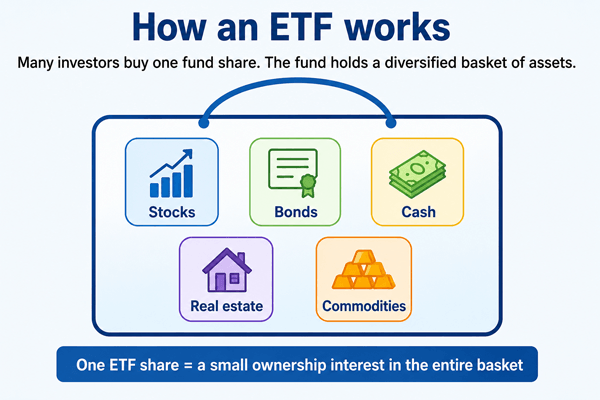
ETF stands for exchange-traded fund. It is an investment fund that trades on a stock exchange, similar to a stock. Instead of buying one company, you can buy one ETF share and get exposure to a basket of investments.
For example, an S&P 500 ETF usually holds shares of large U.S. companies that are included in the S&P 500 index. A total bond market ETF may hold many different government and corporate bonds. A dividend ETF may hold companies that pay dividends. A sector ETF may focus only on technology, healthcare, energy, or another specific industry.
The U.S. SEC describes ETFs as pooled investment products that register with the SEC and invest in a portfolio of stocks, bonds, short-term instruments, other assets, or a mix of assets. FINRA also notes that ETFs are the most common type of exchange-traded product and can be bought and sold throughout the trading day like stocks.
1.1 ETF in one simple example
Imagine 1,000 people each put money into one large basket. A professional fund manager uses that basket to buy 500 different stocks. Instead of each person buying all 500 stocks separately, each person owns shares of the ETF. If the basket rises in value, the ETF share price usually rises. If the basket falls, the ETF share price usually falls.
| You buy | What you actually get | Why it matters |
|---|---|---|
| One ETF share | A small ownership interest in the ETF portfolio | You can get instant diversification with one trade. |
| A broad stock ETF | Exposure to many companies | One company failure hurts less than if you owned only that company. |
| A bond ETF | Exposure to many bonds | It may reduce stock-market volatility, but bond ETFs still have interest-rate and credit risk. |
| A sector ETF | Exposure to one industry | Potentially higher upside, but less diversification and higher concentration risk. |
2. How Do ETFs Work?
Most beginners only need to understand the everyday version: you buy and sell ETF shares through a brokerage account, and the ETF price moves based on the value of what the fund owns. Behind the scenes, large financial institutions create and redeem ETF shares to help keep the ETF market price close to the value of its underlying holdings.
This structure is one reason many ETFs are efficient and liquid. But it does not remove investment risk. If the assets inside the ETF lose value, your ETF can lose value too.
2.1 The three prices beginners should know
| Term | Plain-English meaning | Beginner lesson |
|---|---|---|
| Market price | The price you pay or receive when buying or selling ETF shares on an exchange. | It changes during the trading day. |
| NAV | Net asset value: the estimated per-share value of the ETF holdings. | The ETF market price usually stays close to NAV, but it can trade at a premium or discount. |
| Bid-ask spread | The gap between the highest price buyers offer and the lowest price sellers accept. | A wider spread is a hidden trading cost, especially in niche or thinly traded ETFs. |
2.2 Passive ETFs vs active ETFs
A passive ETF usually tracks an index, such as a broad stock market index or bond index. It is not trying to pick winners. It is trying to follow a market or category. An active ETF is managed by professionals who make investment decisions in an attempt to meet a specific objective, often to outperform a benchmark or manage risk differently.
| Type | Best for | Main risk |
|---|---|---|
| Passive broad-market ETF | Long-term beginners who want simple, low-cost exposure | You still experience market downturns. |
| Active ETF | Investors who understand the manager strategy and accept higher uncertainty | The manager may underperform; costs may be higher. |
| Thematic ETF | Investors who want targeted exposure to a theme such as AI, clean energy, or cybersecurity | The theme may become overhyped, expensive, or slow to deliver profits. |
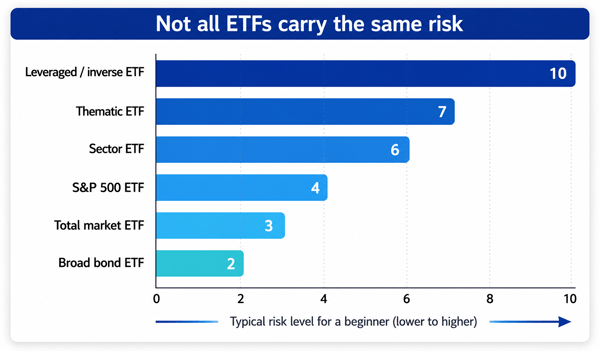
| Leveraged/inverse ETF | Advanced short-term traders, not typical buy-and-hold beginners | Daily reset, compounding effects, derivatives, and large losses. |
3. Are ETFs Safe for Beginners?
For a beginner, a diversified, low-cost ETF can be a practical starting point. But “safe” does not mean “cannot lose money.” It means the investment is understandable, diversified, reasonably priced, liquid, and suitable for your goal and time horizon.
A beginner saving for retirement over 20 or 30 years may use a total stock market ETF or a balanced mix of stock and bond ETFs. A beginner saving for a house down payment needed in 12 months should be much more careful with stock ETFs because a market drop could happen at the wrong time.
3.1 A simple safety test
| Question | Safer answer | Riskier answer |
|---|---|---|
| Do you understand what it owns? | Yes, broad stocks or bonds. | No, complex derivatives, leverage, or unclear strategy. |
| Is it diversified? | Hundreds or thousands of holdings. | One stock, one industry, one country, or one theme. |
| Is it low cost? | Low expense ratio and tight bid-ask spread. | High annual cost, wide spreads, or frequent trading costs. |
| Does it match your time horizon? | Long-term stock ETF for long-term goal; conservative ETF for short-term goal. | Volatile ETF for money needed soon. |
| Can you hold through declines? | You expect downturns and have a plan. | You may panic sell after a normal market drop. |
4. The Main Rewards of ETFs
4.1 Diversification without buying many individual investments
The biggest practical benefit is diversification. Instead of researching and buying 50 or 500 individual securities, you can buy one ETF that holds many investments. Diversification does not guarantee profit or prevent loss, but it can reduce the damage caused by one company or issuer performing badly.
4.2 Low costs can improve long-term results
Many broad index ETFs have low expense ratios. This matters because costs are one of the few parts of investing you can control. A fund charging 0.03% annually costs about $3 per year for every $10,000 invested, while a fund charging 0.75% costs about $75 per year for every $10,000 invested. The higher-cost fund must work harder just to match the lower-cost fund after fees.
| Investment amount | Annual cost at 0.03% | Annual cost at 0.75% | Difference per year |
|---|---|---|---|
| $1,000 | $0.30 | $7.50 | $7.20 |
| $10,000 | $3.00 | $75.00 | $72.00 |
| $100,000 | $30.00 | $750.00 | $720.00 |
4.3 Easy access through an online brokerage account
ETFs are usually bought through an online brokerage account, retirement account, Roth IRA, traditional IRA, or sometimes through robo-advisor portfolios. This makes them accessible for beginners who want a simple way to build a diversified investment portfolio without selecting individual stocks.
4.4 Flexibility during the trading day
Unlike mutual funds that are generally priced once at the end of the trading day, ETFs trade throughout the day. This can be useful, but beginners should not confuse flexibility with a need to trade frequently. For long-term investors, fewer thoughtful trades are usually better than constant buying and selling.
4.5 Potential tax efficiency in taxable accounts
Many ETFs are designed in a way that can reduce capital gains distributions compared with many traditional mutual funds when held in taxable brokerage accounts. This does not mean ETFs are tax-free. Dividends, interest, sales, and capital gains can still create taxes. Tax rules also differ by country and account type, so investors should check local rules or consult a qualified tax professional.
5. The Main Risks of ETFs
5.1 Market risk
If the market falls, a market ETF falls. A stock ETF can decline sharply during a bear market. A bond ETF can fall when interest rates rise or when credit conditions worsen. ETFs do not remove the risk of the underlying assets.
5.2 Concentration risk
Some ETFs look diversified because they hold many securities, but they may still be heavily concentrated in one sector, country, theme, or a few large companies. A technology ETF may own many stocks but still depend mostly on the tech industry. A single-country ETF may depend on that country’s economy, currency, and politics.
5.3 Liquidity and trading risk
Large popular ETFs often trade with tight bid-ask spreads. Smaller niche ETFs may have wider spreads, meaning you may pay more to enter and receive less when exiting. Trading at market open or market close can sometimes be less efficient because prices may move quickly.
5.4 Tracking error
An ETF that tracks an index may not match it perfectly. Fees, trading costs, sampling methods, cash drag, and market conditions can cause tracking error. Small tracking differences are normal, but large or persistent differences deserve attention.
5.5 Currency risk
International ETFs may expose you to foreign currency movements. Even if the foreign stocks rise in their local currency, your return can be hurt if that currency weakens against your home currency.
5.6 Interest-rate and credit risk in bond ETFs
Bond ETFs are often considered more stable than stock ETFs, but they are not risk-free. Longer-duration bond ETFs can lose value when interest rates rise. Corporate bond ETFs may lose value if investors become worried about default risk.
5.7 Leveraged and inverse ETF risk
Leveraged ETFs attempt to multiply daily returns, such as 2x or 3x the daily performance of an index. Inverse ETFs attempt to move opposite to the benchmark. Regulators warn that many leveraged and inverse ETFs reset daily and can perform very differently from the benchmark over longer holding periods. They are generally not suitable for ordinary buy-and-hold beginners.
Beginner warning Avoid buying an ETF just because it has exciting words in the name: AI, crypto, 3x, ultra, inverse, income, covered call, or high yield. These products can be legitimate, but the name alone does not explain the risk.
6. ETF vs Mutual Fund vs Stock
| Feature | ETF | Mutual fund | Individual stock |
|---|---|---|---|
| What you own | Shares of a fund that owns a basket | Shares of a fund that owns a basket | Ownership in one company |
| Trading | Throughout the trading day | Usually once daily at NAV | Throughout the trading day |
| Diversification | Often high, but depends on ETF | Often high, but depends on fund | Low unless you own many stocks |
| Minimum investment | Often one share or fractional share if broker allows | May have minimums | Often one share or fractional share |
| Costs | Expense ratio; possible spread/commission | Expense ratio; possible loads or fees | No fund expense ratio, but company-specific risk |
| Best use | Low-cost portfolio building, targeted exposure | Automated investing, retirement plans, active management | Investors willing to research specific companies |
7. Practical ETF Examples for Beginners
7.1 Example 1: Long-term retirement investor
A 28-year-old investor contributing monthly to a retirement portfolio may use a broad total stock market ETF for growth and a bond ETF for stability. The exact mix depends on risk tolerance, job stability, emergency savings, and time horizon. A younger investor may hold more stocks, while someone close to retirement may use more bonds and cash-like assets.
7.2 Example 2: Saving for a home down payment
A person planning to buy a home in one or two years should be careful with stock ETFs. Even a strong ETF can fall at the wrong time. For short-term money, capital preservation often matters more than return. A high-quality short-term bond ETF, Treasury bill ETF, money market fund, or insured savings account may be more appropriate than an equity ETF, depending on local availability and risk tolerance.
7.3 Example 3: Investor tempted by a hot theme
Suppose an investor sees a trending AI ETF. The idea may be attractive, but the ETF might be concentrated in expensive technology stocks. A practical approach is to keep the core portfolio in broad diversified ETFs and limit thematic ETFs to a smaller “satellite” position that the investor can afford to see decline.
7.4 Example 4: Dividend income investor
Dividend ETFs can be useful for investors who want income, but high dividend yield is not automatically good. Sometimes a very high yield reflects falling prices, weak companies, or risky strategies. A beginner should compare dividend consistency, sector exposure, expense ratio, total return, and tax treatment instead of chasing yield alone.
8. How to Choose an ETF: A Beginner Checklist
| Step | What to check | Why it matters |
|---|---|---|
| 1 | Investment objective | Know whether the ETF is for growth, income, safety, inflation protection, or speculation. |
| 2 | Holdings | Look at the top 10 holdings and sector/country exposure. |
| 3 | Index or strategy | Understand what the ETF is trying to track or achieve. |
| 4 | Expense ratio | Lower costs can improve long-term net returns. |
| 5 | Bid-ask spread and trading volume | Helps estimate trading friction and liquidity. |
| 6 | Assets under management | Very small ETFs may face closure or wider spreads. |
| 7 | Tracking difference | Shows how closely it has followed its benchmark after costs. |
| 8 | Tax fit | Taxable account, retirement account, Roth IRA, or other account type can change the tax impact. |
| 9 | Risk level | Match the ETF to your goal, time horizon, and emotional ability to handle losses. |
| 10 | Alternatives | Compare with similar ETFs, mutual funds, or a robo-advisor portfolio. |
8.1 A simple portfolio structure many beginners can understand
Many long-term investors use a core-and-satellite approach. The core is the serious part of the portfolio: broad, diversified, low-cost ETFs. The satellite portion is smaller and used for personal preferences such as dividend ETFs, sector ETFs, international ETFs, or thematic ETFs.
| Portfolio part | Example role | Beginner-friendly guideline |
|---|---|---|
| Core | Total market ETF, S&P 500 ETF, international stock ETF, bond ETF | Keep this diversified, low cost, and boring. |
| Satellite | Dividend ETF, sector ETF, thematic ETF, commodity ETF | Keep this smaller and only buy what you understand. |
| Cash/emergency fund | Savings account, money market fund, Treasury bills | Do not invest emergency money in volatile ETFs. |
9. Common Beginner Mistakes With ETFs
- Buying only because the past return looks high: Past performance can reflect a temporary trend. Strong recent returns may mean the ETF is now expensive or crowded.
- Ignoring the holdings: Two ETFs with different names may own many of the same companies. This can create hidden overlap.
- Confusing ETF safety with portfolio safety: A safe ETF used in the wrong amount can still create an unsafe portfolio.
- Trading too often: Frequent trading increases the chance of emotional decisions, spreads, taxes, and poor timing.
- Chasing high yield: High income can come with high risk. Always ask where the yield comes from.
- Using leveraged ETFs as long-term investments: Daily reset and compounding can lead to unexpected losses over time.
- Not reading the prospectus or fund page: The fund page, fact sheet, and prospectus reveal the real strategy, costs, holdings, and risks.
10. When ETFs May Be a Good Fit
ETFs may be a good fit when you want diversified exposure, low ongoing costs, easy access through a brokerage or retirement account, transparent holdings, and a simple way to build a long-term portfolio. They can work well for retirement investing, taxable brokerage investing, dollar-cost averaging, rebalancing, and goal-based portfolio management.
11. When ETFs May Not Be a Good Fit
ETFs may not be ideal when you need guaranteed principal protection, when you need the money very soon, when you cannot tolerate market declines, when you do not understand the ETF strategy, or when the ETF is highly leveraged, concentrated, illiquid, or expensive. In these cases, cash, insured deposits, short-term government securities, professional advice, or a simpler investment may be more appropriate.
12. How to Buy Your First ETF Safely
| Action | Practical tip |
|---|---|
| Open the right account | Choose a reputable online brokerage account, retirement account, Roth IRA, or other account suitable for your country and goal. |
| Start with education, not excitement | Understand the difference between a broad index ETF, bond ETF, sector ETF, dividend ETF, and leveraged ETF. |
| Use limit orders for less-liquid ETFs | A limit order helps control the maximum price you pay or minimum price you accept. |
| Avoid market open and close when possible | Spreads can be less stable during fast-moving periods. |
| Invest gradually | Dollar-cost averaging can reduce the pressure of trying to pick the perfect day. |
| Rebalance occasionally | If stocks rise a lot, your portfolio may become riskier than planned. Rebalancing brings it back to target. |
| Keep records for taxes | Track dividends, sales, capital gains, and account type. |
13. Quick “Safe ETF” Decision Framework
| Green flags | Yellow flags | Red flags |
|---|---|---|
| Broad diversification | Narrow sector or theme | Leveraged or inverse strategy for a beginner |
| Low expense ratio | Higher fee but clear reason | High fee with unclear value |
| Tight bid-ask spread | Moderate trading volume | Wide spread and low liquidity |
| Transparent holdings | Complex strategy | You cannot explain how it works |
| Fits time horizon | Unclear goal | Money needed soon invested in volatile assets |
| Clear risk disclosure | Heavy marketing language | Promises, hype, or guaranteed-sounding claims |
14. FAQ: Are ETFs Safe?
14.1 Can I lose all my money in an ETF?
With a broad diversified ETF, losing everything is unlikely unless the entire underlying market collapses permanently. But you can still lose a lot during severe downturns. A narrow, leveraged, inverse, commodity, crypto-related, or single-stock ETF can carry much higher risk.
14.2 Are ETFs safer than stocks?
Usually, a diversified ETF is safer than owning one individual stock because risk is spread across many holdings. But a narrow ETF can still be risky, and a broad stock ETF can fall with the market.
14.3 Are ETFs safer than mutual funds?
Neither is automatically safer. Both are fund structures. The risk depends on what the fund owns, how diversified it is, what it costs, and how you use it.
14.4 Are ETFs good for beginners?
Yes, many beginners use broad, low-cost ETFs to start investing. The key is to avoid complex ETFs until you understand them.
14.5 What is the safest ETF?
There is no single safest ETF for everyone. A short-term government bond or Treasury bill ETF may be lower risk than a stock ETF, but it may not provide the long-term growth a retirement investor wants. Safety depends on your goal and timeframe.
14.6 How many ETFs should a beginner own?
A beginner may need only one balanced ETF or a simple mix of two to four broad ETFs. Owning too many ETFs can create overlap and confusion.
14.7 Do ETFs pay dividends?
Many stock and bond ETFs distribute dividends or interest. The amount and tax treatment depend on the ETF holdings and your account type.
14.8 What is an expense ratio?
The expense ratio is the annual fund cost deducted from assets. Lower is generally better when comparing similar ETFs, but cost should be considered with diversification, tracking, liquidity, and strategy.
14.9 Should I use a financial advisor or robo-advisor?
A confident beginner can learn to use simple ETFs independently. A financial advisor or robo-advisor may help if you need portfolio management, tax planning, retirement planning, or behavioral support.
14.10 What should I read before buying an ETF?
Read the ETF fact sheet, prospectus, holdings list, expense ratio, performance history, index methodology, risk section, and tax information.
15. Bottom Line
ETFs can be safe and useful when they are chosen carefully. The best beginner ETFs are usually simple, diversified, low-cost, liquid, and connected to a clear goal. The riskiest ETFs are often the ones that promise excitement: leverage, inverse exposure, single-stock performance, narrow themes, complex income strategies, or speculative assets.
A good ETF strategy does not start with “What will make me rich quickly?” It starts with “What goal am I funding, how long do I have, how much risk can I handle, and what low-cost diversified fund helps me get there?” That honest approach is better for readers, better for long-term investors, and better aligned with people-first publishing.
Sources Consulted and Checked
The following authoritative sources were consulted and checked while preparing this article and reviewing its accuracy:
- SEC Investor.gov - Characteristics of Mutual Funds and Exchange-Traded Funds (ETFs): "https://www.investor.gov/introduction-investing/general-resources/news-alerts/alerts-bulletins/characteristics-mutual-funds-exchange-traded-funds
- SEC Investor.gov - Exchange-Traded Funds overview: "https://www.investor.gov/introduction-investing/investing-basics/investment-products/mutual-funds-and-exchange-traded-2
- FINRA - Exchange-Traded Funds and Products: "https://www.finra.org/investors/investing/investment-products/exchange-traded-funds-and-products
- SEC Investor.gov - Leveraged and Inverse ETFs Investor Bulletin: "https://www.investor.gov/introduction-investing/general-resources/news-alerts/alerts-bulletins/investor-alerts/sec
- Investment Company Institute - 2026 Investment Company Fact Book: "https://www.icifactbook.org/
Reader Advice
This article is provided solely for educational and informational purposes. It does not constitute personalized investment, financial, tax, accounting, or legal advice, and it should not be treated as a recommendation to buy, sell, or hold any ETF or other investment. Investment values can rise or fall, and past performance does not guarantee future results. Rules, taxes, product features, market conditions, and regulatory requirements may change and may differ by country, account type, investor circumstances, and other factors.
Before making any financial decision, verify current facts, figures, fees, risks, and rules through official sources and the fund’s latest prospectus and disclosures. Consider consulting an appropriately qualified financial, tax, or legal professional when needed.