What Is Volatility? How It Affects Stocks and Investors
1. Simple Definition: What Is Volatility?
Volatility means how much and how quickly an investment price moves up and down. A stock that rises or falls sharply in a short time is called more volatile. A stock that moves slowly and steadily is called less volatile. In plain English, volatility is the bumpiness of the ride.
Think of two cars reaching the same city. One takes a smooth highway. The other takes a mountain road with sudden turns, steep drops, and fast climbs. Both may arrive at the same place, but the second trip feels more stressful. Investing works the same way. Two investments can earn similar long-term returns, but one can make the investor feel far more uncomfortable along the way.
Volatility is not automatically bad. It is the price movement that creates both risk and opportunity. The problem for beginners is not volatility itself; it is reacting to volatility without a plan.
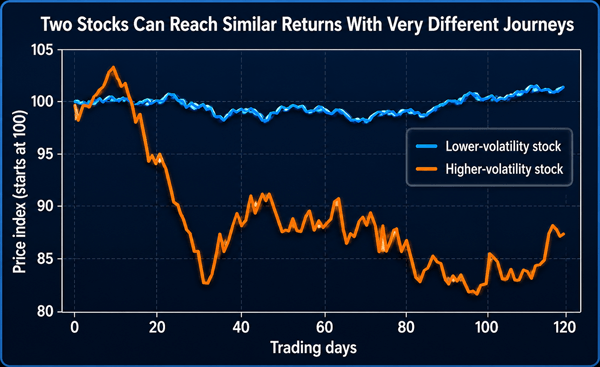
Figure 1: Volatility is about the size and speed of price swings, not just whether the final return is good or bad.
2. How Volatility Works in the Stock Market
Stock prices change because buyers and sellers constantly update what they believe a business is worth. When investors agree about a company’s future, prices often move calmly. When investors strongly disagree, or when new information arrives suddenly, prices can move sharply.
2.1 Common causes of stock market volatility
| Cause | How it creates volatility |
|---|---|
| Company news | Earnings surprises, product launches, lawsuits, management changes, analyst upgrades or downgrades. |
| Economic data | Inflation, interest rates, employment numbers, GDP growth, consumer spending, and recession fears. |
| Market sentiment | Fear, greed, headlines, social media hype, forced selling, and short-term trading behavior. |
| Industry changes | New technology, regulation, supply shortages, commodity prices, and changes in customer demand. |
| Global events | Wars, pandemics, elections, trade disputes, currency moves, and central bank decisions. |
A beginner should understand one key idea: the market does not wait for complete certainty. Prices move when expectations change. A company can report a profit and still fall if investors expected even better results. Another company can lose money and rise if the loss was smaller than feared.
3. Volatility vs. Risk: They Are Related, But Not Identical
Many articles describe volatility as risk, but that is only partly true. Volatility is a measurement of price movement. Real investment risk is the chance that you fail to reach your financial goal, permanently lose capital, overpay for a weak business, or sell at the wrong time because you could not handle the pressure.
| Type | Meaning | Practical example |
|---|---|---|
| Volatility | The price moves a lot in the short term. | A broad stock index falls 12% in a month, then recovers later. |
| Permanent loss risk | The investment is worth less because the business or asset is impaired. | A company takes too much debt, loses customers, and never recovers. |
| Behavioral risk | The investor reacts emotionally and damages results. | A beginner sells during a crash, then buys back after prices recover. |
| Liquidity risk | You need cash at the wrong time and must sell while prices are down. | Money needed for rent, tuition, or medical bills is invested in volatile stocks. |
Beginner takeaway
Volatility is most dangerous when your time horizon is short, your position size is too large, or you do not know why you own the investment.
4. Why Volatility Matters to Investors
Volatility affects more than the number on a brokerage screen. It affects emotions, decision-making, portfolio design, and the timing of financial goals. A 5% drop may feel small in theory, but it feels different when real money is involved.
4.1 It changes how investing feels
Most beginners overestimate their risk tolerance in calm markets. When prices are rising, it is easy to say, “I am a long-term investor.” When the same portfolio falls 20%, the sentence becomes harder to believe. This is why investors should choose a portfolio they can hold during bad weeks, not just one that looks attractive during good months.
4.2 It affects your required recovery
Losses and gains are not symmetrical. If a portfolio falls 50%, it needs a 100% gain to return to its original value. This simple math is one reason risk management matters.
| Portfolio decline | Gain needed to break even |
|---|---|
| 10% loss | 11.1% gain needed |
| 20% loss | 25.0% gain needed |
| 30% loss | 42.9% gain needed |
| 40% loss | 66.7% gain needed |
| 50% loss | 100.0% gain needed |
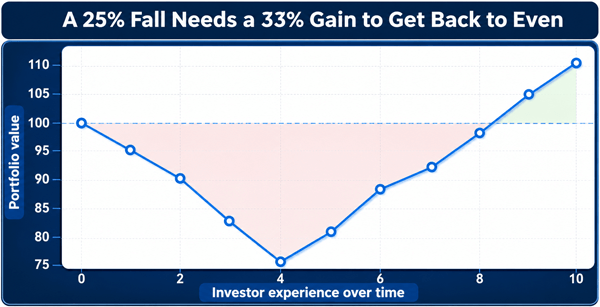
A 25% Fall Needs a 33% Gain to Get Back to Even
4.3 It affects when you should invest money
Money needed soon should usually not be exposed to high volatility. A long-term retirement account can usually tolerate more ups and downs than savings needed for a house deposit next year. The same investment can be reasonable for one person and risky for another because their timelines are different.
5. Types of Volatility Beginners Should Know
| Type | Easy meaning | Why it matters |
|---|---|---|
| Historical volatility | How much a stock actually moved in the past. | Useful for understanding the past behavior of a stock or fund. |
| Implied volatility | The market’s expectation of future volatility, often derived from options prices. | Useful for options pricing and reading market fear, but not a guaranteed forecast. |
| Market volatility | Volatility of a broad index such as the S&P 500. | Helps investors understand whether turbulence is company-specific or market-wide. |
| Portfolio volatility | How much your full investment mix moves. | More important than the volatility of one stock because it reflects your real experience. |
| Beta | A measure of how sensitive a stock is compared with the market. | A beta above 1 usually means larger swings than the market; below 1 usually means smaller swings. |
The VIX index is often called the market’s “fear gauge.” It reflects expected volatility over the next 30 days based on S&P 500 index options, not what already happened today. It can help readers understand market mood, but it should not be treated as a simple buy or sell signal.
6. A Practical Example: Two Investors, Same Market, Different Results
Imagine Sara and Ali each invest $10,000 in a broad stock index fund. The market falls 18% during the year. Sara has an emergency fund, understands that market declines are normal, and keeps investing monthly. Ali invested money he may need soon and checks prices every hour. He sells after the decline because he feels the market will keep falling.
| Point | Sara: prepared investor | Ali: unprepared investor |
|---|---|---|
| Starting investment | $10,000 | $10,000 |
| Market decline | Portfolio falls to $8,200 | Portfolio falls to $8,200 |
| Reaction | Keeps plan and adds monthly contributions | Sells to cash after the drop |
| Market recovery | Participates in rebound | Misses part of rebound |
| Lesson | Volatility becomes uncomfortable but manageable | Volatility becomes a realized loss because of behavior |
This example is not about predicting the market. It shows that investor behavior often matters as much as the investment itself. Volatility punishes people who need certainty from an uncertain market.
7. How Beginners Can Use Volatility Instead of Fearing It
7.1 Use dollar-cost averaging
Dollar-cost averaging means investing a fixed amount on a schedule, such as monthly. When prices fall, the same amount buys more shares. When prices rise, it buys fewer shares. This does not guarantee profit, but it reduces the pressure of guessing the perfect entry point.
7.2 Rebalance your portfolio
Rebalancing means returning your portfolio to its target mix. For example, if your target is 70% stocks and 30% bonds, a strong stock rally may push it to 80% stocks. Rebalancing trims what has grown and adds to what has lagged. During downturns, it can also force disciplined buying instead of emotional selling.
7.3 Keep a watchlist
Volatility can create better prices for strong businesses. A watchlist helps investors prepare before prices move. Instead of asking, “What should I buy in a panic?” the investor already knows which companies or funds they understand, what price range looks reasonable, and how much they are willing to invest.
7.4 Match volatility to the goal
A beginner can reduce mistakes by dividing money into buckets: emergency cash, short-term savings, medium-term goals, and long-term investments. The longer the time horizon, the more volatility the investor may be able to accept. The shorter the goal, the more capital preservation matters.
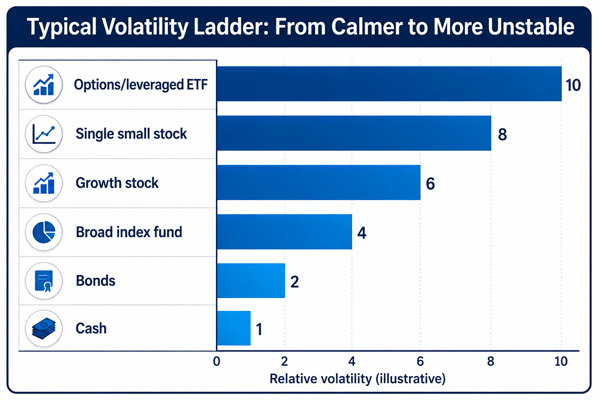
Typical Volatility Ladder: From Calmer to More Unstable
8. Volatility and Different Investment Styles
| Investor type | How volatility fits | Main controls |
|---|---|---|
| Long-term index investor | Usually accepts market volatility as part of wealth building. | Diversification, automatic investing, rebalancing, low costs. |
| Dividend investor | May prefer cash-flowing companies, but dividend stocks can still fall. | Dividend quality, payout ratio, debt levels, valuation. |
| Growth investor | Often accepts higher volatility for higher potential upside. | Position sizing, business quality, revenue durability, valuation risk. |
| Value investor | May use volatility to buy underpriced assets. | Margin of safety, patience, avoiding value traps. |
| Trader | May actively seek volatility for short-term moves. | Risk controls, stop-loss rules, liquidity, transaction costs, taxes. |
9. How to Measure Volatility Without Getting Lost in Math
You do not need advanced math to use volatility wisely. Beginner investors can start with practical questions: How much has this investment fallen before? How long did it take to recover? Would I still hold it if it fell 30%? Does one position dominate my portfolio?
9.1 Simple tools beginners can check
- One-year and three-year price charts: Look for the size and frequency of declines.
- Max drawdown: The largest peak-to-trough fall over a period.
- Standard deviation: A common statistical measure of return swings.
- Beta: How much a stock tends to move relative to the overall market.
- Fund risk rating or category: Compare funds against similar funds, not against unrelated assets.
- Position size: A risky stock is less dangerous at 2% of a portfolio than at 40%.
Honest practice
Do not use volatility numbers to create fake certainty. Past volatility can help you prepare, but it cannot perfectly predict the next crash, rally, or recovery.
10. What Level of Volatility Is Normal?
Normal depends on the asset. Cash barely moves. Bonds can move, especially when interest rates change. Broad stock index funds can fall sharply in bear markets. Individual stocks, small companies, crypto-related stocks, leveraged ETFs, and options can move much more. A beginner should not compare every investment to cash, because higher return potential often comes with a rougher ride.
| Goal | Suitable volatility level | Reason |
|---|---|---|
| Emergency fund | Very low volatility | Cash or insured savings, because access matters more than return. |
| Money needed in 1-3 years | Low volatility | Short-term deposits, money market funds, or high-quality short-duration bonds, depending on local availability and risk. |
| Retirement money 10+ years away | Moderate to high volatility may be acceptable | Diversified stock and bond funds can fit, depending on risk tolerance. |
| Speculative money | High volatility | Only money the investor can afford to lose without harming life goals. |
11. Beginner Mistakes During Volatile Markets
| Mistake | Why it hurts | Better habit |
|---|---|---|
| Checking prices too often | It makes normal movement feel like danger. | Set review times: monthly or quarterly for long-term investing. |
| Selling because of headlines | News explains fear after prices already moved. | Return to your investment thesis and financial plan. |
| Buying only because a stock fell | Cheap can become cheaper if the business is weak. | Check earnings, debt, competition, valuation, and cash flow. |
| Using leverage too early | Borrowed money magnifies both gains and losses. | Avoid margin and complex products until you fully understand them. |
| Confusing volatility with quality | Stable prices do not always mean a safe investment. | Look at business fundamentals and portfolio role. |
| Owning too much of one stock | One company problem can damage the whole portfolio. | Use position limits and diversification. |
12. How to Build a Volatility-Resistant Investing Plan
The goal is not to remove all volatility. That is usually impossible if you want long-term growth. The goal is to make volatility survivable so that you do not abandon a good plan at the worst moment.
12.1 Step-by-step framework
| Step | What to do |
|---|---|
| 1. Define the goal | Retirement, house deposit, education, income, wealth building. |
| 2. Set the time horizon | Short goals need stability; long goals can usually accept more fluctuation. |
| 3. Choose an asset mix | Stocks, bonds, cash, and other assets should match the goal. |
| 4. Limit position size | Avoid letting one stock decide your financial future. |
| 5. Automate contributions | Reduce emotional timing decisions. |
| 6. Rebalance periodically | Keep risk from drifting too high or too low. |
| 7. Write sell rules | Know in advance why you would sell: thesis broken, valuation extreme, better opportunity, or goal changed. |
13. Volatility Checklist Before Buying a Stock or Fund
- What is the investment, and how does it make money?
- How volatile has it been compared with the market?
- What could make it fall 20%, 30%, or 50%?
- Would I add, hold, or sell if it dropped sharply?
- Is this money needed within the next few years?
- What percentage of my total portfolio will it represent?
- Are fees, taxes, currency risk, and liquidity clear?
- Am I buying because of a plan, or because of fear of missing out?
14. FAQ: Volatility in Stocks
14.1 Is high volatility always bad?
No. High volatility means larger price swings. It can create opportunity, but it also increases the chance of emotional mistakes and large short-term losses.
14.2 Can a low-volatility stock still be risky?
Yes. A stock can look calm before bad news arrives. Low volatility is not a substitute for business analysis, valuation discipline, or diversification.
14.3 Should beginners avoid volatile stocks?
Beginners should be careful with highly volatile single stocks, leveraged ETFs, options, and concentrated positions. A diversified fund is often easier to understand and hold.
14.4 What is the best way to handle market volatility?
Have an asset allocation, keep emergency savings outside the market, invest gradually, rebalance, and avoid decisions based only on headlines.
14.5 What does the VIX tell investors?
The VIX reflects expected S&P 500 volatility over the next 30 days based on options prices. It is a market mood indicator, not a guaranteed prediction.
14.6 How can volatility help long-term investors?
It can allow disciplined investors to buy quality assets at lower prices, especially through rebalancing or regular contributions.
14.7 How much volatility should I accept?
Enough to reach your goal, but not so much that you are likely to sell in a downturn. The right level depends on time horizon, income stability, savings, and temperament.
15. Conclusion: The Smart Way to Think About Volatility
Volatility is the market’s way of reminding investors that prices are uncertain. It can feel uncomfortable, but it is not something beginners need to fear blindly. The better approach is to understand what you own, match investments to time horizons, diversify, control position size, and make decisions before emotions take over.
The strongest investors are not the ones who never feel stress. They are the ones who build a plan that can survive stress. Volatility becomes less frightening when every dollar has a job, every investment has a reason, and every decision is guided by a written process rather than a breaking-news headline.
Sources Consulted and Checked
The following authoritative sources were consulted and checked while preparing this article to support its accuracy, clarity, and reliability.
| Reference type | How it supports the article |
|---|---|
| FINRA Investor Education | VIX and volatility-linked products; investor risks around volatility products. |
| U.S. SEC Investor.gov / SEC publications | Asset allocation, diversification, risk, and long-term investing education. |
| Cboe | VIX methodology and interpretation as expected 30-day S&P 500 volatility. |
| Morningstar | Volatility, standard deviation, portfolio risk, and behavior-focused investing education. |
| Morgan Stanley and J.P. Morgan investor education | Long-term behavior, diversification, rebalancing, and market volatility guidance. |
Reader Advice
This article is provided solely for educational and informational purposes and does not constitute personalized investment, financial, legal, tax, or other professional advice. Investment products, market conditions, tax treatment, regulations, fees, and eligibility rules may change and may differ by country, institution, and individual circumstances.
Before making any investment or financial decision, readers should independently verify current facts, figures, product terms, and regulatory requirements through official and authoritative sources; consider their goals, time horizon, financial position, emergency savings, liquidity needs, and risk tolerance; and seek advice from an appropriately qualified and licensed professional where necessary. All investments involve risk, including the possible loss of principal, and past performance or historical volatility does not guarantee future results.