What Is Market Sentiment? Why It Matters to Investors
1. What Is Market Sentiment?
Market sentiment means the collective feeling or attitude of investors and traders toward financial markets. It can apply to the overall stock market, a single stock, a sector such as technology or energy, or even assets like bonds, gold, cryptocurrency, or real estate investment trusts.
If most investors believe prices will go up, sentiment is called bullish. If most investors expect prices to fall, sentiment is called bearish. If investors are unsure, sentiment may be neutral, mixed, or fragile.
Simple example
Imagine a popular company announces strong earnings. Investors get excited, financial news turns positive, social media posts become optimistic, and more buyers enter the stock. The price may rise not only because the company improved, but also because people feel better about owning it. That feeling is market sentiment.
2. Why Market Sentiment Matters to Investors
Market sentiment matters because prices are not moved by facts alone. They are moved by people reacting to facts. The same earnings report, inflation number, or Federal Reserve comment can create different market reactions depending on whether investors are already confident or already nervous.
| Why it matters | What it means in real investing |
|---|---|
| It affects short-term price movement | A stock can rise quickly when excitement is high or fall sharply when fear spreads. |
| It changes risk appetite | Investors take more risk during greedy markets and seek safety during fearful markets. |
| It can create overreaction | Good news can be priced too aggressively; bad news can trigger panic selling. |
| It helps with timing discipline | Sentiment can warn you when the crowd may be too optimistic or too pessimistic. |
| It supports portfolio risk management | Investors can use sentiment as a signal to rebalance, avoid concentration, or review hedges. |
A beginner should not use sentiment to predict every market move. That is unrealistic. Instead, use it as a risk-awareness tool. When everyone is excited, ask whether expectations are too high. When everyone is scared, ask whether quality assets are being sold for emotional reasons.
3. How Market Sentiment Works
Sentiment works through a feedback loop. News affects emotions. Emotions affect buying and selling. Buying and selling affect prices. Price movement then affects emotions again.
| Step | What happens | Example |
|---|---|---|
| 1. A trigger appears | News, earnings, inflation data, interest rates, geopolitics, or a viral story changes attention. | A company reports strong revenue growth. |
| 2. Investors interpret it | People decide whether the news is good, bad, or uncertain. | Traders believe the company can grow faster. |
| 3. Money moves | Buyers, sellers, short sellers, funds, and options traders adjust positions. | More buyers enter; call option activity rises. |
| 4. Price confirms the mood | Rising prices can attract more buyers; falling prices can create more fear. | The stock breaks above a previous high. |
| 5. Sentiment can become extreme | At extremes, the crowd may ignore risk or ignore value. | Investors chase the stock even after valuation becomes stretched. |
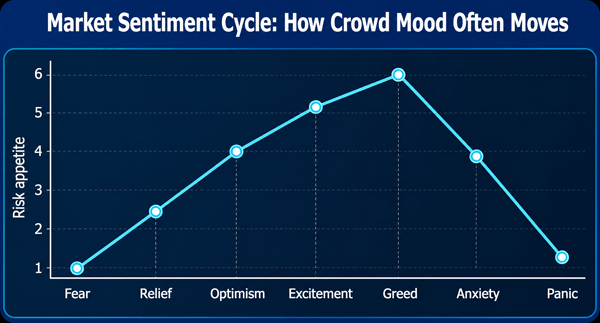
Figure 1. A common market sentiment cycle, showing how crowd mood can move from fear through optimism and greed to anxiety and panic.
4. Bullish vs. Bearish Sentiment
| Sentiment type | Plain meaning | Common signs | Beginner mistake to avoid |
|---|---|---|---|
| Bullish sentiment | Investors generally expect prices to rise. | Rising prices, positive headlines, strong buying volume, lower fear indicators, more risk-taking. | Buying only because everyone else is excited. |
| Bearish sentiment | Investors generally expect prices to fall. | Falling prices, negative headlines, high volatility, defensive positioning, demand for cash or safe assets. | Selling quality investments only because the market feels scary. |
| Neutral or mixed sentiment | Investors are uncertain or divided. | Sideways price action, mixed sector leadership, conflicting economic data. | Forcing a strong opinion when the evidence is unclear. |
Bullish sentiment is not always good, and bearish sentiment is not always bad. A bullish market can become overpriced. A bearish market can create long-term opportunities. The key is not to copy the mood. The key is to understand what the mood may be doing to price and risk.
5. Market Sentiment vs. Fundamentals
Many beginners confuse sentiment with fundamentals. They are related, but they are not the same.
| Factor | What it studies | Main question | Example |
|---|---|---|---|
| Fundamental analysis | Business quality, earnings, cash flow, debt, valuation, economic conditions. | What is this investment worth? | A company grows earnings 15% and trades at a reasonable valuation. |
| Market sentiment analysis | Investor mood, positioning, fear, greed, momentum, headlines, survey data. | How are investors behaving right now? | The same company jumps 40% because investors become extremely excited. |
| Technical analysis | Price trends, volume, support/resistance, chart patterns. | What is the market doing with price? | The stock breaks above a long-term resistance level. |
Practical rule
Use fundamentals to decide what you would like to own. Use sentiment to decide how aggressively you should act, whether expectations are crowded, and whether your emotions are affecting your decision.
6. Common Market Sentiment Indicators
No single indicator can perfectly measure investor mood. A practical investor looks for a cluster of signals. If several indicators point in the same direction, the message is stronger. If they disagree, the market may be more fragile or confused.
| Indicator | What it measures | How beginners can use it | Main limitation |
|---|---|---|---|
| VIX / volatility indexes | Expected market volatility, often called a fear gauge for U.S. stocks. | High readings can show stress; very low readings can show calm or complacency. | A low VIX does not guarantee safety; a high VIX does not guarantee a bottom. |
| Put/call ratio | Options demand for downside protection versus upside bets. | A high ratio can show fear; a very low ratio can show aggressive optimism. | Options activity can reflect hedging, speculation, or institutional positioning. |
| AAII Investor Sentiment Survey | How individual investors say they feel: bullish, bearish, or neutral. | Useful as a contrarian check when optimism or pessimism becomes extreme. | Surveys show opinions, not guaranteed future behavior. |
| Market breadth | How many stocks are rising compared with falling. | If indexes rise but few stocks participate, the rally may be narrow. | Breadth can stay weak or strong longer than expected. |
| News and social sentiment | Tone of headlines, forums, search trends, influencer posts, and financial media. | Helpful for understanding crowd attention and narratives. | Can be noisy, manipulated, emotional, or based on incomplete information. |
| Fund flows | Money moving into or out of funds, ETFs, sectors, or asset classes. | Shows where investors are putting capital. | Flow data often arrives after the move has started. |
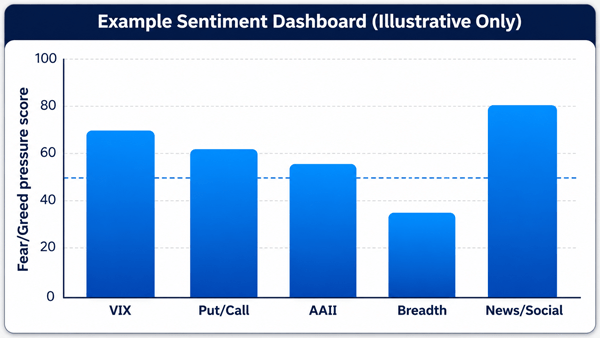
Figure 2. An illustrative sentiment dashboard combining several indicators; it is not a live market signal.
7. How Beginners Can Use Market Sentiment Practically
The safest beginner approach is not to trade every sentiment reading. Use sentiment as a checklist before making decisions.
| Situation | What sentiment may be telling you | Practical action |
|---|---|---|
| Everyone is excited about one sector | Expectations may be crowded; risk of disappointment may be higher. | Avoid putting too much money into one theme. Review valuation and position size. |
| Headlines are extremely negative | Fear may be causing forced selling or emotional selling. | Do not panic sell automatically. Review quality, time horizon, and emergency cash needs. |
| Your stock rises fast without new fundamentals | Sentiment may be driving the move more than business improvement. | Consider trimming if the position has become too large. |
| A good company falls with the whole market | Broad fear may be affecting even strong businesses. | Add gradually only if it still fits your plan and valuation is reasonable. |
| Indicators disagree | Market message is unclear. | Reduce overconfidence. Wait, diversify, or make smaller decisions. |
8. A Simple Sentiment Checklist Before You Invest
- ☐ What is the current mood: fear, greed, optimism, panic, or uncertainty?
- ☐ Is the move based on real fundamentals or mostly hype?
- ☐ Are many people saying the same thing in the same way?
- ☐ Is the asset already expensive because expectations are high?
- ☐ Would I still buy this investment if social media were silent?
- ☐ What could go wrong if the crowd changes its mind?
- ☐ Am I buying because of a plan or because I feel left behind?
- ☐ Is my position size small enough that I can stay rational?
9. Practical Examples
9.1 The Overhyped Technology Stock
A technology stock becomes popular after strong earnings and a new artificial intelligence product announcement. The price rises 60% in two months. Headlines are positive, analysts raise targets, and social media calls it a must-own stock. This is bullish sentiment.
A beginner may feel pressure to buy immediately. A better approach is to ask: Has the business value really increased by 60%, or has the price moved faster than the fundamentals? What happens if the next earnings report is merely good, not amazing? Sentiment analysis does not say never buy. It says do not confuse excitement with margin of safety.
9.2 The Quality Company Sold During Panic
During a market-wide selloff, a profitable company with low debt and steady cash flow falls 25%. The news is negative everywhere, but the company-specific facts have not changed much. This may be bearish market sentiment affecting a good business.
A disciplined investor might not buy all at once. They may create a watchlist, compare valuation to history, check the balance sheet, and buy gradually if the long-term case remains strong. The lesson is simple: fear can create opportunity, but only when the investment itself is still sound.
9.3 The Social Media Stock Tip
A small stock goes viral online. People claim it will double quickly. Volume rises, comments become emotional, and anyone asking about risks gets ignored. This is not healthy analysis; it is crowd pressure.
The practical response is to slow down. Check whether the company has real revenue, filings, audited financials, insider activity, debt risk, and credible news. Social sentiment can show what people are talking about, but it should not replace due diligence.
10. The Role of Emotions: Fear, Greed and FOMO
Market sentiment is powerful because investing is emotional. Beginners often believe they will be rational, but real money creates pressure. When prices rise, people fear missing out. When prices fall, they fear losing more. These emotions can lead to buying high and selling low.
| Emotion | How it appears | Better response |
|---|---|---|
| Fear | Selling because prices are falling and headlines are scary. | Check your plan, time horizon, cash needs, and investment quality before acting. |
| Greed | Increasing risk because recent gains feel easy. | Rebalance, review valuation, and avoid using borrowed money casually. |
| FOMO | Buying because others are making money. | Ask whether you understand the investment and whether the price already reflects the good news. |
| Confirmation bias | Only reading opinions that support what you already believe. | Look for serious opposing arguments before investing. |
| Herding | Following the crowd without independent thought. | Write down your own reason for buying, holding, or selling. |
11. Contrarian Investing and Sentiment Extremes
Contrarian investors pay close attention to sentiment because crowds can become too optimistic near market tops and too pessimistic near market bottoms. The contrarian idea is not to automatically do the opposite of everyone. It is to look for situations where emotion has pushed price away from reasonable value.
For example, extreme fear may create attractive prices in broad index funds or high-quality companies. Extreme greed may signal that future returns could be lower because investors have already priced in too much good news.
Important warning
Contrarian investing is not simply buying everything that falls or shorting everything that rises. Cheap assets can get cheaper, and expensive assets can stay expensive. Sentiment should be combined with valuation, quality, liquidity, diversification, and risk controls.
12. How Sentiment Affects Different Investors
| Investor type | How sentiment matters | Best use |
|---|---|---|
| Long-term investor | Sentiment can create better or worse entry prices. | Use it to rebalance and avoid emotional decisions. |
| Retirement investor | Extreme markets can tempt investors to abandon their plan. | Focus on asset allocation, time horizon, and risk tolerance. |
| Dividend investor | Fear may push quality dividend stocks to better yields, but risks must be checked. | Review payout safety and balance sheets. |
| Growth investor | Bullish sentiment can push growth stocks to high valuations. | Separate durable growth from market hype. |
| Trader | Short-term moves are often sentiment-driven. | Use sentiment with price, volume, and strict risk management. |
13. Mistakes Beginners Should Avoid
Mistake 1: Treating sentiment as a crystal ball: Sentiment shows mood and positioning. It does not guarantee what will happen next.
Mistake 2: Using one indicator alone: A high VIX, low put/call ratio, or bullish survey reading is not enough by itself. Look for confirmation.
Mistake 3: Confusing popularity with quality: A popular stock can still be overpriced, risky, or financially weak.
Mistake 4: Ignoring your own risk tolerance: A strategy that works for a trader may be terrible for a retirement investor.
Mistake 5: Following influencers blindly: Online opinions may be biased, sponsored, exaggerated, or wrong. Verify claims with reliable sources.
Mistake 6: Going all in because the mood feels obvious: Markets often turn when the story feels most certain. Use position sizing and diversification.
14. A Practical Framework: The 4-Part Sentiment Method
| Step | Question | What to do |
|---|---|---|
| 1. Identify the mood | Is the market fearful, greedy, calm, or divided? | Check headlines, price action, volatility, breadth, and surveys. |
| 2. Compare mood with fundamentals | Does the mood match the real business or economic facts? | Read earnings, valuation, debt, cash flow, and macro data. |
| 3. Decide the risk action | Should you add, hold, trim, hedge, or wait? | Match action to your plan, not the crowd. |
| 4. Control behavior | What emotion is influencing you? | Use checklists, position limits, and written investment rules. |
This framework turns sentiment from a vague feeling into a repeatable process. The goal is not to be perfectly right. The goal is to avoid emotional mistakes and improve decision quality.
15. Helpful Facts Readers Should Know
Sentiment can be short-lived. A market can move from panic to relief in days, especially after policy news, earnings surprises, or economic data.
Sentiment can be different across markets. Investors may be bullish on large technology stocks while bearish on small caps, real estate, or banks.
Sentiment can be self-reinforcing. Rising prices attract attention, attention attracts buyers, and buyers push prices higher until expectations become difficult to meet.
Sentiment indicators are often most useful at extremes. Normal readings usually provide less information than unusually high fear or unusually high optimism.
The best investors do not ignore sentiment. They respect it without becoming controlled by it.
16. FAQ: Market Sentiment for Beginners
16.1 Is market sentiment the same as market trend?
No. A trend is what prices are doing. Sentiment is how investors feel and behave. The two often move together, but they can diverge.
16.2 Can market sentiment predict stock prices?
It can provide clues, especially at extremes, but it cannot predict prices with certainty. Use it as one input, not a standalone forecast.
16.3 What is positive market sentiment?
Positive sentiment means investors are generally optimistic and more willing to buy risk assets.
16.4 What is negative market sentiment?
Negative sentiment means investors are worried, defensive, or expecting prices to fall.
16.5 Which market sentiment indicator is best?
There is no single best indicator. Beginners can start with VIX, put/call ratio, investor surveys, market breadth, and fund flows.
16.6 How do I use sentiment without becoming a trader?
Use it to rebalance, avoid chasing hype, stay calm during selloffs, and check whether your decisions are emotional.
16.7 Is social media sentiment useful?
It can show crowd attention, but it is noisy and risky. Verify claims and avoid making investment decisions based only on posts or influencers.
16.8 Should I buy when sentiment is bearish?
Not automatically. Bearish sentiment can create opportunities, but you still need quality, reasonable valuation, diversification, and a clear time horizon.
17. Conclusion: The Smart Way to Read Market Sentiment
Market sentiment is the mood of the market. It matters because investors are human, and human emotions affect prices. When optimism becomes extreme, prices can run ahead of reality. When fear becomes extreme, good assets can be sold too aggressively. Beginners should learn to read sentiment not to gamble on every market move, but to make calmer and better-informed investment decisions.
The practical lesson is simple: do not ignore the crowd, but do not blindly follow it. Study what investors are feeling, compare it with facts, manage your risk, and build decisions around your own financial goals.
Sources Consulted and Checked
The following sources were consulted and checked while preparing this article to support accuracy, clarity, and responsible presentation of the subject.
- Baker, Malcolm and Jeffrey Wurgler. “Investor Sentiment in the Stock Market.” Journal of Economic Perspectives, 2007.
- SEC Investor.gov and FINRA Investor Bulletin: Social Sentiment Investing Tools.
- AAII Investor Sentiment Survey educational material on common market sentiment indicators.
- Cboe educational materials on volatility indexes and options market data.
- Investopedia and SoFi educational explainers on market sentiment, sentiment indicators, bullish sentiment and bearish sentiment.
Reader Advice
This article is provided solely for educational and general informational purposes. It does not constitute personal financial, investment, legal, tax, or other professional advice, and it should not be treated as a recommendation to buy, sell, or hold any security or financial product. Investment decisions should be based on your own objectives, financial circumstances, time horizon, liquidity needs, and tolerance for risk. Consider consulting a suitably qualified and regulated professional before acting on any information discussed here.
Market conditions, laws, regulations, product features, indicator methodologies, and published data may change over time and may differ by country, provider, or individual circumstances. Readers should therefore verify current facts, figures, rules, disclosures, and source material through official regulators, exchanges, issuers, and other authoritative sources. Historical examples and illustrative charts are simplified and do not guarantee future results. All investing involves risk, including the possible loss of principal.