Solidity for Beginners: Complete Guide, Examples, Risks and Best Practices
This article is written for beginners who want to understand Solidity clearly before writing or deploying smart contracts. It explains the language, how Solidity contracts work, common examples, important risks, and practical best practices for safer development.
1. What Is Solidity?
Solidity is a high-level programming language used to write smart contracts. A smart contract is a program stored on a blockchain that runs when specific conditions are met. Instead of being hosted on one company server, the contract runs on a decentralized network such as Ethereum or another Ethereum Virtual Machine compatible blockchain.
Solidity is often compared to JavaScript, C++, and Java because its syntax uses familiar curly braces, functions, variables, and types. However, Solidity is different from normal web programming because smart contracts can hold money, interact with wallets, and become difficult or impossible to change after deployment.
| Term | Simple Meaning |
|---|---|
| Solidity | The programming language used to write many Ethereum smart contracts. |
| Smart contract | A blockchain program that stores rules and executes transactions. |
| EVM | The Ethereum Virtual Machine, where Solidity contracts run after compilation. |
| Gas | The fee paid to execute blockchain operations. More complex actions usually cost more. |
| ABI | A contract interface that lets apps and wallets communicate with the deployed contract. |
2. Why Learn Solidity?
Solidity is useful if you want to build decentralized applications, tokens, NFT projects, DAOs, DeFi protocols, games, on-chain identity tools, or blockchain-based business logic. Even if you do not plan to become a full-time blockchain developer, learning Solidity helps you understand how Web3 applications actually work under the hood.
- It is widely used across Ethereum and many EVM-compatible networks.
- It teaches the core ideas behind smart contracts, wallets, transactions, and gas.
- It is important for auditing or reviewing blockchain projects.
- It helps developers build decentralized apps that interact with on-chain logic.
Solidity is not only about writing code. A good Solidity developer also understands security, testing, gas costs, user experience, and the limits of blockchain systems.
3. How Solidity Works: From Code to Blockchain
A Solidity file is written by a developer, compiled into bytecode, tested, and then deployed to a blockchain network. Once deployed, users interact with the contract by sending transactions or reading data through wallets, websites, scripts, or APIs.
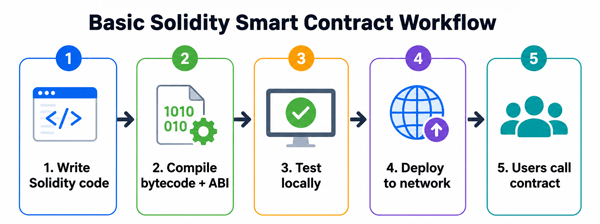
Figure: A simple view of how Solidity code becomes a usable smart contract.
- Write the contract in a .sol file using Solidity syntax.
- Compile the contract into EVM bytecode and an ABI.
- Test the contract locally and on a test network.
- Deploy the contract to a live blockchain network.
- Let users interact with it through transactions or read-only calls.
| Step | What Happens | Beginner Tip |
|---|---|---|
| Write | You define variables, functions, events, and rules. | Start with tiny contracts before building tokens or DeFi apps. |
| Compile | The compiler checks your code and creates bytecode. | Use a recent Solidity compiler unless a project requires another version. |
| Test | You simulate contract behavior before using real funds. | Test normal cases, edge cases, and failure cases. |
| Deploy | The contract gets a blockchain address. | Deploy to testnets before mainnet. |
| Interact | Users call functions through wallets or apps. | Design functions carefully because public mistakes can be expensive. |
4. Solidity Basics Beginners Should Know
4.1 Contract Structure
A Solidity contract looks like a class in other programming languages. It can store data and define functions that read or change that data.
// SPDX-License-Identifier: MIT
pragma solidity ^0.8.24;

contract HelloWorld {
    string public message = "Hello, Solidity!";

    function setMessage(string memory newMessage) public {
        message = newMessage;
    }
}
The SPDX line states the license. The pragma line tells the compiler which Solidity version is compatible. The contract keyword defines the smart contract. The public variable automatically creates a getter function.
4.2 Data Types
Solidity is statically typed, which means you must declare the type of each variable. This makes the code stricter and helps the compiler catch some errors early.
| Type | Example | Used For |
|---|---|---|
| uint256 | uint256 totalSupply; | Positive whole numbers, token amounts, counters. |
| int256 | int256 temperature; | Positive and negative whole numbers. |
| bool | bool isOpen; | True or false values. |
| address | address owner; | Wallet or contract addresses. |
| string | string name; | Text, usually for names or metadata. |
| mapping | mapping(address => uint256) balances; | Key-value storage such as balances. |
| array | uint256[] numbers; | Lists of values. |
4.3 Functions and Visibility
Functions define what your contract can do. Visibility controls who can call a function.
| Visibility | Meaning | Example Use |
|---|---|---|
| public | Callable from inside and outside the contract. | A function users need to call. |
| external | Callable from outside the contract, often cheaper for external calls. | User-facing functions. |
| internal | Callable inside the contract and child contracts. | Shared helper logic. |
| private | Callable only inside the contract where it is defined. | Implementation details. |
4.4 State Variables vs Local Variables
State variables are stored on the blockchain and usually cost gas to change. Local variables exist only during function execution. Beginners often overuse state variables, which can make contracts more expensive.
contract Counter {
    uint256 public count; // state variable stored on-chain

    function add(uint256 amount) public {
        uint256 newCount = count + amount; // local variable
        count = newCount;
    }
}
4.5 Storage, Memory, and Calldata
Solidity has different data locations. This is one of the first confusing topics for beginners.
| Location | Meaning | Beginner Rule |
|---|---|---|
| storage | Permanent blockchain storage. | Use for state variables and persistent data. |
| memory | Temporary data used during function execution. | Use for temporary copies that can be modified. |
| calldata | Read-only function input data. | Use for external function inputs when you do not need to modify them. |
5. Beginner Solidity Examples
5.1 Simple Counter
A counter is the simplest way to learn how state changes work.
// SPDX-License-Identifier: MIT
pragma solidity ^0.8.24;

contract Counter {
    uint256 public count;

    function increment() public {
        count += 1;
    }

    function decrement() public {
        require(count > 0, "Count cannot go below zero");
        count -= 1;
    }
}
The require statement checks a condition. If the condition fails, the transaction reverts and the state does not change.
5.2 Owner-Only Function
Many contracts need admin-only actions. The basic idea is to store the owner address and restrict sensitive functions.
// SPDX-License-Identifier: MIT
pragma solidity ^0.8.24;

contract OwnerExample {
    address public owner;
    string public status;

    constructor() {
        owner = msg.sender;
    }

    modifier onlyOwner() {
        require(msg.sender == owner, "Not the owner");
        _;
    }

    function setStatus(string calldata newStatus) external onlyOwner {
        status = newStatus;
    }
}
The constructor runs once at deployment. msg.sender is the account or contract that called the function. The modifier reuses access-control logic.
5.3 Basic Payment Contract
Solidity contracts can receive Ether. This makes security especially important because a bug can lead to real financial loss.
// SPDX-License-Identifier: MIT
pragma solidity ^0.8.24;

contract TipJar {
    address public owner;

    event TipReceived(address indexed from, uint256 amount);

    constructor() {
        owner = msg.sender;
    }

    receive() external payable {
        emit TipReceived(msg.sender, msg.value);
    }

    function withdraw() external {
        require(msg.sender == owner, "Only owner");
        uint256 balance = address(this).balance;
        (bool success, ) = owner.call{value: balance}("");
        require(success, "Transfer failed");
    }
}
6. Common Solidity Use Cases
| Use Case | What Solidity Does | Example |
|---|---|---|
| Tokens | Defines balances, transfers, approvals, and supply rules. | ERC-20 token for app credits or governance. |
| NFTs | Defines unique ownership records and metadata links. | Digital collectibles, memberships, game items. |
| DeFi | Manages deposits, swaps, lending, staking, or rewards. | Liquidity pools or staking contracts. |
| DAOs | Controls proposals, voting, treasuries, and execution. | Community-governed project funds. |
| Escrow | Locks funds until conditions are met. | Freelance payment released after delivery. |
| On-chain games | Stores game assets and transparent rules. | Simple turn-based blockchain game. |
7. Tools Beginners Can Use to Write Solidity
You do not need a complex setup on day one. Start with a browser-based editor, then move to professional tools when you understand the basics.
| Tool | Best For | Beginner Notes |
|---|---|---|
| Remix IDE | Writing, compiling, and testing contracts in the browser. | Best starting point for absolute beginners. |
| Hardhat | Local development, tests, scripts, and deployment. | Popular JavaScript-based framework. |
| Foundry | Fast testing and Solidity-focused tooling. | Great for developers who like command-line tools. |
| OpenZeppelin Contracts | Reusable audited contract building blocks. | Useful for ERC-20, ERC-721, access control, and security patterns. |
| MetaMask or other wallet | Signing transactions and using testnets. | Never use your main wallet for experiments. |
8. How to Start Learning Solidity Step by Step
- Learn the basics of blockchain, Ethereum, wallets, private keys, transactions, gas, and smart contracts.
- Write small contracts in Remix, such as HelloWorld, Counter, and simple storage contracts.
- Learn Solidity syntax: types, functions, visibility, modifiers, events, errors, mappings, arrays, structs, and inheritance.
- Study common standards such as ERC-20 and ERC-721 conceptually before copying code.
- Learn testing with Hardhat or Foundry. Do not rely only on manual testing.
- Practice security patterns such as checks-effects-interactions, access control, and pull payments.
- Deploy only to testnets until you are comfortable with debugging and verification.
- Read real contracts from reputable projects and compare their design choices.
- Build small portfolio projects: token, NFT minting contract, voting app, escrow contract, and staking demo.
- Before mainnet deployment, get code reviews and, for valuable contracts, professional audits.
9. Testing Solidity Contracts
Testing is not optional in Solidity. A normal web app bug can often be patched quickly. A smart contract bug may lock funds, expose funds, or require a complicated migration.
| Test Type | What It Checks | Example |
|---|---|---|
| Unit tests | Individual functions. | Does increment increase count by one? |
| Integration tests | Multiple contracts working together. | Can the token, staking contract, and rewards contract interact correctly? |
| Failure tests | Expected reverts and invalid actions. | Can a non-owner call an owner-only function? |
| Fuzz tests | Many random inputs. | Does the contract behave safely across unusual values? |
| Fork tests | Behavior against a copy of a live chain state. | How does the contract interact with an existing DeFi protocol? |
At minimum, test successful actions, rejected actions, boundary values, permission rules, and economic assumptions. For financial contracts, also test attacks and unusual market conditions.
10. Deployment Basics
Deployment means publishing your compiled contract to a blockchain. After deployment, the contract gets an address. Users and apps can then call it.
- Use testnets before mainnet. Testnets use test tokens and help you practice safely.
- Verify your source code on block explorers so users can inspect it.
- Keep deployment scripts and addresses organized.
- Use a dedicated deployment wallet, not your everyday wallet.
- Document constructor arguments and admin roles.
11. Major Solidity Risks Beginners Must Understand
The biggest beginner mistake is treating Solidity like ordinary application code. Smart contracts are public, adversarial, and often hold assets. Attackers can read your code, simulate attacks, and interact with your contract in ways you did not expect.
| Risk | What Can Go Wrong | How to Reduce the Risk |
|---|---|---|
| Reentrancy | An external contract calls back before your contract finishes updating state. | Use checks-effects-interactions and reentrancy guards when needed. |
| Bad access control | Unauthorized users call admin functions. | Use clear ownership or role-based access control and test it. |
| Unchecked external calls | A transfer or call fails silently or behaves unexpectedly. | Check return values and handle failures. |
| Oracle manipulation | A contract trusts a price or data source that can be manipulated. | Use robust oracle design and avoid relying on a single spot price. |
| Gas limit problems | A function loops over too much data and becomes impossible to execute. | Avoid unbounded loops over growing arrays. |
| Upgrade mistakes | Proxy upgrades break storage layout or introduce bugs. | Use established upgrade patterns and strict reviews. |
| Private key compromise | Admin or deployer key is stolen. | Use hardware wallets, multisigs, and operational controls. |
| Immutability | A deployed bug may be difficult to fix. | Test, review, audit, and use cautious launch limits. |
12. Solidity Security Best Practices
12.1 Use Checks-Effects-Interactions
When a function checks conditions, updates internal state, and then interacts with external contracts, it reduces the chance of reentrancy problems.
function withdraw(uint256 amount) external {
    require(balances[msg.sender] >= amount, "Insufficient balance"); // checks
    balances[msg.sender] -= amount; // effects
    (bool ok, ) = msg.sender.call{value: amount}(""); // interactions
    require(ok, "Transfer failed");
}
12.2 Prefer Pull Payments Over Push Payments
Instead of sending funds to many users in one transaction, record what each user can withdraw and let them withdraw individually. This avoids gas-limit problems and reduces the risk that one failed payment blocks everyone.
12.3 Use Battle-Tested Libraries
Do not rewrite common token standards from scratch unless you are learning in a sandbox. For production, use trusted libraries such as OpenZeppelin Contracts and understand what each inherited contract does.
12.4 Be Careful with Admin Powers
Admin functions can be useful, but they create trust and security risks. Users should know who controls upgrades, pausing, minting, fees, treasury transfers, and emergency actions.
- Use multisig wallets for important admin roles.
- Emit events for sensitive admin actions.
- Limit admin powers where possible.
- Add timelocks for major changes in higher-value systems.
12.5 Do Not Trust External Input
Validate addresses, amounts, signatures, oracle data, and user permissions. In smart contract development, every public function should be treated as an attack surface.
12.6 Avoid tx.origin for Authorization
Use msg.sender for access control. tx.origin can create security problems because it refers to the original external account that started the transaction, not necessarily the immediate caller.
12.7 Document Assumptions
Good documentation helps reviewers understand your intended behavior. Write comments for non-obvious logic, keep a list of known assumptions, and explain what should never happen.
13. Gas Optimization Basics for Beginners
Gas optimization means reducing the cost of contract deployment and function execution. Beginners should focus first on correctness and security, then optimize carefully. A cheaper unsafe contract is not a good contract.
| Technique | Why It Helps | Beginner Warning |
|---|---|---|
| Use calldata for read-only external inputs | Avoids unnecessary memory copies. | Only works for certain reference-type inputs. |
| Avoid unnecessary storage writes | Storage writes are expensive. | Do not sacrifice clarity or safety. |
| Use events for historical logs | Events are useful for off-chain indexing. | Events are not accessible inside contracts like storage. |
| Avoid unbounded loops | Large loops can exceed gas limits. | Design pagination or user-triggered withdrawals. |
| Pack small variables when appropriate | Can reduce storage slots. | Useful later; not the first thing beginners should optimize. |
14. Solidity vs Other Programming Languages
| Feature | Solidity | Typical Web Language |
|---|---|---|
| Execution | Runs on blockchain nodes through the EVM. | Runs on servers, browsers, or devices. |
| Cost | Users pay gas for transactions. | Usually paid by app owner or infrastructure provider. |
| Visibility | Code and state are often public. | Back-end code and databases are often private. |
| Updates | Contracts can be hard to change after deployment. | Apps can usually be updated quickly. |
| Security model | Assume public adversarial interaction. | Usually protected by servers, auth systems, and firewalls. |
15. Beginner Mistakes to Avoid
- Copying contract code without understanding it.
- Deploying to mainnet before testing thoroughly.
- Using a real wallet or important private key for experiments.
- Ignoring access control on sensitive functions.
- Assuming private variables are hidden from blockchain observers.
- Creating loops that grow forever and become too expensive.
- Using random numbers incorrectly on-chain.
- Relying on an audit as a guarantee instead of one part of a security process.
- Not verifying contract source code after deployment.
- Forgetting that failed transactions can still cost gas.
16. A Practical Beginner Project Plan
Here is a simple project path that builds skills gradually.
| Project | Skills Learned | Risk Level |
|---|---|---|
| HelloWorld contract | Contract structure, compiler, deployment. | Very low on testnet. |
| Counter contract | State changes, functions, require statements. | Low. |
| Simple voting app | Mappings, structs, permissions, events. | Low to medium. |
| Basic ERC-20 using OpenZeppelin | Token standards, inheritance, supply rules. | Medium. |
| Escrow demo | Payments, access control, withdrawal pattern. | Medium to high. |
| NFT minting demo | ERC-721, metadata, minting rules. | Medium. |
17. How Much Does It Cost to Learn and Practice Solidity?
You can start learning Solidity for free using documentation, Remix, YouTube tutorials, and testnets. Costs usually appear when you buy courses, use premium developer tools, deploy to mainnet, pay for audits, or run production infrastructure.
| Item | Typical Cost Level | Notes |
|---|---|---|
| Learning resources | Free to paid | Official docs and many tutorials are free; structured courses may cost money. |
| Development tools | Mostly free | Remix, Hardhat, Foundry, and many libraries are free. |
| Testnet deployment | Usually free | Requires test tokens from faucets. |
| Mainnet deployment | Variable | Depends on network gas prices and contract complexity. |
| Security audit | Can be expensive | Needed for serious contracts holding meaningful value. |
18. When Should You Not Use Solidity?
Solidity is powerful, but it is not the right tool for every problem. Use normal databases and servers when you need cheap private data storage, fast edits, high throughput, or easy reversibility. Use Solidity when decentralization, transparency, programmable ownership, and trust-minimized execution are truly needed.
19. Solidity Best Practices Checklist
- Use a recent stable compiler version and read breaking-change notes when upgrading.
- Keep contracts small and focused.
- Use explicit visibility on functions and variables.
- Write tests before deploying anywhere important.
- Use established libraries for standards and security utilities.
- Apply checks-effects-interactions when sending funds or calling external contracts.
- Avoid unbounded loops and large on-chain storage structures.
- Emit events for important state changes.
- Verify source code on block explorers after deployment.
- Use code review, automated analysis, and audits for production contracts.
- Protect deployer and admin keys with strong operational security.
- Launch cautiously, with limits and monitoring when real value is involved.
20. Frequently Asked Questions About Solidity
20.1 Is Solidity hard for beginners?
Solidity is learnable for beginners, but it becomes risky when real money is involved. The syntax is manageable; the hard part is understanding blockchain execution, gas, security, and irreversible deployment.
20.2 Do I need JavaScript before learning Solidity?
JavaScript is helpful, especially because many development tools use it, but it is not strictly required. You should understand programming basics such as variables, functions, conditions, loops, and errors.
20.3 Can I build a smart contract without coding?
Some no-code tools and contract generators exist, but you should not deploy valuable contracts without understanding the generated code and its risks.
20.4 What is the best Solidity IDE for beginners?
Remix is usually the easiest starting point because it runs in the browser. After that, Hardhat and Foundry are common choices for professional development.
20.5 Is Solidity only for Ethereum?
Solidity is mainly associated with Ethereum, but it is also used on many EVM-compatible networks. Each network has its own fees, tooling, risks, and ecosystem.
20.6 Can smart contracts be changed after deployment?
Some contracts are immutable, while others use upgrade patterns. Upgradeability adds flexibility but also adds complexity, trust assumptions, and security risks.
20.7 What is gas in Solidity?
Gas is the unit used to measure computational work on Ethereum-style networks. Users pay gas fees when transactions change blockchain state.
20.8 Are Solidity private variables really private?
No. Private in Solidity limits access from other contracts at the language level, but blockchain data can still be inspected. Never store secrets directly on-chain.
20.9 Should beginners write their own ERC-20 token from scratch?
It is fine as a learning exercise, but production tokens should use well-tested libraries and receive proper testing and review.
20.10 What should I learn after Solidity basics?
Learn testing, security patterns, token standards, contract architecture, oracles, upgradeability, front-end integration, and auditing basics.
21. Final Thoughts
Solidity is one of the most important languages in blockchain development, but it rewards careful builders. Start small, learn the mental model of blockchain execution, write many tests, and treat security as part of the design rather than a final step. A beginner who builds slowly and reviews carefully will progress faster than someone who copies complex contracts and deploys too early.
Sources Consulted and Checked
These sources were consulted and checked while preparing this article to support clarity and accuracy.
- Solidity Documentation
- Solidity Security Considerations
- Ethereum Smart Contract Security
- OpenZeppelin Contracts
- Consensys Ethereum Smart Contract Security Recommendations
Reader Advice
This article is provided for educational and informational purposes only and is not personalized legal, financial, investment, security, or professional advice or a recommendation to deploy or use any smart contract. The Basic Payment Contract example is educational, not production-ready; real contracts should include stronger testing, clear withdrawal rules, and reentrancy protection when needed. Solidity, Ethereum tooling, blockchain rules, platform policies, laws, fees, risks, and available statistics can change over time and may vary by network and region, so verify important details through current official documentation and qualified local professionals before making decisions. Smart contracts may contain coding, security, operational, regulatory, market, and irreversible-loss risks. Test thoroughly on test networks, protect keys, obtain appropriate reviews or audits for valuable deployments, and never commit funds you cannot afford to lose.