Create an ERC-20 Token: Complete Guide, Examples, Risks and Best Practices
1. Quick answer: what is an ERC-20 token?
An ERC-20 token is a fungible token smart contract that follows a common interface used across Ethereum and many Ethereum Virtual Machine, or EVM-compatible, networks. Fungible means each unit of the token is interchangeable with every other unit, like one dollar or one USDC token. The ERC-20 standard defines the basic functions and events wallets, exchanges, block explorers, and decentralized applications expect a token contract to support.
In simple terms, ERC-20 is a shared rulebook. If your token follows that rulebook, other tools can understand how to show balances, transfer tokens, approve spending, and track token movement.
2. What ERC-20 means
ERC-20 is the common token standard for fungible tokens on Ethereum. The official EIP-20 specification describes a standard API for tokens, including transfers and approvals. The goal is interoperability: a wallet, exchange, DeFi app, or block explorer should not need a custom integration for every new token.
The standard includes required functions such as totalSupply, balanceOf, transfer, transferFrom, approve, and allowance. It also includes Transfer and Approval events so external applications can track token movements and approvals.
| Term | Beginner meaning | Why it matters |
|---|---|---|
| Token contract | A smart contract that records balances and rules for a token. | The token is not a file or coin stored in your wallet; it is state inside a contract. |
| Fungible | Every unit is equal to every other unit. | ERC-20 is suitable for currencies, points, governance tokens, and utility credits. |
| Balance | How many token units an address owns. | Wallets call balanceOf to display this. |
| Transfer | Moving tokens from one address to another. | Users expect this to work consistently across wallets and apps. |
| Allowance | Permission for another address or contract to spend tokens. | DeFi apps use approvals before swaps, staking, and deposits. |
| Decimals | Display precision used by wallets and apps. | Most ERC-20 tokens use 18 decimals, but this is a display convention, not a safety feature. |
3. How ERC-20 tokens work
An ERC-20 token does not create physical coins. It stores a ledger inside a smart contract. The ledger maps each address to a token balance. When Alice transfers tokens to Bob, the contract subtracts tokens from Alice and adds them to Bob. The blockchain records the transaction, and the contract emits a Transfer event so apps can index the movement.
| Action | What happens inside the contract | Common user interface |
|---|---|---|
| Mint | The contract creates new tokens and adds them to an address. | Token creator, treasury, reward system, bridge, or admin action. |
| Transfer | Balance is moved from sender to receiver. | Send button in a wallet. |
| Approve | Owner allows a spender to use up to a certain amount. | Approve button before using a DeFi app. |
| TransferFrom | Approved spender moves tokens from the owner. | Swap, stake, deposit, subscription, or contract interaction. |
| Burn | Tokens are destroyed and total supply is reduced. | Burn feature, redemption, or supply reduction mechanism. |
The approval system is powerful but risky. Many users approve very high allowances because it is convenient. If the approved contract is hacked or malicious, the user can lose tokens up to the approved amount. For beginner projects, clear warnings and limited approval patterns are safer than encouraging unlimited approvals.
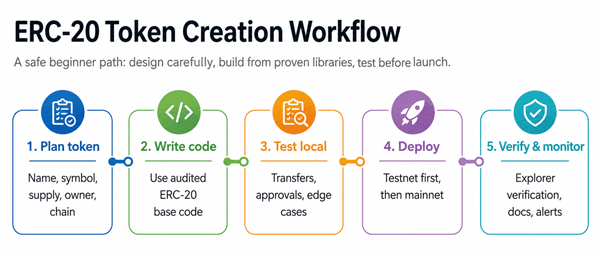
Diagram: A practical ERC-20 token creation workflow from planning to monitoring.
4. ERC-20 token vs Ether vs NFT
| Feature | ERC-20 token | Ether (ETH) | NFT / ERC-721 |
|---|---|---|---|
| Main purpose | Fungible custom token. | Native currency of Ethereum. | Unique digital item or asset. |
| Interchangeable? | Yes. One unit equals another unit of the same token. | Yes. ETH is fungible. | No. Each NFT can be unique. |
| Smart contract required? | Yes, for the token rules. | No, ETH is native to the protocol. | Yes, for NFT ownership and metadata. |
| Typical uses | Stablecoins, governance, rewards, points, utility tokens. | Gas fees, payments, staking, collateral. | Art, collectibles, game items, identity, tickets. |
5. When should you create an ERC-20 token?
You should create an ERC-20 token only when a token genuinely solves a problem. A token can help coordinate ownership, access, incentives, governance, or accounting across many users. But a token can also create confusion, speculation, legal risk, and security exposure if it is unnecessary.
5.1. Good reasons to create a token
- Your application needs transferable points, credits, rewards, or governance rights.
- Your protocol needs a standard token that wallets and DeFi apps can support.
- You need programmable supply rules such as minting, burning, vesting, or capped supply.
- You want transparent on-chain accounting that users can verify.
5.2. Weak reasons to create a token
- You only want to raise money without a real product or clear legal structure.
- A normal database, loyalty system, or payment system would work better.
- You cannot explain why the token needs to be transferable.
- You plan to copy a contract without understanding its permissions, supply, or risks.
6. Planning your token before writing code
The safest ERC-20 projects start with design decisions before coding. Write these decisions in plain English first. If you cannot explain the token clearly, the code is not ready.
| Decision | Questions to answer | Example |
|---|---|---|
| Name and symbol | What will users see in wallets? Is the symbol already used by another popular token? | ExampleToken, EXT |
| Decimals | How many decimal places should wallets display? | 18 is common for Ethereum-style tokens. |
| Initial supply | How many tokens exist at launch? Who receives them? | 1,000,000 tokens minted to the deployer or treasury. |
| Minting | Can more tokens be created later? Who can mint? | Fixed supply, owner-only minting, or role-based minting. |
| Burning | Can tokens be destroyed? Who can burn? | Users may burn their own tokens, or no burn feature. |
| Ownership | Who controls admin functions? Is it a wallet, multisig, DAO, or timelock? | A 2-of-3 or 3-of-5 multisig is safer than one private key. |
| Upgradeability | Can the contract logic change after deployment? | Avoid upgradeable contracts as a beginner unless you deeply understand proxy risks. |
| Legal and compliance | Could the token be treated as a security, payment instrument, or regulated product? | Get legal advice before public fundraising or promises of profit. |
7. Tools you need to create an ERC-20 token
Beginners can create ERC-20 tokens with browser tools such as Remix, or with local development frameworks such as Hardhat and Foundry. Remix is easier for learning. Hardhat and Foundry are better for serious testing, automation, and team workflows.
| Tool | Best for | Beginner note |
|---|---|---|
| Remix IDE | Learning and quick testnet deployment. | Runs in the browser and needs less setup. |
| OpenZeppelin Contracts | Using trusted ERC-20 building blocks. | Prefer this over writing ERC-20 logic from scratch. |
| MetaMask or another wallet | Signing deployments and transactions. | Use a separate test wallet while learning. |
| Sepolia testnet ETH | Testing deployment without real mainnet cost. | Use testnet faucets carefully and avoid scams. |
| Block explorer | Verifying source code and checking transactions. | Examples include Etherscan and explorers for EVM networks. |
| Hardhat or Foundry | Professional testing and deployment. | Use when your project moves beyond a tutorial. |
8. Beginner example: a fixed-supply ERC-20 token
The safest first example is a fixed-supply token. It mints all tokens once during deployment and has no admin minting function afterward. This reduces risk because the supply cannot be silently increased later.
// SPDX-License-Identifier: MIT
pragma solidity ^0.8.24;

import "@openzeppelin/contracts/token/ERC20/ERC20.sol";

contract ExampleToken is ERC20 {
    constructor(uint256 initialSupply) ERC20("Example Token", "EXT") {
        _mint(msg.sender, initialSupply * 10 ** decimals());
    }
}
8.1. What this code does
- SPDX-License-Identifier tells tools and users the license of the source code.
- pragma solidity ^0.8.24 tells the compiler which Solidity version range is expected.
- The import uses OpenZeppelin’s ERC20 implementation instead of writing token logic manually.
- The constructor sets the token name and symbol.
- The _mint line creates the initial supply and assigns it to the deployer address.
- decimals() is used so passing 1,000,000 creates 1,000,000 whole displayed tokens when decimals is 18.
9. Step-by-step: create and deploy an ERC-20 token with Remix
This is a learning workflow. Use a testnet first. Do not deploy a public mainnet token until you have tested thoroughly and reviewed the security and legal risks.
- Open Remix IDE in your browser.
- Create a new Solidity file, for example ExampleToken.sol.
- Paste the fixed-supply ERC-20 code above.
- In the Solidity compiler tab, choose a compatible compiler version such as 0.8.24 or newer within the pragma range.
- Compile the contract and fix any errors before continuing.
- Connect your wallet to a testnet such as Sepolia.
- In the Deploy tab, choose Injected Provider so Remix uses your wallet.
- Enter the initialSupply constructor value, such as 1000000.
- Deploy the contract and confirm the transaction in your wallet.
- Copy the deployed contract address and check it in a block explorer.
- Verify and publish the source code on the explorer so users can inspect it.
- Add the token address to your wallet to see the balance.
10. Example with minting, burning, and ownership
A token with minting is more flexible, but it creates more trust risk. Users need to know who can mint, when minting can happen, and whether the owner can abuse the power. Use a multisig or timelock for serious projects, not a single private wallet.
// SPDX-License-Identifier: MIT
pragma solidity ^0.8.24;

import "@openzeppelin/contracts/token/ERC20/ERC20.sol";
import "@openzeppelin/contracts/token/ERC20/extensions/ERC20Burnable.sol";
import "@openzeppelin/contracts/access/Ownable.sol";

contract MintableBurnableToken is ERC20, ERC20Burnable, Ownable {
    constructor(address initialOwner)
        ERC20("Mintable Burnable Token", "MBT")
        Ownable(initialOwner)
    {
        _mint(initialOwner, 1_000_000 * 10 ** decimals());
    }

    function mint(address to, uint256 amount) external onlyOwner {
        _mint(to, amount);
    }
}
10.1. Important note about this example
In this contract, the owner can mint unlimited additional tokens. That may be acceptable for a game, reward system, or controlled test project, but it is dangerous for users if the token is marketed as scarce or fixed supply. If you add minting, document the minting policy clearly.
11. Fixed supply vs mintable supply
| Choice | Pros | Cons | Best fit |
|---|---|---|---|
| Fixed supply | Simple, predictable, fewer admin risks. | Less flexible if the project needs future rewards or emissions. | Beginner tokens, capped assets, simple community tokens. |
| Mintable supply | Flexible for rewards, bridges, treasury issuance, and protocol incentives. | Requires trust in admin controls; can dilute holders. | Projects with transparent emission schedules and strong governance. |
| Capped mintable supply | Allows controlled minting up to a maximum. | Still needs admin security and careful implementation. | Reward systems that need a hard maximum supply. |
12. Testing your ERC-20 token
Testing is not optional. Even simple token contracts can fail because of incorrect supply calculations, wrong ownership, missing access control, bad decimals assumptions, or unsafe integrations.
12.1. Minimum test checklist
- The deployer or intended treasury receives the expected initial supply.
- Users can transfer tokens successfully.
- Transfers fail when the sender does not have enough balance.
- Approvals and transferFrom work as expected.
- Allowance decreases after transferFrom unless the implementation intentionally handles unlimited allowances differently.
- Only the authorized owner or role can mint, pause, or perform admin actions.
- Burning reduces the user balance and total supply if burning is included.
- The token name, symbol, and decimals display correctly in wallets and block explorers.
12.2. Example Hardhat-style test ideas
A professional test suite should include both normal cases and failure cases. For example, test successful transfers, rejected transfers, approval behavior, ownership restrictions, and events. Do not rely only on manual testing in a wallet.
13. Deployment: testnet first, mainnet later
A deployment is permanent unless the contract is upgradeable, and upgradeability brings its own risks. Always deploy to a testnet first, verify the source code, test wallet interactions, and ask someone else to review the address and settings before deploying to mainnet.
| Stage | Goal | Do not skip |
|---|---|---|
| Local testing | Catch simple logic and access-control mistakes. | Unit tests and failure tests. |
| Testnet deployment | Test with real wallet signatures and explorer verification. | Verify source code and test transfers. |
| Mainnet deployment | Launch the final contract. | Check chain, constructor values, owner, supply, and explorer verification. |
| Post-launch monitoring | Detect suspicious activity and user issues. | Monitor admin actions, transfers, liquidity, and social reports. |
14. Gas fees and cost considerations
Deploying an ERC-20 token costs gas because you are storing contract code and initial state on-chain. Transfers and approvals also cost gas on most networks. Costs vary by network congestion, contract size, and chain. Ethereum mainnet is usually more expensive than many layer 2 and EVM-compatible networks, but cheaper fees can come with different security, liquidity, and ecosystem trade-offs.
14.1. Ways to reduce unnecessary cost
- Use standard, audited libraries instead of oversized custom code.
- Avoid adding features you do not need, such as taxes, blacklists, snapshots, pausing, or upgradeability.
- Batch operations carefully; large loops can become too expensive or fail.
- Test constructor arguments before deployment so you do not need to redeploy because of a simple mistake.
15. Common ERC-20 risks and mistakes
| Risk or mistake | Why it matters | Safer practice |
|---|---|---|
| Copying random token code | Hidden minting, blacklist, fee, or honeypot logic may exist. | Use well-known libraries and read every line of custom code. |
| Single-owner admin power | One stolen key can mint, pause, or damage the token. | Use a multisig, timelock, or role-based governance for serious projects. |
| Unlimited minting without disclosure | Holders can be diluted unexpectedly. | Use fixed supply or publish a clear emission policy. |
| Wrong decimals or supply math | A token may show far more or fewer units than intended. | Test the displayed supply in wallets before launch. |
| Unverified source code | Users cannot easily inspect what the contract does. | Verify source code on the block explorer immediately after deployment. |
| No tests | Basic mistakes may remain hidden until users interact. | Write automated tests and perform testnet trials. |
| Upgradeable proxy confusion | The visible contract may not contain the main logic, and admin powers can be misunderstood. | Avoid upgradeability as a beginner or document it clearly. |
| Bad tokenomics | The token may attract speculation but fail to provide real value. | Explain utility, supply, distribution, and incentives honestly. |
16. Security best practices for ERC-20 tokens
16.1. Use audited building blocks
For most projects, the right approach is to inherit from a widely reviewed ERC-20 implementation, such as OpenZeppelin Contracts, and keep your custom logic small. Writing ERC-20 balance, allowance, and event logic from scratch is a common beginner mistake.
16.2. Keep the first token simple
A plain fixed-supply token is easier to understand and audit than a token with taxes, automatic liquidity, rebasing, blacklists, snapshots, upgradeability, pausing, and custom transfer rules. Complexity increases the chance of bugs and user misunderstanding.
16.3. Protect admin keys
- Use a hardware wallet for important deployment and ownership actions.
- Transfer ownership to a multisig for serious projects.
- Limit who can mint, pause, upgrade, or change settings.
- Document admin powers publicly so users understand the trust assumptions.
16.4. Be careful with transfer restrictions
Some tokens add blacklists, fees, limits, or anti-bot restrictions. These features can break integrations with wallets, exchanges, and DeFi protocols. They can also make users distrust the token if they are not disclosed clearly. Add restrictions only when there is a strong reason and a clear policy.
16.5. Avoid misleading users
Do not imply that a token is safe, scarce, profitable, or officially endorsed unless that is true and verifiable. Token projects often involve legal and financial risk. Clear, honest documentation is a security feature because it helps users make informed decisions.
17. ERC-20 extensions you may see
| Extension or pattern | What it does | Beginner caution |
|---|---|---|
| Burnable | Allows holders or approved spenders to destroy tokens. | Useful, but users must understand burning is permanent. |
| Capped | Sets a maximum total supply. | Good for limiting minting, but implement from a trusted library. |
| Pausable | Allows transfers to be paused in emergencies. | Creates admin power that can freeze users. |
| Permit / EIP-2612 | Allows approvals by signature instead of a separate approval transaction. | Improves UX but must be implemented correctly. |
| Votes | Adds governance voting checkpoints. | Useful for DAOs, but more complex and storage-heavy. |
| Upgradeable | Allows logic changes through a proxy. | Powerful but risky; avoid until you understand proxy admin controls. |
18. Real-world scenarios
18.1. Scenario 1: Community reward points
A community wants to reward contributors with points that can be shown in wallets and used for voting on small decisions. An ERC-20 token may work, but the team should decide whether points should be transferable. If transferability creates speculation or unfair buying of influence, a non-transferable or off-chain system might be better.
18.2. Scenario 2: Game currency
A blockchain game wants a currency for purchases and rewards. A mintable ERC-20 can work, but the minting rules must be protected and transparent. If the game server can mint unlimited tokens, users need to trust the operator. A capped or scheduled emission model may be more credible.
18.3. Scenario 3: Governance token
A protocol wants token holders to vote on proposals. A basic ERC-20 may not be enough. Governance often needs snapshot or voting extensions, delegation, quorum rules, and protection against flash-loan voting attacks. This is more advanced than a first token.
18.4. Scenario 4: Fundraising token
A token sold to raise money can create significant legal and investor-protection issues. Technical deployment is the easy part. Before selling tokens to the public, speak with qualified legal counsel in the relevant jurisdictions.
19. Best practices before public launch
- Write a plain-English token specification: name, symbol, supply, minting, burning, ownership, and upgradeability.
- Use a trusted ERC-20 implementation and minimize custom code.
- Write automated tests for transfers, approvals, minting, burning, and access control.
- Deploy to a testnet and ask others to test the token address.
- Verify source code on the relevant block explorer.
- Use a multisig for admin powers if real users or value are involved.
- Publish documentation explaining supply, distribution, risks, and admin permissions.
- Do not promise profits, guaranteed value, or unrealistic outcomes.
- Plan incident response: who acts if a bug, exploit, or phishing campaign appears?
- Monitor the contract after launch and keep communication channels clear.
20. Beginner launch checklist
| Area | Checklist item | Status |
|---|---|---|
| Design | Token name, symbol, decimals, supply, and owner are documented. | Not started / In progress / Done |
| Code | Contract uses a trusted ERC-20 base implementation. | Not started / In progress / Done |
| Security | Admin functions are minimal and protected. | Not started / In progress / Done |
| Testing | Automated tests cover transfers, approvals, and failure cases. | Not started / In progress / Done |
| Testnet | Token is deployed and tested on a testnet. | Not started / In progress / Done |
| Explorer | Source code is verified on a block explorer. | Not started / In progress / Done |
| Docs | Users can read supply, permissions, risks, and contract address. | Not started / In progress / Done |
| Legal | Legal and compliance questions are reviewed where relevant. | Not started / In progress / Done |
21. Common misconceptions about ERC-20 tokens
21.1. “Creating a token creates value.”
No. A token only has value if people have a reason to use, hold, or accept it. Code alone does not create demand, utility, liquidity, or trust.
21.2. “All ERC-20 tokens are safe because they follow a standard.”
No. ERC-20 defines an interface, not the full economic design or all custom behavior. A token can follow the interface and still include risky admin powers, bad tokenomics, or malicious custom logic.
21.3. “A verified contract means the project is trustworthy.”
No. Verification only means the published source code matches the deployed bytecode. Users still need to read the code, understand permissions, and evaluate the project.
21.4. “The deployer owns the token forever.”
Not always. Ownership can be transferred, renounced, assigned to a multisig, or managed through roles. Always check the contract state, not just the original deployer address.
22. Frequently asked questions
22.1. How long does it take to create an ERC-20 token?
A simple test token can be created quickly, especially with Remix and OpenZeppelin. A serious public token takes much longer because it needs design, testing, security review, documentation, deployment planning, and legal review where relevant.
22.2. Do I need to know Solidity to create an ERC-20 token?
You can generate a basic token with tools, but you should understand the code before deploying anything public. At minimum, learn constructors, inheritance, decimals, minting, access control, and approvals.
22.3. Can I create an ERC-20 token for free?
You can write and test code for free locally or on many testnets. Mainnet deployment and transactions require gas fees. The exact cost changes with network conditions and the chain you use.
22.4. Should I deploy on Ethereum mainnet or a cheaper EVM chain?
Ethereum mainnet has strong security and ecosystem support but can be expensive. Layer 2 networks and EVM-compatible chains may be cheaper, but you should compare security assumptions, liquidity, wallet support, bridges, and user needs.
22.5. What is the safest first ERC-20 token to build?
A fixed-supply token based on a trusted ERC-20 library is usually the safest first learning project. Avoid taxes, upgradeability, rebasing, and complex admin controls until you understand the trade-offs.
22.6. Can I change my ERC-20 token after deployment?
A normal non-upgradeable contract cannot be changed after deployment. You can deploy a new token, but that creates migration and trust issues. Upgradeable contracts can change logic, but they add complexity and admin risk.
22.7. What happens if I send ERC-20 tokens to the wrong address?
Blockchain transactions are usually irreversible. If tokens are sent to an address that no one controls, they may be permanently inaccessible. Some contracts can also be unable to receive or recover tokens.
22.8. Do I need an audit?
For a learning token, no formal audit is usually necessary. For a public token involving real money, many users, complex custom logic, or admin powers, professional security review is strongly recommended.
22.9. Is an ERC-20 token legal?
Legality depends on the token design, marketing, sale structure, user location, and applicable regulations. A token can raise securities, tax, consumer-protection, sanctions, and financial compliance issues. Get qualified legal advice before public fundraising or investment-related claims.
23. Conclusion
Creating an ERC-20 token is a useful way to learn smart contract development, but it should not be treated as a shortcut to launching a trustworthy crypto project. Start with a simple fixed-supply token, use proven libraries, test on a testnet, verify your source code, and document every important decision. As soon as real users or real value are involved, treat the token as a security-critical product: reduce complexity, protect admin keys, review legal risks, and communicate honestly.
Sources Consulted and Checked
These sources were consulted and checked while preparing this document to support accuracy and reliability.
- Ethereum EIP-20: ERC-20 Token Standard - official specification of the ERC-20 interface and events.
- Ethereum.org developer documentation: ERC-20 token standard overview and learning resources.
- OpenZeppelin Contracts documentation: ERC20 implementation, extensions, and access-control patterns.
- Solidity official website and documentation: Solidity language overview and compiler guidance.
Reader Advice
Creating and deploying an ERC-20 token can involve technical, cybersecurity, financial, regulatory, and operational risks. This article is provided for educational and informational purposes only and is not personalized legal, financial, investment, tax, security, or professional advice or a recommendation to create, buy, sell, or use any token. Rules, policies, laws, network conditions, fees, software versions, and statistics can change over time and may vary by country, region, platform, and blockchain. Before making decisions or deploying a contract, verify current requirements through official sources, test carefully on a testnet, review permissions and code, protect private keys, and seek qualified legal or security advice where real users, fundraising, or real value are involved. Smart-contract transactions may be irreversible, and errors, exploits, scams, lost keys, or regulatory issues can result in permanent loss.