How to Become a Blockchain Developer
Blockchain development is the skill of building software that interacts with blockchains. That may mean writing smart contracts, creating decentralized applications, building wallet integrations, maintaining blockchain nodes, or designing back-end systems that read and write on-chain data. It is an exciting field, but it is also technical and risk-sensitive. A small mistake in a smart contract can lock or lose real money.
This guide explains how to become a blockchain developer from a beginner level. It covers the learning path, required skills, tools, costs, common mistakes, risks, best practices, and a practical portfolio plan. You do not need to be a crypto trader to learn blockchain development. You do need patience, basic programming ability, and a security-first mindset.
Quick answer: To become a blockchain developer, first learn programming basics, then understand how blockchains work, then build smart contracts and decentralized apps, then practice testing and security, and finally publish real portfolio projects. A realistic beginner timeline is 6 to 12 months for consistent learners, depending on prior coding experience.
1. What Does a Blockchain Developer Do?
A blockchain developer builds applications, systems, and tools that use blockchain networks. Some developers focus on smart contracts. Others focus on front-end interfaces, back-end infrastructure, protocol engineering, wallet integrations, analytics, or security.
| Role | What they build | Common skills |
|---|---|---|
| Smart contract developer | Token contracts, DeFi logic, NFT contracts, governance contracts, escrow systems | Solidity or Rust, testing, audits, gas optimization, security patterns |
| dApp developer | User-facing apps that connect wallets and smart contracts | JavaScript/TypeScript, React, ethers.js/viem, wallet UX, APIs |
| Protocol/core developer | Blockchain clients, consensus logic, virtual machines, networking layers | Go, Rust, C++, cryptography, distributed systems |
| Blockchain back-end developer | Indexers, APIs, transaction services, analytics, node integrations | Node.js/Python/Go, databases, RPC APIs, queues, cloud |
| Security researcher/auditor | Finds vulnerabilities before attackers do | Threat modeling, formal reasoning, fuzzing, auditing tools, exploit analysis |
2. How Blockchain Development Works in Simple Terms
A normal web app usually stores data in a company database. A blockchain app stores important state on a shared network that many independent computers verify. Users interact with the app through a wallet, such as MetaMask or another wallet, and every on-chain action is recorded as a transaction.
- A wallet holds keys and signs transactions. The developer should never ask users for seed phrases or private keys.
- A smart contract is code deployed to a blockchain address. Ethereum describes it as code and data that live at a specific address on the Ethereum blockchain.
- A dApp is usually a normal website plus blockchain connections. The website may be hosted like any other web app, but it reads from and writes to smart contracts.
- Gas fees are the cost of computation on networks such as Ethereum. The fee depends on how much gas an operation uses and the price per unit of gas.
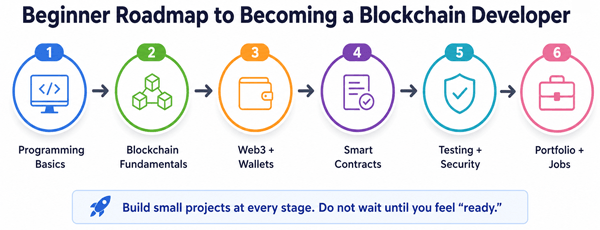
Figure 1: A simple beginner roadmap for learning blockchain development.
3. Do You Need a Degree to Become a Blockchain Developer?
A computer science degree can help, especially for protocol engineering, cryptography, or research roles. However, many blockchain developers enter through self-study, bootcamps, open-source contributions, freelance projects, hackathons, and strong portfolios. Employers usually care about whether you can build, test, explain, and secure working code.
4. Skills You Need Before Learning Blockchain
Blockchain development is easier when you already understand basic software development. Beginners should avoid jumping directly into complex DeFi or zero-knowledge systems before learning programming fundamentals.
| Skill | Why it matters | Beginner target |
|---|---|---|
| Programming fundamentals | Smart contracts and dApps are still software. | Variables, functions, arrays, objects, loops, error handling |
| JavaScript or TypeScript | Most Ethereum dApps use JS/TS tooling. | Build a small website and call an API |
| Command line and Git | Most developer tools run from the terminal. | Use npm, git clone, commit, branch, and push |
| Basic web development | Most users access blockchain through a web interface. | HTML, CSS, React basics, forms, state management |
| Security mindset | Smart contracts can hold real value. | Never deploy untested code; understand common attacks |
5. Step-by-Step Roadmap to Become a Blockchain Developer
5.1. Step 1: Learn basic programming
Start with JavaScript or Python if you are a complete beginner. JavaScript/TypeScript is especially useful because many blockchain front-end libraries and development frameworks use it. Your goal is not to memorize syntax. Your goal is to solve small problems, read errors, and understand how programs are structured.
5.2. Step 2: Understand blockchain fundamentals
Learn blocks, transactions, wallets, private keys, public addresses, consensus, nodes, gas fees, smart contracts, token standards, and the difference between Layer 1 and Layer 2 networks. Do not skip this stage. Developers who do not understand the underlying model often make dangerous assumptions.
5.3. Step 3: Choose an ecosystem
For most beginners, Ethereum and EVM-compatible chains are a practical starting point because there is strong documentation, tooling, and community support. EVM skills can also transfer to many networks. Other good paths include Solana with Rust, Cosmos with Go, or Bitcoin scripting for specialized use cases.
5.4. Step 4: Learn smart contract basics
If you choose Ethereum, learn Solidity. Solidity is a statically typed language designed for smart contracts that run on Ethereum. Start with simple contracts: storage, voting, escrow, ERC-20-style tokens, and NFT minting examples. Learn events, modifiers, mappings, access control, and error handling.
5.5. Step 5: Set up the developer toolkit
Install Node.js, a code editor, Git, a wallet, and a smart contract framework such as Hardhat or Foundry. Learn how to compile contracts, write tests, deploy to a local chain, deploy to a testnet, and verify a contract on a block explorer.
5.6. Step 6: Build small projects
Projects are where learning becomes real. Build a simple token, a voting contract, a crowdfunding contract, a wallet-connected website, and a small NFT project. Keep projects small enough to finish. Each project should have a README, screenshots, tests, and deployment notes.
5.7. Step 7: Learn testing, security, and gas optimization
Testing is not optional. Write unit tests, integration tests, and negative tests that prove invalid actions fail. Learn common vulnerabilities such as reentrancy, access-control mistakes, integer assumptions, oracle manipulation, front-running, and unsafe upgrades.
5.8. Step 8: Learn dApp front-end development
A smart contract alone is rarely enough. Learn how a website connects to wallets, switches networks, reads contract data, sends transactions, waits for confirmations, and shows error messages in plain language.
5.9. Step 9: Build a portfolio and contribute to open source
Publish your best projects on GitHub. Write short case studies explaining what you built, how it works, how you tested it, and what risks remain. Join hackathons, fix documentation issues, and contribute small pull requests to projects you use.
5.10. Step 10: Apply for jobs or freelance work carefully
Start with junior blockchain developer, web3 front-end developer, smart contract developer intern, technical writer, developer relations, or back-end blockchain integration roles. Avoid projects that ask you to deploy unaudited financial contracts without support.
6. Recommended Beginner Learning Path by Month
| Timeframe | What to learn | Project milestone |
|---|---|---|
| Month 1 | Programming basics, Git, command line, JavaScript fundamentals | Build a small calculator or task app and publish it on GitHub |
| Month 2 | Blockchain basics, wallets, transactions, gas, testnets | Send testnet transactions and document what happened |
| Month 3 | Solidity basics, Remix, simple contracts | Build a storage, voting, or escrow contract |
| Month 4 | Hardhat or Foundry, unit testing, deployment scripts | Deploy a tested contract to a testnet |
| Month 5 | React front end, wallet connection, reading/writing contract data | Build a simple dApp interface |
| Month 6 | Security basics, gas optimization, portfolio polish | Publish a complete portfolio project with tests and README |
| Months 7-12 | Advanced projects, audits, open source, hackathons, job applications | Contribute to open source or ship a more serious dApp |
7. Tools Blockchain Developers Commonly Use
| Category | Tools/examples | Beginner advice |
|---|---|---|
| Code editor | VS Code, extensions for Solidity and JavaScript | Use one editor and learn it well. |
| Smart contract IDE | Remix | Good for first Solidity experiments. |
| Frameworks | Hardhat, Foundry | Pick one at first; learn tests and deployments. |
| Libraries | ethers.js, viem, web3.js | Use current docs and avoid copying outdated snippets. |
| Wallets | MetaMask and other browser/mobile wallets | Use testnets first. Never expose private keys. |
| Block explorers | Etherscan-style explorers | Use them to verify contracts and inspect transactions. |
| Security libraries | OpenZeppelin Contracts | Helpful, but not a replacement for understanding or audits. |
| Node/RPC providers | Alchemy, Infura, QuickNode, public RPCs | Free tiers are enough for learning; production needs reliability planning. |
8. How Much Does It Cost to Become a Blockchain Developer?
The cost can be very low if you self-study. The biggest investment is time. You can learn with free documentation, free courses, open-source tools, local blockchain networks, and testnets. Paid courses or bootcamps can help with structure and accountability, but they are not required.
| Cost item | Typical cost range | Notes |
|---|---|---|
| Free documentation and tutorials | $0 | Official docs, free courses, YouTube, blogs, and open-source examples. |
| Online course subscription | $0-$399+ per year | Many platforms offer free previews or paid certificates. Prices and promotions change. |
| Bootcamp | $500-$10,000+ | Can be useful, but quality varies. Check curriculum, mentors, refund policy, and job claims. |
| Laptop/computer | $0-$1,500+ | A normal development laptop is enough for most smart contract and dApp work. |
| Testnet practice | Usually $0 | Testnet tokens are not real money, but faucet availability can vary. |
| Mainnet deployment/gas | Variable | Depends on network demand, contract complexity, and chain. Start on testnets or Layer 2 networks. |
| Security audit for serious project | Hundreds to tens of thousands of dollars+ | For real-money protocols, independent review is often essential. |
9. Understanding Blockchain Fees as a Developer
Developers must understand fees because users pay them. On Ethereum-style networks, fees are commonly called gas fees. Gas is paid for computation, storage, and transaction execution. A complex contract call usually costs more than a simple token transfer. Fees can also rise when the network is busy.
- Use local development chains for early testing so you do not spend real money.
- Use testnets before mainnet deployment.
- Estimate gas in your application, but still show users clear warnings because estimates can change.
- Avoid unnecessary on-chain storage. Storing data on-chain is usually more expensive than emitting events or using off-chain storage when appropriate.
- Consider Layer 2 networks for lower-cost user interactions, but understand their bridge and withdrawal assumptions.
10. Beginner Portfolio Projects That Actually Help
| Project | What it proves | How to improve it |
|---|---|---|
| Token contract | You understand balances, transfers, events, and tests. | Add access control, mint limits, and full test coverage. |
| Voting dApp | You can combine smart contracts and a wallet-connected UI. | Add time limits, duplicate-vote prevention, and readable transaction states. |
| Crowdfunding contract | You understand deposits, refunds, deadlines, and withdrawals. | Add security tests and edge cases for failed campaigns. |
| NFT minting app | You understand metadata, ownership, minting, and front-end integration. | Use testnet deployment and explain storage choices. |
| Escrow contract | You understand multi-party flows and dispute scenarios. | Add roles, cancellation logic, and threat model notes. |
| On-chain analytics dashboard | You can read blockchain data and present it clearly. | Use an indexer or RPC provider and explain data limits. |
11. Common Risks in Blockchain Development
Blockchain development has higher consequences than many beginner projects because deployed code may be public, irreversible, and financially valuable. These are the major risks to understand early.
| Risk | Example | How to reduce it |
|---|---|---|
| Smart contract bug | A withdrawal function can be exploited repeatedly. | Use checks-effects-interactions, tests, reviews, and audits. |
| Lost private key | A deployer key controls upgrade or admin permissions. | Use hardware wallets, multisigs, and secure key management. |
| Bad access control | Anyone can mint tokens or withdraw funds. | Use role-based permissions and test unauthorized calls. |
| Frontend deception | User signs a transaction they do not understand. | Show clear transaction purpose, amounts, network, and contract address. |
| Oracle/manipulation risk | A price feed can be manipulated in a thin market. | Use reliable oracle design and understand data assumptions. |
| Upgrade risk | Admin can change contract behavior unexpectedly. | Use transparent governance, timelocks, and clear documentation. |
| Regulatory risk | A token or financial app may trigger legal requirements. | Get qualified legal advice for real products. |
12. Best Practices for New Blockchain Developers
- Build locally first, then testnet, then mainnet only when necessary.
- Write tests before adding advanced features.
- Never copy smart contract code you do not understand.
- Use well-reviewed libraries, but still read the code and documentation.
- Keep contracts simple. Complexity is one of the biggest sources of bugs.
- Do not store secrets in code, GitHub, front-end files, or environment files committed by mistake.
- Use separate wallets for learning, testing, deploying, and holding funds.
- Document assumptions, risks, admin powers, and known limitations.
- Treat every external call as a possible risk.
- Ask for code review before deploying anything that can hold real value.
13. Smart Contract Security Checklist for Beginners
| Question | Why it matters |
|---|---|
| Have I written tests for successful and failing cases? | Many bugs appear only when invalid actions are attempted. |
| Can unauthorized users call privileged functions? | Access-control bugs are common and dangerous. |
| Can funds get stuck? | A contract may receive assets but have no safe withdrawal path. |
| Does the contract rely on block timestamps or randomness? | Some values can be influenced or predicted. |
| Are external calls handled safely? | External calls can create reentrancy and control-flow risks. |
| Is upgradeability really necessary? | Upgradeable contracts add power and risk. |
| Have I documented admin powers? | Users should know who can pause, upgrade, mint, or withdraw. |
14. Mistakes Beginners Should Avoid
- Learning only theory and never building projects.
- Deploying to mainnet too early.
- Ignoring testing because a contract “looks simple.”
- Using random code from social media without understanding it.
- Thinking a library removes the need for security review.
- Confusing blockchain development with trading or investing.
- Trying to learn every chain at once instead of mastering one ecosystem first.
- Making unrealistic salary assumptions before building real skills.
15. Blockchain Developer Career Paths
There is no single blockchain developer career path. Choose based on your strengths and interests.
| Path | Good for you if... | What to learn next |
|---|---|---|
| Smart contract engineer | You like logic, security, and precise code. | Solidity/Rust, audits, DeFi patterns, formal verification basics |
| Web3 front-end developer | You enjoy user interfaces and wallet UX. | React, TypeScript, viem/ethers, transaction flows |
| Blockchain back-end engineer | You like APIs, databases, and infrastructure. | Indexers, RPC, event processing, queues, cloud |
| Protocol engineer | You like deep systems and computer science. | Rust/Go/C++, networking, consensus, cryptography |
| Security auditor | You enjoy breaking systems responsibly. | Exploit patterns, fuzzing, invariant testing, audit reports |
| Developer relations | You like teaching and community. | Technical writing, demos, workshops, sample apps |
16. How to Get Your First Blockchain Developer Job
- Pick one primary track: smart contracts, dApp front end, back end, or protocol engineering.
- Create 3 to 5 polished portfolio projects instead of 20 unfinished demos.
- Write READMEs that explain the problem, architecture, setup, tests, and security assumptions.
- Show your testing discipline. Employers notice projects with real tests.
- Join hackathons and ship small projects under time pressure.
- Contribute to open-source documentation or small issues first.
- Apply to junior roles, internships, grants, bounties, and developer-relations roles.
- Prepare to explain gas, transactions, wallets, events, token standards, and security basics in interviews.
17. How Long Does It Take?
A complete beginner may need 6 to 12 months of consistent study and practice to become job-ready for junior roles. Someone who already knows JavaScript, React, Git, and testing may build a useful blockchain portfolio in 2 to 4 months. Protocol engineering and security auditing usually take longer because they require deeper computer science and security knowledge.
18. Practical Weekly Study Plan
| Day | Focus | Example task |
|---|---|---|
| Monday | Theory | Read one official documentation section and take notes. |
| Tuesday | Coding | Implement one small contract feature. |
| Wednesday | Testing | Write tests for both success and failure cases. |
| Thursday | Front end or back end | Connect contract data to a simple interface or script. |
| Friday | Security review | Look for access-control, reentrancy, and edge-case issues. |
| Saturday | Project polish | Improve README, screenshots, deployment notes, and comments. |
| Sunday | Review | Summarize what you learned and plan the next feature. |
19. When Should You Pay for a Course or Bootcamp?
Paying for a course can make sense if you need structure, mentorship, feedback, and deadlines. It is less useful if the course is outdated, mostly theory, or promises guaranteed income without proof. Before paying, inspect the syllabus, tools, project requirements, instructor background, refund policy, community quality, and whether students actually publish working code.
- Choose a paid program if it includes code review, projects, and security basics.
- Avoid programs that focus mainly on hype, token speculation, or vague career promises.
- Prefer courses that use current tooling and official documentation.
- Do not spend money you cannot afford to lose. Free resources are enough to start.
20. Is Blockchain Development Still Worth Learning?
It can be worth learning if you enjoy distributed systems, finance, security, open-source software, or digital ownership. It is not a guaranteed shortcut to a high-paying job. The market is cyclical, hiring can change quickly, and beginner competition is real. The safest approach is to become a strong general software developer first, then add blockchain specialization.
21. FAQs
21.1. What programming language should I learn first?
For Ethereum and EVM development, start with JavaScript or TypeScript plus Solidity. For Solana, Rust is important. For protocol work, Rust, Go, or C++ may matter more.
21.2. Can I become a blockchain developer without coding experience?
Yes, but you should learn basic programming before smart contracts. Jumping straight into Solidity without programming fundamentals usually leads to confusion.
21.3. Is Solidity hard to learn?
Solidity syntax is not the hardest part. The harder part is understanding blockchain execution, gas, security, and irreversible deployment.
21.4. Do blockchain developers need to understand cryptography?
You need basic concepts such as hashing, digital signatures, public/private keys, and Merkle trees. Deep cryptography is mainly required for protocol, privacy, and zero-knowledge roles.
21.5. Should I learn Ethereum first?
For many beginners, yes, because Ethereum has strong documentation, many tools, and transferable EVM skills. But it is not the only path.
21.6. How much money do I need to start?
You can start for free with official docs, free courses, open-source tools, local chains, and testnets. Mainnet deployment and paid courses are optional at the beginning.
21.7. Can I get a job with only portfolio projects?
It is possible, especially if your projects are well documented, tested, deployed, and explained clearly. A portfolio is stronger when combined with open-source contributions, hackathons, or freelance experience.
21.8. What is the biggest beginner mistake?
The biggest mistake is deploying or promoting smart contracts without proper testing, review, and understanding of the risks.
21.9. Do I need to buy cryptocurrency to learn?
No. You can use local chains and testnets. If you later deploy to mainnet, you may need real tokens for fees, but that should come after practice.
21.10. What should my first serious project be?
A simple crowdfunding, escrow, voting, or token dashboard project is a good start because it teaches contract logic, front-end integration, tests, and user flows without being too complex.
22. Final Takeaway
To become a blockchain developer, learn software development first, then blockchain fundamentals, then smart contracts, testing, security, and dApp integration. Keep your first projects small, publish your work, and treat security as part of the job from day one. The developers who stand out are not the ones who know the most buzzwords. They are the ones who can build useful, tested, understandable, and safe applications.
Sources Consulted and Checked
These sources were consulted and checked while preparing this document for context and accuracy.
- Ethereum.org developer documentation
- Ethereum.org smart contract documentation
- Ethereum.org gas and fees documentation
- Solidity official documentation
- Solidity language website
- OpenZeppelin Contracts and security resources
- Alchemy University free Ethereum development courses
- Coursera blockchain courses and learning roadmap
- Electric Capital Developer Report / Open Dev Data
- Web3.career blockchain developer salary data
Reader Advice
This article is provided for educational and informational purposes only. It is not personalized legal, financial, investment, cybersecurity, employment, or professional advice, and it does not recommend any specific blockchain, token, course, platform, employer, or transaction. Blockchain development can involve software defects, irreversible transactions, lost keys, security breaches, volatile fees, financial loss, regulatory obligations, and changing job-market conditions. Rules, policies, laws, technical standards, fees, salaries, statistics, and platform features can change over time and may vary by country or region. Before spending money, deploying code, handling real assets, or making career or business decisions, verify current information through official sources, test carefully in safe environments, and obtain qualified professional advice where appropriate.