What Is Liquidity in Stocks? Why It Matters Before You Buy or Sell
1. Quick Answer: What Is Liquidity in Stocks?
Liquidity in stocks means how easily you can buy or sell shares without causing a big change in the stock price. A liquid stock has many active buyers and sellers, frequent trading, a narrow bid-ask spread, and enough shares available near the current market price. An illiquid stock is harder to trade quickly at a fair price because fewer people are willing to buy or sell at that moment.
In plain English: liquidity is the difference between “I can sell this stock almost instantly at a price close to what I see on screen” and “I may have to accept a worse price, wait longer, or split my order into smaller pieces.”
| Term | Beginner meaning | Why it matters |
|---|---|---|
| Liquidity | How easy it is to buy or sell without moving the price much. | Affects speed, cost, and execution quality. |
| Bid price | The highest price buyers are currently offering. | This is often near what you can sell for right now. |
| Ask price | The lowest price sellers are currently asking. | This is often near what you can buy for right now. |
| Bid-ask spread | The gap between bid and ask. | A hidden trading cost; wider spreads usually mean lower liquidity. |
| Volume | How many shares traded during a period. | More volume often means more liquidity, but not always. |
| Market depth | How many shares are available at different prices. | Shows whether larger orders may push the price around. |
2. Why Liquidity Matters Before You Buy or Sell
Liquidity matters because the price you see is not always the price you get. Beginners often look only at the last traded price. Experienced investors also look at the bid, ask, spread, volume, and how the stock behaves during normal and stressful markets.
A stock can look attractive on a chart, but if it is thinly traded, entering and exiting can become expensive. The cost may not appear as a commission. It can show up as a worse execution price, wider spread, partial fill, or sharp move against you after your order hits the market.
2.1 The Everyday Example: Selling a Phone vs Selling a Rare Collectible
Imagine you want to sell a popular used phone. Many buyers know the model, many sellers list it, and prices are easy to compare. You may sell it quickly near a fair price. That is similar to a liquid stock.
Now imagine selling a rare collectible that only a few people understand. You might still get a good price, but only after waiting for the right buyer. If you need money today, you may have to discount it. That is similar to an illiquid stock.
3. How Liquidity Works in the Stock Market
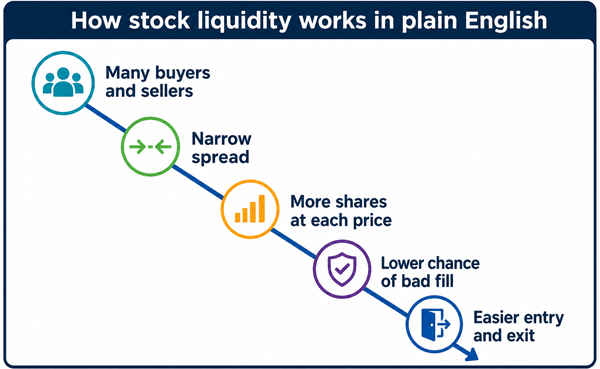
Every trade needs two sides: a buyer and a seller. Liquidity is strong when many participants are willing to trade at prices close to the current market price. Liquidity is weak when buyers and sellers are far apart, small orders move the price, or quotes disappear during volatile periods.
A beginner should understand three layers of liquidity: quoted liquidity, traded liquidity, and real exit liquidity. Quoted liquidity is what you see in bid and ask prices. Traded liquidity is what actually changes hands. Real exit liquidity is whether you can sell the amount you own, when you need to sell, without taking a painful discount.
4. Bid-Ask Spread: The Liquidity Signal Beginners Should Check First
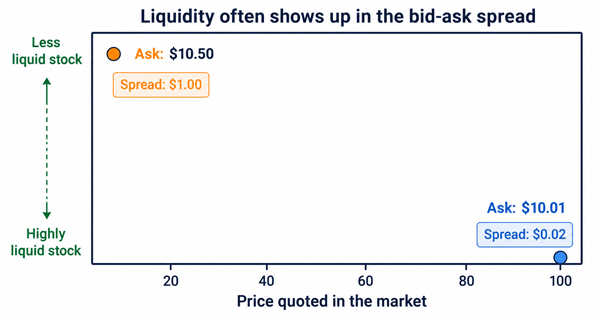
The bid-ask spread is the gap between what buyers are willing to pay and what sellers are willing to accept. If a stock has a bid of $50.00 and an ask of $50.02, the spread is $0.02. If another stock has a bid of $10.00 and an ask of $10.80, the spread is $0.80. The second stock may look cheaper by share price, but it is often much more expensive to trade.
| Stock | Bid | Ask | Spread | Spread as % of ask | What it tells you |
|---|---|---|---|---|---|
| Large active stock | $100.00 | $100.02 | $0.02 | 0.02% | Likely easy to trade in small amounts. |
| Thin small-cap stock | $5.00 | $5.25 | $0.25 | 4.76% | You may lose almost 5% just crossing the spread. |
| Low-priced microcap | $0.80 | $0.95 | $0.15 | 15.79% | Extremely high trading friction and execution risk. |
Practical rule of thumb
For beginners, a wide spread is a warning sign. It does not automatically mean “never buy,” but it does mean you should slow down, use limit orders carefully, and think about how you would exit.
5. Trading Volume: Useful, But Not Enough by Itself
Trading volume tells you how many shares traded over a period, usually a day. Higher average daily volume often supports better liquidity because more participants are active. But volume alone can mislead you. A stock may have high volume during one news event and then dry up later. Another stock may trade many shares because the share price is very low, but the dollar value traded may still be small.
| Metric | What to check | Beginner-friendly interpretation |
|---|---|---|
| Average daily share volume | Shares traded per day over 30 to 90 days. | Shows whether trading is active normally, not just today. |
| Dollar volume | Share volume x stock price. | Often more useful than share count because it shows money traded. |
| Spread during market hours | Bid-ask gap near the time you plan to trade. | Shows current trading cost. |
| Volume compared with your order | Your shares as a % of typical daily volume. | Large orders relative to volume can move price. |
| Depth of book | Shares available at each bid/ask level. | Important for bigger trades and fast-moving stocks. |
6. Market Depth and Slippage: Why Big Orders Can Get Worse Prices
Market depth means how many shares are available at different price levels. Slippage is the difference between the price you expected and the price where your order actually executes. Slippage becomes more likely when a stock is illiquid, volatile, or when your order is large compared with available shares.
Example: You see a stock at $20.00, but only 100 shares are offered at $20.00. The next sellers are at $20.20 and $20.50. If you submit a market order to buy 1,000 shares, you may not get all shares at $20.00. Your average price could be much higher. That difference is slippage.
| Situation | Possible result | Safer beginner approach |
|---|---|---|
| You buy with a market order in a thin stock. | The order may sweep through higher asks. | Use a limit order and accept that it may not fill. |
| You sell a large position quickly. | Your selling may push the price down. | Break orders into smaller pieces or wait for better depth. |
| News hits before the market opens. | Spreads can widen dramatically at the open. | Avoid rushing; wait for spreads to stabilize when appropriate. |
| You trade near the close. | Liquidity may be uneven in the final minutes. | Check live spread and depth before placing orders. |
7. Liquid Stocks vs Illiquid Stocks
| Feature | Liquid stock | Illiquid stock |
|---|---|---|
| Typical participants | Many buyers, sellers, institutions, market makers. | Few active participants; sometimes mostly retail traders. |
| Bid-ask spread | Usually narrow. | Often wide and unstable. |
| Execution speed | Fast for typical retail-sized orders. | May be slow, partial, or at poor prices. |
| Price impact | Small orders rarely move price much. | Even modest orders can move price. |
| Risk during bad news | Liquidity can still fall, but there may be more natural buyers. | Liquidity can disappear quickly. |
| Best suited for beginners? | Generally easier to understand and trade. | Requires extra caution and experience. |
8. Where Beginners Commonly Get Hurt
- Confusing low share price with cheap valuation. A $2 stock is not automatically cheaper than a $200 stock. Liquidity, market value, earnings, debt, share count, and business quality matter more than the share price alone.
- Using market orders in illiquid stocks. Market orders prioritize speed, not price. In a thin market, speed can become expensive.
- Looking only at today’s volume. A one-day volume spike may be caused by news, promotion, or panic. Check average volume and whether liquidity remains after the excitement fades.
- Ignoring exit liquidity. Before buying, ask: “If I am wrong, who will buy this from me and at what kind of spread?”
- Buying into hype. Stocks promoted on social media can have temporary liquidity. When attention moves on, the exit can become crowded.
9. How to Check Stock Liquidity Before Placing a Trade
| Step | What to do | Why it helps |
|---|---|---|
| 1 | Check the bid and ask, not just last price. | Shows the real buy/sell gap. |
| 2 | Calculate spread percentage: spread / ask x 100. | Makes different stock prices comparable. |
| 3 | Look at 30-day and 90-day average volume. | Avoids being fooled by one-day excitement. |
| 4 | Estimate dollar volume. | Shows how much money actually trades. |
| 5 | Compare your order size with typical volume. | Reveals whether your order is large for that stock. |
| 6 | Use limit orders when liquidity is questionable. | Controls the worst price you are willing to accept. |
| 7 | Recheck liquidity before selling, not only before buying. | Liquidity can change after you enter. |
10. Market Order vs Limit Order: Which Helps With Liquidity Risk?
A market order is designed to execute immediately at the best available price. A limit order sets the maximum price you will pay when buying or the minimum price you will accept when selling. Limit orders help you control price, but they do not guarantee execution.
| Order type | What it does | Liquidity risk | Beginner use case |
|---|---|---|---|
| Market order | Executes quickly at available prices. | Can fill at a worse price when spreads are wide or depth is thin. | Usually more suitable for very liquid stocks and small orders. |
| Limit buy order | Buys only at your limit price or lower. | May not fill if price never reaches your limit. | Useful when you do not want to overpay. |
| Limit sell order | Sells only at your limit price or higher. | May not fill if buyers do not meet your price. | Useful when you want to avoid selling too cheaply. |
| Stop order | Triggers an order after a stop price is reached. | In fast markets, the final fill can differ from the stop level. | Use carefully; understand the exact order type. |
Honest investing practice
Do not place an order just because a stock is moving fast. A disciplined investor decides the maximum acceptable price before buying and the minimum acceptable price before selling.
11. Practical Example: The Same $5,000 Trade in Two Stocks
Suppose you want to invest about $5,000. Stock A trades at $100 with a $100.00 bid and $100.02 ask. Stock B trades at $10 with a $9.70 bid and $10.30 ask.
| Item | Stock A | Stock B |
|---|---|---|
| Approx. shares bought | 50 shares | 485 shares |
| Spread | $0.02 | $0.60 |
| Spread % | 0.02% | 5.83% |
| Hidden cost of crossing spread | Very small | Meaningful immediately |
| Exit concern | Likely easier for a small order | You may need a large price concession to exit |
The lesson is simple: the lower-priced stock may feel more accessible, but the liquidity cost may be much higher. For a beginner, the spread percentage often tells a clearer story than the share price.
12. How Liquidity Changes During the Trading Day
Liquidity is not fixed. It can be strong at one time of day and weak at another. Many stocks are most active near the market open and close, but those periods can also be more volatile. Midday trading can be calmer, but some smaller stocks may become very quiet. Pre-market and after-hours trading often have wider spreads and less depth than regular market hours.
| Time or condition | Liquidity pattern | Beginner caution |
|---|---|---|
| Market open | High activity, but spreads and volatility can be jumpy. | Avoid panic orders in the first minutes. |
| Midday | Often calmer for large stocks; smaller stocks can become thin. | Check live spread before assuming liquidity. |
| Market close | Volume may rise, but prices can move quickly. | Be careful with last-minute orders. |
| After-hours | Often less depth and wider spreads. | Use limit orders and understand the risk. |
| News or earnings | Liquidity may appear high but become unstable. | Expect fast price changes and potential slippage. |
13. Liquidity Is Not the Same as Safety
A liquid stock is easier to trade, but it can still be risky. Large, active stocks can fall sharply after bad earnings, lawsuits, regulatory changes, or broad market selloffs. Liquidity helps with execution; it does not guarantee a good investment outcome.
At the same time, an illiquid stock is not automatically a bad business. Some smaller companies are thinly traded but financially solid. The problem is that the investor must demand a bigger margin of safety because entering and exiting may be harder.
14. Beginner Checklist Before You Buy or Sell
| Question | Why it matters |
|---|---|
| Is the bid-ask spread narrow enough? | Wide spreads can create an instant loss. |
| Is average dollar volume healthy? | Shows whether enough money trades regularly. |
| Is my order small relative to normal volume? | Large relative orders can move price. |
| Am I using the right order type? | Market orders can be risky in thin stocks. |
| Would I still buy if I had to sell tomorrow? | Forces you to think about exit liquidity. |
| Is liquidity temporary because of news or hype? | Attention-driven volume can vanish. |
| Do I understand the company, not just the chart? | Liquidity is only one part of risk management. |
15. Advanced But Useful: Liquidity Premium
Investors often prefer assets they can sell easily. Because of that, illiquid stocks may need to offer a higher expected return to attract buyers. This is sometimes called a liquidity premium. In practice, it means investors may demand a cheaper price before buying a hard-to-sell stock.
For beginners, the practical takeaway is not to chase illiquid stocks just because they look undervalued. Ask whether the discount is a real opportunity or compensation for a risk you do not fully understand.
16. Red Flags of Poor Stock Liquidity
| Red flag | What it may mean |
|---|---|
| Very wide bid-ask spread | Trading cost and uncertainty are high. |
| Low or inconsistent volume | You may not find buyers when you need them. |
| Large price jumps on small trades | The order book may be thin. |
| Heavy promotion on social media | Liquidity may be temporary and hype-driven. |
| Mostly after-hours movement | Regular market liquidity may not support the quoted price. |
| Frequent trading halts or extreme volatility | Execution risk can rise quickly. |
17. Frequently Asked Questions About Stock Liquidity
17.1 What does high liquidity mean in stocks?
High liquidity means a stock can usually be bought or sold quickly near the current quoted price because many buyers and sellers are active.
17.2 What does low liquidity mean?
Low liquidity means there may be fewer buyers and sellers, wider spreads, less market depth, slower fills, and a greater chance of price slippage.
17.3 Is high volume the same as high liquidity?
Not always. High volume is helpful, but you should also check bid-ask spread, dollar volume, market depth, and whether volume is normal or only caused by temporary news.
17.4 Are liquid stocks better for beginners?
Generally, liquid stocks are easier for beginners to trade because execution is usually cleaner. But liquidity does not make a stock automatically safe or undervalued.
17.5 How do I avoid losing money to the bid-ask spread?
Compare the spread as a percentage of the ask price, avoid market orders in thin stocks, consider limit orders, and avoid trading when spreads are unusually wide.
17.6 Can liquidity disappear?
Yes. Liquidity can shrink during market stress, bad news, earnings announcements, trading halts, or after social-media attention fades.
17.7 What is a good liquidity level for stocks?
There is no universal number. A good level depends on your order size, holding period, risk tolerance, and whether the stock regularly trades with tight spreads and meaningful dollar volume.
18. Final Takeaway
Liquidity is one of the most practical concepts a beginner can learn because it affects the real price of buying and selling. Before you buy a stock, do not only ask, “Can this go up?” Also ask, “Can I enter at a fair price, and can I exit without being forced to accept a bad price?”
A strong stock analysis looks at the business, valuation, risk, and liquidity together. Liquidity will not protect you from a poor investment, but ignoring it can turn even a good idea into a frustrating trade.
Sources Consulted and Checked
These sources were consulted and checked while preparing this article to support accuracy and clarity.
- SEC Investor.gov, “Types of Orders” - market orders and limit orders.
- FINRA investor education materials - bid-ask spreads as the gap between highest buyer price and lowest seller price.
- Investopedia, “Understanding Liquidity and How to Measure It” - relationship between liquidity and bid-ask spread.
- Investopedia, “What Is a Bid-Ask Spread?” - bid-ask spread as a practical measure of market liquidity.
- Academic market microstructure literature on bid-ask spreads, depth, and liquidity costs.
Reader Advice
This article is provided solely for educational and informational purposes and does not constitute personal investment, financial, legal, tax, or trading advice. Stock-market conditions, brokerage practices, order-execution methods, regulations, fees, quoted prices, trading volume, and liquidity can change over time and may differ by market, security, platform, jurisdiction, and individual circumstances.
Before buying or selling any security, readers should independently verify current facts, figures, rules, and product details through official regulatory, exchange, issuer, and brokerage sources. Consider your objectives, financial situation, risk tolerance, time horizon, and the possibility of loss, and seek advice from an appropriately qualified and licensed professional when necessary. Examples in this article are hypothetical and are intended only to explain concepts; they do not predict results or recommend any security, broker, product, or strategy.