What Is a Direct Listing? How It Differs From an IPO
1. Quick Answer: What Is a Direct Listing?
A direct listing is a way for a private company to become publicly traded without running a traditional initial public offering, or IPO. Instead of investment banks selling a fixed block of shares to selected investors at an IPO offer price, the company lists its shares on a stock exchange and lets the opening auction match public buy and sell orders.
In plain English: a direct listing is like opening the doors to a marketplace. Existing shareholders - such as employees, founders, and early investors - may sell their shares directly to public-market buyers. The first trading price is discovered by the market, not negotiated through a traditional underwriting process.
The most important beginner takeaway is this: a direct listing is not automatically better or worse than an IPO. It is simply a different route to the public market. It can be more transparent and cheaper for the company, but it may also bring more price uncertainty for investors on day one.
2. How a Direct Listing Works
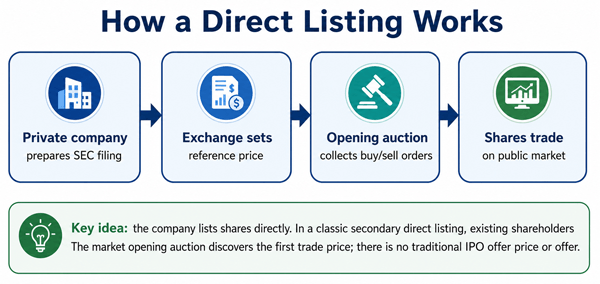
A company that wants to go public through a direct listing still has to prepare public-company disclosures. It files a registration statement with the SEC, publishes a prospectus, works with an exchange such as the NYSE or Nasdaq, and meets listing standards. This means a direct listing is not a shortcut around disclosure rules. It is a different selling and pricing method.
In a traditional IPO, underwriters market the deal, collect demand from institutional investors, help set the offer price, and allocate shares. In a direct listing, there is no traditional underwritten sale at a single offer price. The exchange publishes a reference price, but that reference price is not the same thing as an IPO price. No investor necessarily buys shares at the reference price; actual trading begins when the opening auction produces a match between buyers and sellers.
A secondary direct listing mainly allows existing shareholders to sell. A primary direct listing can allow the company itself to sell newly issued shares and raise capital, but this structure has additional rules and is less common in practice. For readers, the practical question is simple: is the company raising money for growth, or are existing shareholders mainly getting liquidity? The answer affects dilution, supply of shares, and investor expectations.
| Step | What Happens |
|---|---|
| 1. Preparation | The company prepares audited financials, risk disclosures, governance documents, investor education, and exchange listing materials. |
| 2. SEC registration | The company files registration documents, often on Form S-1 for U.S. companies or F-1 for many foreign private issuers. |
| 3. Reference price | The exchange sets a reference price based on available information such as private-market trades and financial-advisor input. This is a guidepost, not a guaranteed trading price. |
| 4. Opening auction | Buy and sell orders are collected. The designated market maker or exchange mechanism determines the opening price based on supply and demand. |
| 5. Public trading | Once trading opens, anyone with a brokerage account that supports the stock can generally buy or sell, subject to market rules and broker availability. |
3. Direct Listing vs IPO: The Main Differences
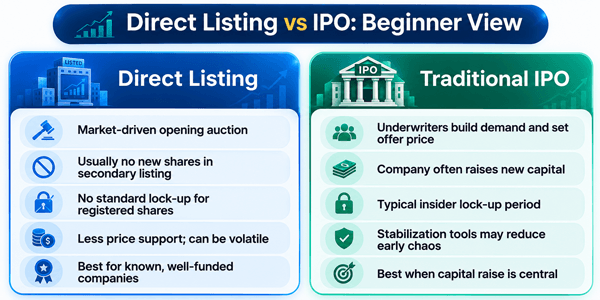
| Area | Direct Listing | Traditional IPO |
|---|---|---|
| Who sells shares? | Usually existing shareholders; in a primary direct listing, the company may sell new shares. | Usually the company sells new shares, sometimes alongside existing shareholders. |
| Pricing | Opening price is discovered through the exchange auction. The reference price is only a guide. | Offer price is set before trading by the company and underwriters after investor marketing. |
| Underwriters | No traditional underwritten offering; banks may act as financial advisors. | Investment banks underwrite, market, price, and allocate shares. |
| Capital raised | Often no new capital in a secondary direct listing. | Usually raises new capital for the company. |
| Lock-up | Often no traditional IPO lock-up for registered shares, so supply can appear sooner. | Typical lock-up periods restrict insiders from selling for about 90 to 180 days. |
| Day-one investor access | Public buyers enter through the open market once trading begins. | Many retail investors cannot buy at the IPO offer price and must buy after trading opens. |
| Price support | No standard greenshoe stabilization structure. | Underwriters may use stabilization tools, subject to rules. |
| Best suited for | Well-known companies that do not urgently need cash and already have investor awareness. | Companies that want to raise capital, build demand, and receive structured underwriting support. |
3.1 A Simple Example
Imagine a software company called CloudNote. It is already profitable, has a famous product, and has enough cash. Employees and early investors own shares, but those shares are hard to sell because the company is private. CloudNote chooses a direct listing.
The exchange publishes a $40 reference price. On opening day, buyers submit orders because they believe CloudNote is a high-quality business. Sellers submit orders because some employees and early investors want liquidity. The opening auction matches demand and supply at $52. That $52 becomes the first public trading price. CloudNote receives no cash in a secondary direct listing, but its shares now trade publicly and existing shareholders have liquidity.
Now compare that with an IPO. If CloudNote used a traditional IPO, it might issue new shares at $45, raise cash for the business, pay underwriting fees, and allocate many shares to institutional investors before public trading begins. The stock might still open at $52, but the process and economics would be different.
4. Why Companies Choose Direct Listings
4.1 They Do Not Need to Raise Money Immediately
A company with strong cash reserves may care more about public liquidity than new capital.
4.2 They Want Market-Based Price Discovery
Direct listings can reduce the gap between a negotiated offer price and the price public investors are willing to pay once trading starts.
4.3 They Want Liquidity for Employees and Early Investors
Without a standard IPO lock-up, eligible shareholders may have more flexibility to sell earlier.
4.4 They Already Have Brand Awareness
Famous companies may not need a traditional IPO roadshow to explain their business to the market.
4.5 They May Save on Some Underwriting Costs
There are still legal, accounting, exchange, advisory, and compliance costs, but the traditional underwriting fee structure is different.
5. What Beginners Should Know Before Buying a Direct Listing
5.1 The Reference Price Is Not a Bargain Price
Many beginners see a reference price and assume they can buy at that level. That is often wrong. In a direct listing, the stock may open far above or below the reference price.
5.2 There May Be Heavy Selling Pressure
Because existing shareholders may be able to sell earlier, the first weeks can include large supply. That does not always mean the company is bad; it may simply mean insiders want liquidity after years of holding private shares.
5.3 No IPO Allocation Does Not Mean No Risk
Retail investors may like that there is no special IPO allocation. But open-market access also means you are competing with institutions, algorithms, and investors who have already studied the company deeply.
5.4 Read the Prospectus Before Buying
Focus on revenue growth, gross margin, profitability, cash flow, customer concentration, competition, valuation, voting control, and risk factors.
5.5 Use Limit Orders, Not Emotional Market Orders
On the first trading day, prices can move quickly. A limit order helps define the maximum price you are willing to pay. It does not guarantee execution, but it prevents accidental buying at a price far above your plan.
| Question Area | Beginner-Friendly Check |
|---|---|
| Business quality | Do I understand how the company makes money? Is revenue recurring or one-time? |
| Profitability | Is the company profitable? If not, is the path to profitability believable? |
| Cash position | Does it need new money soon? A secondary direct listing may not add cash to the balance sheet. |
| Valuation | How do price-to-sales, gross margin, growth, and cash flow compare with peers? |
| Share supply | How many shares can existing holders sell? Is there a lock-up or not? |
| Governance | Are there dual-class shares or founder control? |
| Risk factors | What risks does management say could hurt the business? |
| Personal fit | Would I still want to own this after a 30% drop? Is this position size appropriate? |
6. Real-World Direct Listing Examples
These examples show why the reference price should be treated as a guide, not a guaranteed entry point. Opening prices can be much higher than the reference price, and the closing price can move meaningfully from the open.
| Company | Date | Exchange | Reference | Open | Close | Lesson |
|---|---|---|---|---|---|---|
| Spotify (SPOT) | April 3, 2018 | NYSE | $132.00 | $165.90 | $149.01 | Opened 25.7% above reference, then closed below the open. |
| Slack (WORK) | June 20, 2019 | NYSE | $26.00 | $38.50 | $38.62 | Opened far above reference and closed near the opening price. |
| Roblox (RBLX) | March 10, 2021 | NYSE | $45.00 | $64.50 | $69.50 | Strong first day; reference price was far below open. |
| Coinbase (COIN) | April 14, 2021 | Nasdaq | $250.00 | $381.00 | $328.28 | Opened high, but closed well below its first trade. |
Investor lesson: buying simply because a direct listing is famous can be dangerous. The business may be excellent, but the first public price can already include a lot of optimism.
7. Advantages and Disadvantages
| Potential Advantages | Potential Disadvantages |
|---|---|
| More open access: Public-market buyers generally participate after trading opens rather than relying on underwriter allocation. | Price uncertainty: There is no traditional IPO offer price and the opening auction may produce a wide gap from the reference price. |
| Market-based pricing: The first trade reflects real-time buy and sell orders. | Less marketing support: Companies without strong brand awareness may struggle to attract balanced demand. |
| Liquidity for insiders: Employees and early investors may get a cleaner path to sell registered shares. | Possible selling pressure: More insider liquidity can mean more supply in the market. |
| Potential cost efficiency: The company avoids a traditional underwritten share sale, though it still pays advisors and compliance costs. | Investor protection complexity: Legal claims can be more complex when registered and unregistered shares mix in the market. |
| Not ideal for every company: A company that needs a large, predictable capital raise may prefer an IPO. |
8. Direct Listing Red Flags
- You cannot clearly explain how the company makes money.
- The valuation is based on hype rather than revenue, margins, or cash flow.
- The prospectus shows slowing growth, widening losses, or rising customer concentration.
- Insiders appear eager to sell but the company is not raising capital for growth.
- You are buying only because the ticker is trending on social media.
- Your broker shows a fast-moving quote and you are tempted to use a market order.
9. How Investors Can Use This Knowledge Practically
For a beginner, the goal is not to predict the exact first-day price. The goal is to avoid common mistakes. Before buying, decide what the business is worth to you, what price would be too expensive, and how much volatility you can tolerate.
A practical approach is to wait through the first hours or days of trading, read the prospectus, compare valuation with listed peers, and use a small starter position if the price is reasonable. Many experienced investors avoid day-one trading entirely because the first print can be driven by excitement, limited supply, and fast-moving institutional orders.
| Reader Type | Practical Use |
|---|---|
| Conservative beginner | Wait several days or weeks; study earnings reports and analyst coverage once available. |
| Long-term investor | Build a valuation range, buy only below your planned price, and size the position modestly. |
| Active trader | Use strict limit orders and risk controls; understand that opening-day volatility can be extreme. |
| Employee/shareholder | Consider taxes, diversification, lock-up or trading-window rules, and personal cash needs before selling. |
| Company founder/CFO | Consider whether the company has enough brand recognition, investor education, liquidity, and cash to make a direct listing work. |
10. Direct Listing vs IPO vs SPAC
| Feature | Direct Listing | IPO | SPAC Merger |
|---|---|---|---|
| Basic idea | Company lists shares directly on an exchange. | Company sells shares in an underwritten public offering. | Private company merges with an already public shell company. |
| Capital raise | Often none in secondary listings; possible in primary direct listings. | Usually yes. | Often through SPAC cash and/or PIPE financing. |
| Pricing | Opening auction. | Underwriter-led offer price. | Negotiated merger valuation. |
| Best for | Known companies with liquidity needs and enough cash. | Companies wanting capital and structured demand. | Companies seeking a merger route, though market appetite changes over time. |
| Main investor risk | Volatile price discovery and insider selling supply. | IPO hype, allocation limits, and post-IPO valuation risk. | Deal quality, dilution, projections, and redemption risk. |
11. Frequently Asked Questions
11.1 Is a Direct Listing the Same as an IPO?
No. Both can make a company publicly traded, but an IPO usually involves underwriters, a set offer price, and new capital raised by issuing shares. A direct listing uses exchange price discovery and often lets existing shareholders sell shares directly.
11.2 Can a Company Raise Money in a Direct Listing?
Yes, in a primary direct listing structure, but many well-known direct listings were secondary listings where the company itself did not raise new money.
11.3 Can Retail Investors Buy a Direct Listing?
Generally yes, after trading opens through a brokerage account that supports the stock. However, investors should use care because the opening price may be very different from the reference price.
11.4 Is a Direct Listing Cheaper Than an IPO?
It can avoid traditional underwriting fees, but it is not free. Companies still pay legal, accounting, exchange, advisory, investor-relations, and compliance costs.
11.5 Why Do Some Direct Listings Open Far Above the Reference Price?
Because the reference price is only a guide. If buy orders greatly exceed sell orders near that level, the opening auction can produce a much higher first trade.
11.6 Is a Direct Listing Good for Employees?
It can be helpful because it may create liquidity sooner than a traditional IPO lock-up structure. Employees still need to consider taxes, diversification, company trading windows, and personal financial planning.
11.7 Should Beginners Buy on the First Day?
Many beginners are better served by waiting, reading the prospectus, watching price discovery, and avoiding emotional orders. A good company can still be a poor investment at the wrong price.
12. Conclusion
A direct listing is a public-market entry method where shares begin trading through exchange price discovery rather than a traditional underwritten IPO sale. For companies, it can provide liquidity, transparency, and potential cost savings. For investors, it can provide open-market access but also demands discipline because the opening price can be volatile and very different from the reference price.
The smartest way to approach a direct listing is simple: understand the business, read the prospectus, compare valuation, respect volatility, and never treat the reference price as a guaranteed bargain. In investing, the process may be new, but the old rule still applies: price matters.
13. Sources Consulted and Checked
These sources were consulted and checked while preparing this article to support accuracy, context, and verification. Readers should refer to the latest official materials because rules, guidance, filings, and market practices may change.
- NYSE - Direct Listings: https://www.nyse.com/direct-listings
- Nasdaq - Learn About Direct Listings: https://www.nasdaq.com/solutions/listings/markets/americas/ways-to-list/direct
- SEC Investor.gov - Investing in an IPO: https://www.investor.gov/introduction-investing/general-resources/news-alerts/alerts-bulletins/investor-bulletins-17
- SEC Statement on Primary Direct Listings: https://www.sec.gov/newsroom/speeches-statements/lee-crenshaw-listings-2020-12-23
- Latham & Watkins / NYSE IPO Guide - Direct listings section: https://www.lw.com/en/insights/2021/07/NYSE-IPO-Guide
- Jay Ritter, University of Florida - Direct Listings in the U.S., 2018-2026: https://site.warrington.ufl.edu/ritter/files/Direct-Listings.pdf
- Harvard Law School Forum - Spotify Direct Listing Case Study: https://corpgov.law.harvard.edu/2018/07/05/spotify-case-study-structuring-and-executing-a-direct-listing/
- SEC EDGAR - Slack registration/prospectus materials: https://www.sec.gov/Archives/edgar/data/1764925/000162828019008125/slack424.htm
- SEC EDGAR - Coinbase registration statement: https://www.sec.gov/Archives/edgar/data/1679788/000162828021003168/coinbaseglobalincs-1.htm
- Reuters - Roblox reference price: https://www.reuters.com/technology/roblox-reference-share-price-set-45-ahead-nyse-debut-2021-03-10/
Disclaimer
This article is provided solely for educational and informational purposes. It does not constitute investment, financial, legal, tax, accounting, or other professional advice, and it should not be treated as a recommendation to buy, sell, or hold any security. Direct listings, IPOs, exchange procedures, securities rules, company disclosures, prices, and other facts may change because of regulatory, market, company-specific, or other developments. Before making any decision, readers should review the latest prospectus and filings, verify facts and figures through official sources such as the SEC and the relevant stock exchange, consider their own objectives and risk tolerance, and seek advice from appropriately qualified professionals where necessary. Investing involves risk, including possible loss of principal.