Bid vs Ask Price: Meaning, Spread, and Simple Examples
1. Quick Answer: Bid vs Ask Price in Plain English
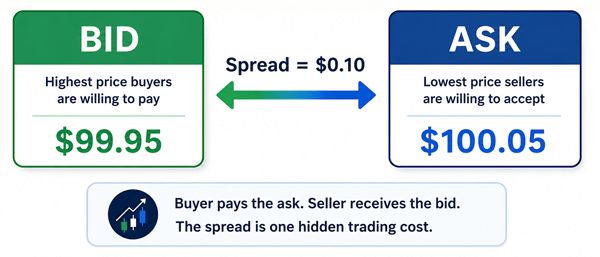
The bid price is the highest price buyers are currently willing to pay. The ask price, also called the offer price, is the lowest price sellers are currently willing to accept. The difference between them is the bid-ask spread.
For a beginner, the most important rule is simple: if you buy immediately, you usually pay the ask. If you sell immediately, you usually receive the bid. That small gap can become a real cost, especially when you trade often, trade large amounts, or trade assets with low liquidity.
| Term | Simple meaning | Beginner takeaway |
|---|---|---|
| Bid price | What buyers are offering right now | This is usually the price you can sell at immediately. |
| Ask price | What sellers are asking right now | This is usually the price you can buy at immediately. |
| Bid-ask spread | Ask price minus bid price | A wider spread means higher trading friction. |
| Mid price | Halfway between bid and ask | Useful as a fair reference, but you may not actually trade at it. |
AN Easy example A stock quote shows bid $49.95 and ask $50.05. If you want to buy right now, your likely price is around $50.05. If you want to sell right now, your likely price is around $49.95. The spread is $0.10 per share.
2. Bid Price Meaning
The bid is the best current buying offer in the market. It is not the price you wish the asset was worth. It is the highest visible price someone is ready to pay at that moment for a certain quantity.
When you sell using a market order, your order normally meets the buyers sitting on the bid side. That is why sellers often receive the bid price or a nearby price, depending on market movement and available size.
2.1 What bid size means
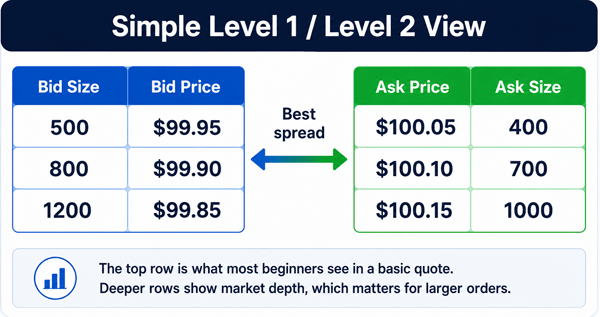
Bid size shows how many shares, units, contracts, or lots buyers are willing to buy at the quoted bid. If the best bid is $20.00 for 100 shares and you try to sell 1,000 shares with a market order, only the first 100 shares may fill at $20.00. The rest may fill at lower bid levels if there are not enough buyers at the top price.
3. Ask Price Meaning
The ask is the best current selling offer in the market. It is the lowest visible price someone is ready to accept to sell the asset at that moment.
When you buy using a market order, your order normally meets the sellers on the ask side. This is why buyers usually pay the ask price or a nearby price. In fast markets, thinly traded securities, or large orders, the final execution price may move beyond the first ask level.
3.1 What ask size means
Ask size shows how much supply is available at the current ask. A small ask size can be a warning for larger buyers because the visible quantity may disappear quickly, causing the order to fill at higher prices.
4. Bid-Ask Spread Meaning and Formula
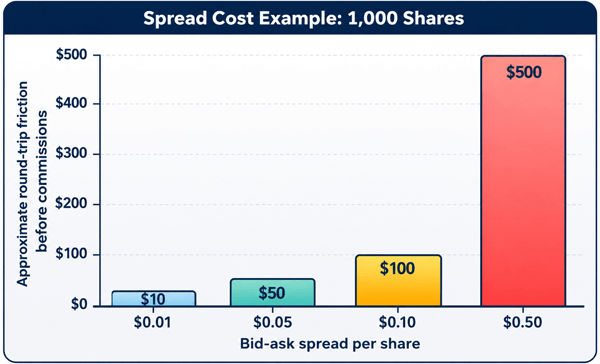
The bid-ask spread is the gap between the ask price and bid price. It is one of the most important hidden costs in trading because it affects your entry and exit price even when the broker advertises zero commission.
| Formula | Example |
|---|---|
| Spread = Ask price - Bid price | $100.05 - $99.95 = $0.10 |
| Spread percentage = (Spread / Ask price) x 100 | $0.10 / $100.05 x 100 = about 0.10% |
| Approximate spread cost on shares = Spread x number of shares | $0.10 x 1,000 shares = $100 of round-trip friction before other costs |
For long-term investors, a small spread on a large, liquid ETF may barely matter. For short-term traders, frequent traders, crypto traders, option traders, penny-stock traders, and forex/CFD traders, spreads can strongly affect profitability because every trade starts slightly behind.
5. Simple Examples for Stocks, ETFs, Forex, and Crypto
| Market | Quote shown | What happens if you buy immediately? | What happens if you sell immediately? | Spread |
|---|---|---|---|---|
| Stock | Bid $49.95 / Ask $50.05 | You likely pay around $50.05 | You likely receive around $49.95 | $0.10 |
| ETF | Bid $250.00 / Ask $250.03 | You likely pay around $250.03 | You likely receive around $250.00 | $0.03 |
| Forex | EUR/USD 1.0850 / 1.0852 | You likely buy near 1.0852 | You likely sell near 1.0850 | 0.0002, or 2 pips |
| Crypto | Bid $62,000 / Ask $62,040 | You likely pay around $62,040 | You likely receive around $62,000 | $40 |
| Option | Bid $2.10 / Ask $2.40 | You likely pay around $2.40 | You likely receive around $2.10 | $0.30 per contract share equivalent |
Real trader experience pattern Many beginners think their trade is losing immediately because the market moved against them. Often, the first small loss is simply the spread. If you buy at the ask and instantly check the position value using the bid, it may show a small negative number even if the market has not really moved.
6. Why the Spread Exists
A spread exists because buyers and sellers rarely agree on one exact price at the same instant. Markets need liquidity providers, market makers, and patient limit-order traders to stand ready to buy and sell. The spread compensates them for providing immediacy, taking inventory risk, handling order-processing costs, and trading when prices may change quickly.
| Reason | What it means in simple words | How beginners see it |
|---|---|---|
| Liquidity cost | It costs something to trade instantly instead of waiting. | Market orders cross the spread. |
| Inventory risk | Market makers may hold assets that can fall or rise before they offset the trade. | Riskier assets often have wider spreads. |
| Volatility | Fast price movement makes quotes less certain. | Spreads often widen during news or market stress. |
| Low volume | Fewer buyers and sellers means less competition. | Small stocks, thin ETFs, and illiquid crypto pairs can have big spreads. |
| Order size | Large orders can consume the best available quotes. | Part of the trade may fill at worse prices. |
7. What Makes Spreads Tight or Wide?
| Factor | Tighter spread usually happens when... | Wider spread usually happens when... |
|---|---|---|
| Trading volume | Many buyers and sellers are active. | Few participants are trading. |
| Competition | Many market makers and limit orders compete. | Few quotes are available. |
| Volatility | Prices are calm and predictable. | Prices are jumping quickly. |
| Time of day | Regular market hours are active. | Pre-market, after-hours, open, close, or weekend crypto liquidity is thinner. |
| Asset type | Large-cap stocks and major ETFs trade actively. | Options, penny stocks, micro-cap shares, and minor crypto pairs can be thin. |
| News risk | No major surprise is expected. | Earnings, economic data, lawsuits, or exchange outages create uncertainty. |
A tight spread is often a sign of better liquidity, but it is not a guarantee that your whole order will execute at the displayed price. Always compare spread with order size and available depth.
8. Market Order vs Limit Order: The Most Practical Difference
Understanding bid and ask prices becomes useful when choosing order type. A market order prioritizes execution. A limit order prioritizes price. For beginners, this difference matters more than memorizing trading jargon.
| Order type | Main goal | Benefit | Risk | When it may make sense |
|---|---|---|---|---|
| Market order | Get filled quickly | High chance of execution | You may cross the spread and get slippage | Small trades in highly liquid assets during normal hours |
| Limit buy order | Buy at a set price or lower | Controls maximum purchase price | May not fill | When spread is wide or you do not need instant execution |
| Limit sell order | Sell at a set price or higher | Controls minimum sale price | May not fill | When you want to avoid selling too cheaply into a wide spread |
Actionable rule for beginnersBefore clicking Buy or Sell, look at the spread. If the spread feels large compared with your expected profit or holding period, slow down. Consider using a limit order, reducing order size, or waiting for more liquid market conditions.
9. How Beginners Can Use Bid and Ask Prices
9.1 Estimate your real entry cost
Do not judge a trade using only the last traded price. The last price is historical; bid and ask are current quotes. If the last price is $100 but the ask is $100.30, a market buy may start near $100.30, not $100.
9.2 Check whether a trade has enough room to be worth it
If a short-term trade aims to make $0.20 per share but the spread is $0.10, half the expected gross move is already consumed by spread friction. That does not automatically make the trade bad, but it raises the required accuracy.
9.3 Avoid trading illiquid assets casually
A wide spread can be a warning sign. Beginners often enter thin assets easily but struggle to exit at a fair price. This can happen in low-volume stocks, small ETFs, crypto pairs outside major exchanges, and far out-of-the-money options.
9.4 Use limit orders when price matters
A limit order can protect you from paying more than planned or selling for less than planned. The trade-off is that the order may not execute. This is usually a better problem than receiving a surprisingly bad price.
9.5 Compare spreads before choosing a broker, exchange, or product
Zero-commission trading does not mean zero-cost trading. Spreads, slippage, platform fees, foreign exchange conversion, margin interest, tax treatment, and execution quality can all matter. For forex, CFDs, crypto, options, and active stock trading, spread cost can be one of the biggest practical differences between platforms.
10. Beginner Checklist Before Placing a Trade
- What is the current bid and ask?
- How wide is the spread in dollars and percentage?
- Is the spread small compared with my expected holding period and potential gain?
- Is there enough size at the best bid or ask for my order?
- Am I trading during normal liquid market hours?
- Is news, earnings, economic data, or high volatility affecting quotes?
- Would a limit order protect me better than a market order?
- Do I understand all other costs, including commissions, exchange fees, margin interest, tax, and currency conversion?
11. Common Mistakes Beginners Make
| Mistake | Why it hurts | Better habit |
|---|---|---|
| Looking only at the last price | The last trade may not match the current buy/sell quote. | Use bid and ask for execution expectations. |
| Using market orders in wide spreads | You may pay far more or receive far less than expected. | Use limit orders when spread is wide. |
| Ignoring spread percentage | A $0.05 spread may be tiny on a $500 stock but large on a $1 stock. | Convert spread into percentage. |
| Trading too often | Small costs compound over many trades. | Track total spread cost, not only commissions. |
| Buying illiquid options casually | Options can have very wide spreads and poor fills. | Compare bid, ask, volume, open interest, and realistic exit price. |
| Placing large orders without checking depth | Your order may move through several price levels. | Split orders carefully or use limits. |
12. Bid-Ask Spread and Different Investor Types
| Investor type | How much spread matters | Practical focus |
|---|---|---|
| Long-term investor | Usually moderate if buying liquid stocks/ETFs rarely. | Avoid wide spreads and poor timing; use limits for ETFs and thin assets. |
| Day trader | Very high. | Spread must be included in every strategy and backtest. |
| Options trader | Very high. | Wide spreads can erase edge; negotiate with limit orders around fair value. |
| Forex trader | Very high. | Spread is often a primary trading cost, especially on smaller pairs. |
| Crypto trader | High and exchange-dependent. | Compare exchange liquidity, fee tier, spread, and slippage. |
| Dividend investor | Lower, but not zero. | Avoid overpaying during illiquid periods; use patient limits. |
13. How to Calculate Spread Cost Step by Step
Example: You want to buy 500 shares of a stock quoted at bid $19.98 and ask $20.02.
- Calculate spread: $20.02 - $19.98 = $0.04 per share.
- Calculate spread percentage: $0.04 / $20.02 x 100 = about 0.20%.
- Estimate round-trip spread friction: 500 shares x $0.04 = $20 before commissions, taxes, and slippage.
- Ask whether your expected gain is large enough to justify that cost. A $20 friction may be acceptable for a long-term position but high for a tiny short-term target.
14. Important Nuance: The Spread Is Not Always the Whole Cost
The displayed spread is a helpful starting point, but your true execution cost can differ. You may receive price improvement, partial fills, or slippage. In a fast-moving market, the quote can change between the moment you click and the moment your order reaches the market. For larger orders, market depth matters because the first quote may not have enough size.
| Concept | Simple explanation |
|---|---|
| Price improvement | You receive a better price than the displayed bid or ask. |
| Slippage | You receive a worse price than expected because the quote moved or there was not enough liquidity. |
| Partial fill | Only part of your order executes at your limit price. |
| Market depth | The amount available at different bid and ask levels beyond the best quote. |
| Effective spread | A real-world measure comparing execution price with a benchmark such as the midpoint. |
15. Practical Examples of Better Order Placement
| Situation | Beginner reaction | Smarter approach |
|---|---|---|
| Large-cap ETF quoted $100.00 / $100.01 | Market order may be acceptable for small amount. | Still check size and avoid volatile open/close if possible. |
| Small stock quoted $4.80 / $5.20 | Buy immediately because the chart looks good. | Pause. The spread is 8% of the ask. Use a limit order or avoid. |
| Option quoted $1.00 / $1.40 | Buy at ask because option might move fast. | Consider a limit order between bid and ask, and check fair value, volume, and open interest. |
| Crypto token quoted $0.095 / $0.105 | Assume price is about $0.10. | Recognize a 10% spread. Check liquidity and exit risk before entering. |
16. Bid vs Ask Price FAQ
16.1 Is bid the price I buy at?
Usually no. If you buy immediately with a market order, you normally pay the ask. The bid is usually what you receive if you sell immediately.
16.2 Is ask the price I sell at?
Usually no. The ask is what sellers are asking from buyers. If you sell immediately, you normally receive the bid.
16.3 Why is the ask higher than the bid?
Because sellers want the highest possible price and buyers want the lowest possible price. The gap is the spread.
16.4 Is a tight spread good?
Generally yes, because it suggests better liquidity and lower trading friction. It does not guarantee perfect execution for large or fast-moving orders.
16.5 Can the spread change?
Yes. Spreads can change every second. They often widen during volatility, low volume, market open/close, pre-market, after-hours, and major news.
16.6 What is a good bid-ask spread?
It depends on the asset price and your strategy. A one-cent spread can be excellent on a $100 stock but expensive on a $0.20 stock. Always calculate percentage spread.
16.7 Do zero-commission brokers remove the spread?
No. Commission and spread are different costs. A broker may charge no commission while the market still has a bid-ask spread.
16.8 Should beginners use market orders or limit orders?
For small trades in very liquid assets during normal market hours, market orders may be reasonable. When price matters, spreads are wide, markets are volatile, or the asset is thinly traded, limit orders are usually safer.
17. Final Takeaway
Bid and ask prices are not complicated once you connect them to real trading behavior. Buyers bid. Sellers ask. The spread is the gap. If you buy instantly, you usually pay the ask. If you sell instantly, you usually receive the bid. The wider the spread, the more careful you should be.
A beginner who learns to check spreads, calculate spread percentage, use limit orders when needed, and avoid illiquid products has already avoided one of the most common trading mistakes. That habit can improve execution quality, reduce unnecessary costs, and encourage more patient, honest decision-making.
18. Glossary
| Term | Meaning |
|---|---|
| Bid | Highest current price buyers are willing to pay. |
| Ask / Offer | Lowest current price sellers are willing to accept. |
| Spread | Ask price minus bid price. |
| Liquidity | How easily an asset can be bought or sold without a big price impact. |
| Market order | An order to buy or sell immediately at the best available price. |
| Limit order | An order to buy or sell only at a chosen price or better. |
| Slippage | Difference between expected price and actual execution price. |
| Market depth | The amount available at multiple bid and ask levels. |
| Mid price | The halfway point between the bid and ask. |
Sources Consulted and Checked
These sources were consulted and checked while preparing this article to support clarity and accuracy.
- SEC Investor.gov. “Bid Price/Ask Price.” Defines bid, ask, and spread for investors. https://www.investor.gov/introduction-investing/investing-basics/glossary/ask-price
- SEC Investor.gov. “Types of Orders.” Explains market orders and limit orders. https://www.investor.gov/introduction-investing/investing-basics/how-stock-markets-work/types-orders
- FINRA. “Order Types.” Explains market orders, limit orders, and execution considerations. https://www.finra.org/investors/investing/investment-products/stocks/order-types
- FINRA. “Exchange-Traded Funds and Products.” Notes that ETFs are subject to bid-ask spreads. https://www.finra.org/investors/investing/investment-products/exchange-traded-funds-and-products
- Britannica Money. “Bid-Ask Spread.” Provides a plain-English overview of bid, ask, spread, and liquidity. https://www.britannica.com/money/bid-ask-spread
- Investopedia. “What Is a Bid-Ask Spread, and How Does It Work in Trading?” Practical explanation of spread as trading friction and liquidity indicator. https://www.investopedia.com/terms/b/bid-askspread.asp
Reader Advice
This article is provided solely for educational and informational purposes. It does not constitute personal investment, financial, tax, legal, or trading advice, and it should not be treated as a recommendation to buy, sell, or hold any security, currency, cryptocurrency, derivative, or other financial product. Trading and investing involve risk, including the possible loss of principal.
Before making any decision, readers should consider their objectives, financial circumstances, risk tolerance, costs, time horizon, and applicable laws and regulations, and should seek advice from an appropriately qualified professional where necessary. Market conditions, prices, spreads, platform practices, fees, tax rules, and regulatory requirements can change and may differ by country, broker, exchange, product, and account type. Readers should therefore verify important facts, figures, current rules, and product terms directly from official regulators, exchanges, brokers, and other authoritative sources.