Limit Order vs Market Order: Key Differences for New Investors
When you tap Buy or Sell in a brokerage app, you are not just choosing a stock. You are also telling the market how you want that trade handled. The two order types beginners see most often are market orders and limit orders.
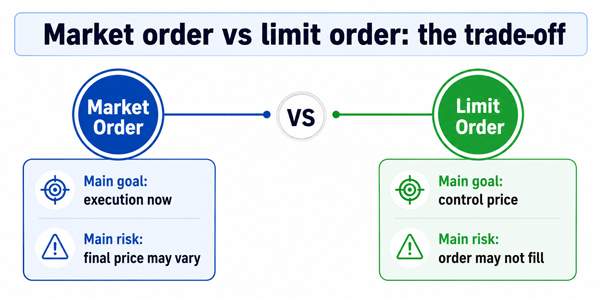
A market order says: complete the trade as soon as possible at the best available price right now. A limit order says: complete the trade only at my price or better. That one difference can affect your final price, your risk, and whether the trade happens at all.
This guide explains both order types in plain English, with real-life examples, beginner mistakes, practical rules of thumb, and a side-by-side comparison you can use before placing your next trade.
1. Quick Answer: The Main Difference
| Order type | What it means | Best when | Main risk |
|---|---|---|---|
| Market order | Buy or sell now at the best available current price. | You care more about getting the trade done quickly than getting an exact price. | The final execution price can be different from the price you saw on screen. |
| Limit order | Buy or sell only at your chosen price or better. | You care more about price control than speed. | The order may not execute if the market never reaches your limit price. |
Beginner takeaway: Use a market order when speed matters and the stock or ETF is very liquid with a tight bid-ask spread. Use a limit order when price matters, the stock is volatile, the spread is wide, or you are trading outside normal market hours.
2. What Is a Market Order?
A market order is an instruction to buy or sell an investment immediately at the best price currently available in the market. It is the simplest order type and the one many beginners use first because it feels like online shopping: choose a ticker, enter the amount, press buy, and the trade usually goes through quickly.
But a market order does not promise the exact price you see before clicking. Stock prices move constantly. The price displayed in your app may be a quote, not a guaranteed fill price. In a calm, liquid market, the difference may be tiny. In a fast-moving or thinly traded stock, the difference can be meaningful.
According to Investor.gov, a market order is commonly used when investors want immediate execution. The trade-off is that execution is prioritized over price certainty.
| Market order example | Details |
|---|---|
| You want to buy | 100 shares of ABC |
| Price shown in app | Around $50.00 |
| What your order says | Buy 100 shares now at the best available market price |
| Possible result | Some or all shares may fill at $50.00, but the final average price could be $50.02, $50.10, or higher if the price moves quickly |
2.1 How a Market Order Works Step by Step
- You enter the stock ticker, quantity, and choose Market.
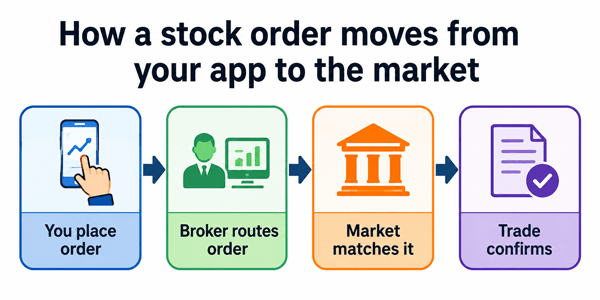
- Your broker sends the order for execution.
- The order matches with available sellers if you are buying, or buyers if you are selling.
- You receive a trade confirmation showing the actual execution price, quantity filled, and any fees or commissions.
Practical experience from beginnersMany new investors assume the price on the screen is the price they will definitely get. That is usually close for highly liquid large-cap stocks and major ETFs during regular market hours, but it is not guaranteed. The surprise often comes during market open, market close, after-hours trading, earnings news, or with low-volume stocks.
3. What Is a Limit Order?
A limit order is an instruction to buy or sell only at a specific price or better. You set the maximum price you are willing to pay when buying, or the minimum price you are willing to accept when selling.
If you place a buy limit order at $50.00, you are saying: buy only at $50.00 or lower. If you place a sell limit order at $50.00, you are saying: sell only at $50.00 or higher.
Limit orders are useful because they give you price control. The trade-off is that your order may not fill. The market might touch your price but not have enough shares available, or it might move away before your order reaches the front of the queue.
| Limit order example | Details |
|---|---|
| You want to buy | 100 shares of ABC |
| Current quote | Bid $49.95 / Ask $50.05 |
| Your limit price | $50.00 |
| What your order says | Buy only if shares are available at $50.00 or lower |
| Possible result | You might get filled at $50.00, $49.98, or another better price. Or the order may not fill if sellers stay above $50.00. |
4. Limit Order vs Market Order: Detailed Comparison
| Factor | Market Order | Limit Order |
|---|---|---|
| Main goal | Fast execution | Price control |
| Price guarantee | No exact price guarantee | Yes, price will be your limit or better if it executes |
| Execution guarantee | Usually executes quickly in liquid markets, but not absolutely guaranteed | Not guaranteed; may remain unfilled |
| Best for | Large, liquid stocks and ETFs during normal market hours | Volatile stocks, wide spreads, low volume, after-hours, and planned entry/exit prices |
| Beginner risk | Slippage: paying more or receiving less than expected | Missed trade: the price moves away and your order does not execute |
| Emotional effect | Feels simple and fast, but can encourage impulse trades | Forces you to decide your acceptable price before acting |
| Common mistake | Using it in thinly traded stocks or during news spikes | Setting an unrealistic limit price and wondering why it never fills |
5. The Hidden Concept Beginners Must Understand: Bid-Ask Spread
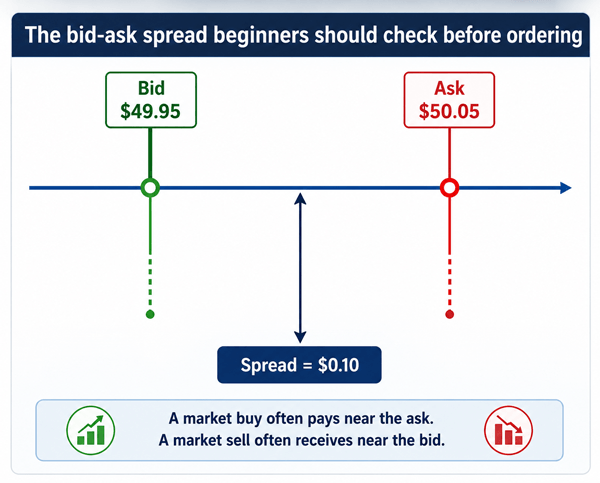
Before choosing between a market order and a limit order, look at the bid and ask. The bid is the highest price buyers are currently offering. The ask is the lowest price sellers are currently asking. The gap between them is the bid-ask spread.
For example, if the bid is $49.95 and the ask is $50.05, the spread is $0.10. A market buy order will typically execute near the ask. A market sell order will typically execute near the bid. A limit order lets you choose the price you are willing to accept within or around that spread.
A tight spread usually means many buyers and sellers are active. A wide spread can be a warning sign that a market order may produce a worse price than expected.
| Spread situation | Example | Beginner-friendly action |
|---|---|---|
| Tight spread | Bid $100.00 / Ask $100.01 | A market order may be acceptable for a small trade in a liquid ETF or large stock, though a limit order still gives more control. |
| Moderate spread | Bid $50.00 / Ask $50.20 | Consider a limit order so you do not automatically pay the full ask or sell at the bid. |
| Wide spread | Bid $10.00 / Ask $10.80 | Avoid careless market orders. Use a limit order or reconsider whether the security is too illiquid for your needs. |
6. When a Market Order May Make Sense
- You are trading a highly liquid ETF or large-cap stock during regular market hours.
- The bid-ask spread is very tight.
- Your order size is small compared with normal trading volume.
- You value immediate execution more than saving a few cents per share.
- You are not trading during major news, earnings releases, market open, market close, or after-hours sessions.
Simple market order ruleA market order is usually more reasonable when the investment is liquid, the spread is tiny, the order is small, and the market is calm. It is less suitable when the price is jumping, the spread is wide, or the stock barely trades.
7. When a Limit Order May Make Sense
- You want to control the maximum price you pay or the minimum price you accept.
- The stock is volatile or reacting to news.
- The security has low trading volume or a wide bid-ask spread.
- You are trading before or after normal market hours.
- You are buying gradually and do not mind waiting.
- You are selling and do not want a sudden drop to trigger a poor execution price.
Simple limit order ruleA limit order is often the safer default for beginners who are not in a rush. It slows the process down and forces a clear answer to one question: what price am I actually willing to accept?
8. Practical Examples for New Investors
8.1 Example 1: Buying a popular ETF
You want to buy $1,000 of a large, heavily traded ETF during regular market hours. The bid is $250.00 and the ask is $250.01. The spread is one cent. In this case, a market order may execute close to the price you expect. A limit order at or slightly above the ask can still provide price protection without making the order too difficult to fill.
8.2 Example 2: Buying a low-volume stock
You want to buy a small company stock. The bid is $8.80 and the ask is $9.40. That $0.60 spread is large for a $9 stock. A market buy order could fill near $9.40 or worse if the quote changes. A limit order lets you decide whether you are willing to pay $9.00, $9.10, or another price instead of accepting whatever is available.
8.3 Example 3: Selling during bad news
A stock you own drops after disappointing earnings. You panic and place a market sell order before checking the spread. The price is moving quickly, and the final execution is lower than you expected. A limit sell order could protect your minimum acceptable price, but it may also leave you holding the shares if the market falls below your limit.
8.4 Example 4: Trying to buy at yesterday's price
A beginner sees that a stock closed yesterday at $40 and places a buy limit order at $40, but today it opens at $43 after good news. The order does not fill. This is not a broker error. The limit order did exactly what it was told to do: avoid buying above $40.
9. Common Beginner Mistakes and How to Avoid Them
| Mistake | Why it happens | Better habit |
|---|---|---|
| Thinking a market order guarantees the displayed price | Apps make trading look instant, but quotes move. | Check the bid, ask, spread, and final confirmation. |
| Using market orders after hours | After-hours markets can have lower liquidity and wider spreads. | Use limit orders outside regular market hours. |
| Setting limit prices too far from reality | Beginners may anchor to an old price instead of the current market. | Use current bid/ask quotes and decide whether your price is realistic. |
| Ignoring partial fills | A limit order may fill only part of the quantity. | Review order status and understand your broker's time-in-force choices. |
| Chasing price moves | Fear of missing out leads to rushed orders. | Decide your entry price before opening the trade ticket. |
| Confusing order type with investment quality | A good order type cannot fix a bad investment decision. | Research the security, risk, fees, liquidity, and your time horizon first. |
10. Order Duration: Day Order vs Good-Til-Canceled
Order type answers how your trade should execute. Order duration answers how long the instruction should stay active. The two common choices are day order and good-til-canceled, often shown as GTC.
A day order expires if it is not filled by the end of the trading day. A GTC order remains active until it executes, you cancel it, or the broker's expiration policy ends it. Beginners should be careful with GTC orders because market conditions can change while the old order remains open.
| Duration | Meaning | Beginner caution |
|---|---|---|
| Day | Order is active for the current trading day only. | Good for keeping decisions fresh. If it does not fill, reassess tomorrow. |
| GTC | Order can stay open beyond today. | Useful for planned prices, but review it regularly so it does not execute after your view has changed. |
11. How to Choose Between a Limit Order and Market Order
- Check whether the investment is liquid. Look at daily volume and the bid-ask spread.
- Decide what matters more: immediate execution or price control.
- Avoid market orders when the spread is wide, the price is moving fast, or trading volume is low.
- For a buy order, ask: what is the highest price I am comfortable paying? That number can become your buy limit.
- For a sell order, ask: what is the lowest price I am comfortable accepting? That number can become your sell limit.
- Review the order preview before submitting. Confirm ticker, quantity, order type, estimated value, time in force, and account type.
- After the trade, read the confirmation. Learn from the execution price instead of ignoring it.
A useful beginner frameworkIf you are investing long term in a liquid ETF with a tiny spread, the order type may not change your life. But if you are trading individual stocks, volatile names, small caps, or after-hours markets, order type can matter a lot. When unsure, price control is usually more beginner-friendly than speed.
12. Pre-Trade Checklist for Beginners
- Am I investing or reacting emotionally?
- Do I understand what the company, ETF, or fund actually owns?
- What are the bid, ask, and spread right now?
- Is this regular market hours or extended-hours trading?
- Is my order size reasonable for the security's normal trading volume?
- Would I be upset if a market order filled a little higher or lower?
- Would I be upset if a limit order did not fill?
- Have I checked any commissions, trading fees, expense ratios, margin interest, or account restrictions?
- Did I verify the ticker symbol and avoid confusing similar company names?
13. Brokerage Platform Tips: What Beginners Should Look For
The right order type is only one part of safe online investing. Beginners should also choose a reputable brokerage account or online trading platform that provides clear order previews, real-time quotes where available, transparent trading fees, easy access to trade confirmations, educational material, and strong account security. Low commissions are helpful, but they should not be the only factor. Good execution quality, customer support, and clear risk disclosures also matter.
Be especially careful with margin trading, options trading, penny stocks, leveraged ETFs, and day trading features. These can increase risk quickly. A beginner-friendly broker should make it easy to understand order execution, not encourage constant trading just because it is convenient.
14. FAQ: Limit Order vs Market Order
14.1 Is a limit order safer than a market order?
A limit order is safer in the sense that it controls price. But it does not remove investment risk, and it may not execute. A market order is simpler and faster, but it can expose you to slippage.
14.2 Can a limit order execute at a better price?
Yes. A buy limit can execute at the limit price or lower. A sell limit can execute at the limit price or higher.
14.3 Why did my limit order not fill even though the stock touched my price?
There may not have been enough shares available at that price before other orders were filled. Order routing, queue priority, share quantity, and fast price changes can affect execution.
14.4 Should beginners always use limit orders?
Not always. Market orders can be reasonable for small trades in highly liquid stocks or ETFs during regular hours. But limit orders are often a better default when beginners care about avoiding surprise prices.
14.5 Do order types protect me from losing money?
No. Order types help manage execution. They do not make an investment good, prevent market losses, or protect against poor research.
14.6 Are market orders bad?
No. They are tools. A market order can be appropriate when speed matters and the market is liquid. Problems happen when beginners use them without checking spreads, volatility, or trading hours.
14.7 What order type should I use after hours?
A limit order is usually more appropriate because extended-hours trading often has lower liquidity and wider spreads. Some brokers require limit orders outside regular market hours.
14.8 What is slippage?
Slippage is the difference between the price you expected and the price you actually received. It can happen with market orders and in fast-moving markets.
14.9 What is partial execution?
Partial execution means only part of your order fills. This can happen when there are not enough shares available at your limit price.
14.10 Can I cancel a limit order?
Usually yes, if it has not already executed. However, markets move quickly, so cancellation is not guaranteed until your broker confirms it.
15. Final Verdict: Which Order Type Should a New Investor Use?
The best choice depends on your goal. If you want the trade completed quickly and the security is highly liquid, a market order can be simple and efficient. If you want control over price, a limit order is usually the better tool.
For most beginners, the safest habit is not to ask, Which button is fastest? Instead ask, What price am I willing to accept, and what happens if the order does not fill? That mindset reduces emotional trading, helps avoid surprise execution prices, and makes investing more intentional.
A market order prioritizes certainty of action. A limit order prioritizes certainty of price. Once you understand that trade-off, you are already ahead of many new investors.
Sources Consulted and Checked
The following authoritative sources were consulted and checked while preparing this article to support accuracy, clarity, and responsible presentation of the information.
- Investor.gov - Types of Orders: Market orders, limit orders, and basic investor education definitions.
- Investor.gov - Investor Bulletin: Understanding Order Types: Examples of execution risk and order type behavior in fast-moving markets.
- FINRA - Order Types: Investor-focused explanation of market orders, limit orders, and execution considerations.
- Investor.gov - Executing an Order: Broker order routing and execution process.
- SIPC - What SIPC Protects: Clarifies that SIPC protection does not cover market losses or bad investment outcomes.
Reader Advice
This article is provided solely for educational and general informational purposes. It does not constitute personalized financial, investment, legal, tax, or trading advice; a recommendation to buy or sell any security; or a guarantee of any result. Investment products, brokerage features, market conditions, fees, order-execution practices, trading hours, and applicable rules can change and may vary by country, exchange, broker, account type, and individual circumstances.
Before making a financial decision, readers should assess their own objectives, risk tolerance, financial position, and time horizon; review the latest terms and disclosures from their regulated broker; verify important facts and figures through current official or authoritative sources; and seek advice from an appropriately qualified professional when needed. All investing involves risk, including the possible loss of principal.