TVL Explained: Meaning, How It Works, Examples, Benefits and Risks
TVL, short for Total Value Locked, is one of the most common metrics used in decentralized finance, often called DeFi. Beginners see it on analytics dashboards, exchange research pages, protocol websites, and crypto news articles. A project may say it has $500 million in TVL, a blockchain may be ranked by TVL, or a lending protocol may announce that its TVL has doubled in a month.
At first, TVL sounds simple: it is the total value of assets deposited in a DeFi protocol or blockchain ecosystem. But using TVL well requires more care. A high TVL can suggest strong liquidity and user interest, but it does not automatically mean a project is safe, profitable, fairly valued, or growing sustainably. TVL can rise because more users deposited assets, because token prices increased, or because incentives temporarily attracted capital.
This guide explains TVL in plain English. It covers what TVL means, how it works, how it is calculated, why investors and users monitor it, where it can mislead, and how beginners can use it responsibly alongside other metrics.
1. Quick Answer: What Is TVL?
TVL, or Total Value Locked, is the estimated market value of crypto assets deposited into a DeFi protocol, decentralized application, blockchain, or DeFi category. These assets may be supplied to lending pools, liquidity pools, staking contracts, yield vaults, bridges, or other smart contracts. TVL is usually shown in U.S. dollars so users can compare different assets, protocols, and chains more easily.
2. Simple TVL Diagram
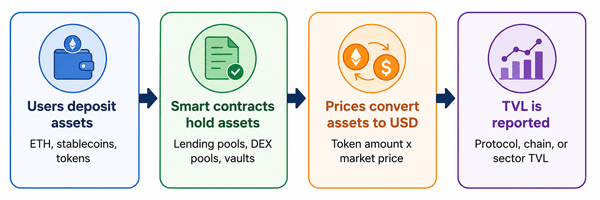
Diagram: A simplified view of how deposits become a reported TVL number. Actual TVL methods vary by data provider and protocol design.
3. What Does “Locked” Mean in Total Value Locked?
The word “locked” can be confusing. In many DeFi apps, funds are not locked forever. Users may be able to withdraw at any time, depending on the protocol rules, withdrawal queues, cooldown periods, liquidity, or smart contract conditions. In TVL, “locked” generally means assets are currently deposited in smart contracts or platform-controlled accounts and are being used by the protocol.
For example, a user may deposit ETH into a lending market, add ETH and USDC to a decentralized exchange liquidity pool, stake tokens in a vault, or bridge tokens to another network. While those assets remain in the protocol, their value may count toward TVL.
| DeFi activity | How assets may count toward TVL | Beginner example |
|---|---|---|
| Lending and borrowing | Supplied assets in lending pools may count as TVL. | A user deposits USDC so borrowers can borrow from the pool. |
| Decentralized exchange liquidity | Assets deposited into liquidity pools may count as TVL. | A user adds ETH and USDC to a trading pool. |
| Staking and restaking | Tokens deposited into staking-related contracts may count, depending on methodology. | A user stakes ETH or a liquid staking token. |
| Yield vaults | Deposits in automated strategy vaults may count. | A user deposits stablecoins into a yield optimizer. |
| Bridges | Assets locked or represented across chains may be tracked, but methods vary. | A user bridges tokens from Ethereum to another chain. |
4. How TVL Works
TVL combines two things: the quantity of assets deposited and the market price of those assets. If a protocol holds 1,000 ETH and ETH is priced at $3,000, that part of the protocol has $3 million in TVL. If ETH rises to $3,500 and no one deposits or withdraws, the TVL rises to $3.5 million simply because the asset price changed.
This is one of the most important beginner lessons: TVL is not the same as new money entering a protocol. It is a dollar-value estimate of assets currently deposited. TVL can change because of deposits, withdrawals, token price movements, reward programs, liquidations, hacks, bridge issues, or changes in the way data providers calculate the number.
| Reason TVL changes | What it means | What to check |
|---|---|---|
| More deposits | Users or institutions added funds. | Look at token balances, wallet inflows, active users, and incentives. |
| Withdrawals | Users removed funds from the protocol. | Check whether withdrawals are broad or linked to one whale, exploit, or reward ending. |
| Token price changes | The deposited assets became more or less valuable in dollar terms. | Compare TVL in native token terms and USD terms. |
| Incentive campaigns | Rewards attracted temporary liquidity. | Check whether TVL remains after rewards decline. |
| Methodology changes | The data provider changed what is counted. | Read notes from the protocol or analytics provider. |
5. How Is TVL Calculated?
A basic TVL calculation follows this formula:
TVL = Sum of each deposited asset amount x its current market price
Imagine a DeFi lending protocol holds the following deposits:
| Asset | Amount deposited | Market price | Value counted in TVL |
|---|---|---|---|
| ETH | 2,000 ETH | $3,000 | $6,000,000 |
| USDC | 4,000,000 USDC | $1 | $4,000,000 |
| WBTC | 100 WBTC | $60,000 | $6,000,000 |
| Total | $16,000,000 |
In this simplified example, the protocol TVL is $16 million. Real TVL calculations can be more complex because protocols may hold liquidity pool tokens, staked tokens, derivatives, bridged assets, reward tokens, or assets that are difficult to price. This is why different analytics platforms may show slightly different TVL numbers for the same project.
6. Example Chart: TVL Changes Over Time
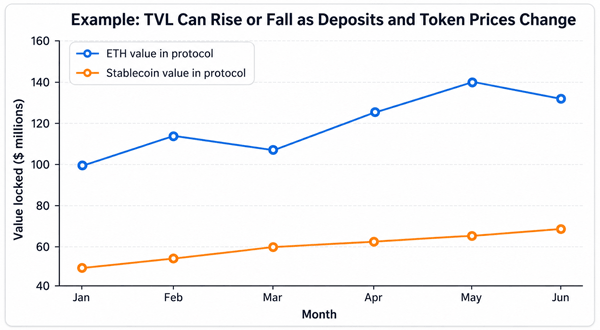
Chart: A simplified example showing how TVL can change over time. In real markets, both user deposits and token prices can move quickly.
7. Types of TVL You May See
| TVL type | Meaning | How beginners should use it |
|---|---|---|
| Protocol TVL | Value deposited in one DeFi protocol. | Useful for comparing similar apps, such as two lending platforms. |
| Chain TVL | Value deposited across DeFi protocols on one blockchain. | Useful for seeing DeFi activity on networks like Ethereum, Solana, Base, or Arbitrum. |
| Category TVL | Value deposited across a DeFi sector. | Useful for comparing lending, DEXs, liquid staking, derivatives, or bridges. |
| Pool TVL | Value deposited in one pool or vault. | Useful for checking liquidity and potential slippage in a specific strategy. |
| Adjusted TVL | A modified number that may remove double counting or certain token types. | Useful when standard TVL overstates real economic value. |
8. Why TVL Matters
TVL is popular because it gives a quick snapshot of how much value is being used inside a protocol or ecosystem. It is not perfect, but it can be helpful when understood correctly.
8.1 Liquidity
Higher TVL can mean deeper liquidity. In a decentralized exchange, deeper liquidity may reduce slippage for traders. In a lending protocol, more supplied assets may support more borrowing.
8.2 User confidence
Users are often more comfortable depositing into protocols where many others have already supplied funds. However, popularity should never replace security research.
8.3 Protocol traction
A rising TVL can indicate growing adoption, especially when it rises alongside active users, transaction volume, fees, and revenue.
8.4 Ecosystem comparison
Chain TVL helps users compare where DeFi activity is concentrated. This can be useful for developers, investors, and users choosing where to interact.
8.5 Risk monitoring
Sudden TVL drops can warn that users are withdrawing funds because of exploit concerns, poor yields, governance problems, or falling token prices.
9. Benefits of Using TVL
- Easy to understand: TVL turns many asset balances into one simple dollar-value figure.
- Useful for comparisons: TVL helps compare protocols, chains, pools, and DeFi sectors.
- Helpful liquidity signal: Higher TVL may support better trading, lending, and borrowing conditions.
- Trend indicator: TVL changes over time can show whether a protocol is gaining or losing deposits.
- Research starting point: TVL can help beginners decide which projects deserve deeper investigation.
10. Risks and Limitations of TVL
TVL is useful, but it is often misunderstood. Beginners should treat TVL as one metric, not a final verdict.
| Limitation | Why it matters | Better question to ask |
|---|---|---|
| TVL can rise because prices rise | A protocol may look healthier even if no new users deposited funds. | Is TVL rising in token amounts, not only in USD? |
| TVL does not prove safety | Hacked protocols have had large TVL before exploits. | Has the code been audited, battle-tested, and monitored? |
| TVL can be incentive-driven | Liquidity may leave when token rewards end. | Is usage organic or mostly reward farming? |
| TVL can be double-counted | The same economic value may appear in multiple protocols through LP tokens or derivatives. | Does the data provider adjust for double counting? |
| TVL ignores profitability | A protocol can hold large deposits while generating weak revenue. | What are fees, revenue, active users, and retention? |
| TVL may hide concentration risk | A few whales can dominate deposits. | Is TVL spread across many users or controlled by a few wallets? |
11. TVL Compared With Other Crypto Metrics
| Metric | What it measures | What it does not tell you |
|---|---|---|
| TVL | Value deposited into a protocol or ecosystem. | Profitability, safety, or real user count. |
| Market capitalization | Token price multiplied by circulating supply. | How much value users deposited into the protocol. |
| Trading volume | How much value was traded over a period. | How much liquidity remains deposited. |
| Fees | Amount users paid to use the protocol. | Whether deposits are sticky or safe. |
| Revenue | Fees captured by the protocol or token holders, depending on definition. | Whether TVL is organic or incentive-driven. |
| Active users | Number of wallets interacting with the protocol. | Whether those users are high quality or just farming rewards. |
12. What Is the TVL Ratio?
Some investors compare a project’s token market capitalization with its TVL. This is often called the market cap to TVL ratio. A simplified formula is:
Market cap to TVL ratio = Token market capitalization / TVL
For example, if a protocol token has a market cap of $200 million and the protocol has $100 million in TVL, the ratio is 2. A lower ratio may look cheaper, but it is not automatically better. Some protocols have high TVL but weak revenue, weak governance, high emissions, or major security risks. Others may have lower TVL but stronger usage and revenue quality. Use this ratio only as a starting point.
13. Practical Examples of TVL in DeFi
13.1 Example 1: Lending Protocol
A lending app lets users deposit USDC, ETH, and WBTC. Depositors earn interest, while borrowers pay interest. The assets supplied by depositors count toward TVL. If users withdraw because yields fall, TVL may drop. If token prices rise, TVL may rise even without new deposits.
13.2 Example 2: Decentralized Exchange
A decentralized exchange uses liquidity pools. If a pool contains $20 million of ETH and $20 million of USDC, that pool has $40 million in liquidity. This contributes to the exchange’s TVL. Higher pool TVL may reduce slippage, but traders should still check pool depth, trading volume, and impermanent loss risk.
13.3 Example 3: Yield Vault
A vault automatically moves deposited assets into strategies. Its TVL shows how much users have deposited into the vault. But a high vault TVL does not guarantee returns. Strategy risk, smart contract risk, leverage, liquidity, and reward sustainability still matter.
13.4 Example 4: Blockchain Ecosystem
A blockchain’s DeFi TVL is the combined value deposited into DeFi protocols on that chain. This can show ecosystem activity, but it should be compared with transaction fees, users, developer activity, bridge security, stablecoin liquidity, and application quality.
14. How Beginners Should Use TVL in Research
A practical way to use TVL is to treat it as the first filter, not the final decision. Here is a simple process:
- Check the current TVL and the 7-day, 30-day, and longer-term trend.
- Separate deposit growth from token price growth where possible.
- Compare TVL with active users, trading volume, fees, revenue, and token incentives.
- Read the protocol documentation to understand what assets are counted.
- Look for audits, bug bounty programs, incident history, admin keys, and risk disclosures.
- Check whether a few wallets dominate TVL.
- Ask whether users would still deposit if rewards were reduced.
- Avoid depositing money you cannot afford to lose, even in high-TVL protocols.
15. Common Beginner Mistakes
| Mistake | Why it is risky | Better approach |
|---|---|---|
| Assuming high TVL means safe | Large protocols can still have smart contract, oracle, governance, or bridge risks. | Use TVL with security checks and risk reviews. |
| Ignoring token price effects | USD TVL may rise because ETH or BTC went up. | Compare native asset balances and deposit flows. |
| Chasing the highest APY plus high TVL | High yields may be temporary or funded by inflationary rewards. | Check yield source and sustainability. |
| Comparing unrelated protocols | A DEX, bridge, and lending app use TVL differently. | Compare similar protocols in the same category. |
| Trusting one dashboard blindly | Data providers may use different methods. | Cross-check with protocol dashboards and multiple analytics sites. |
| Ignoring withdrawal conditions | Some systems have lockups, queues, or liquidity limits. | Read withdrawal rules before depositing. |
16. Best Practices for Reading TVL
- Use TVL trends, not just one number. A stable multi-month trend is more useful than a one-day spike.
- Compare like with like. Lending TVL should be compared with lending TVL, not with DEX or bridge TVL.
- Check TVL alongside revenue and fees. Deposits without real usage may be less meaningful.
- Watch for incentive cliffs. TVL can fall quickly when reward campaigns end.
- Look for adjusted metrics when available. Adjusted TVL may reduce double counting.
- Read risk documentation. Understand smart contract, oracle, liquidation, governance, and bridge risks.
- Start small. Test deposits and withdrawals before committing larger amounts.
- Keep records. Save transaction hashes and notes for tax, accounting, and risk management.
17. Where Can You Check TVL?
Common places to check TVL include DeFi analytics dashboards, protocol websites, blockchain explorers, and research platforms. DeFiLlama is widely used for protocol, chain, and category TVL; Token Terminal focuses on financial metrics such as TVL, fees, and revenue; CoinMarketCap and CoinGecko provide educational pages and market context. Because TVL methods can differ, serious users should compare more than one source when making important decisions.
18. Misconceptions About TVL
| Misconception | Reality |
|---|---|
| High TVL means the protocol is guaranteed safe. | TVL indicates deposits, not guaranteed security. |
| TVL always means assets are permanently locked. | Many deposits can be withdrawn, subject to protocol rules. |
| Rising TVL always means more users joined. | Rising token prices can increase USD TVL without new deposits. |
| The biggest TVL project is always the best investment. | Token value depends on revenue, supply, governance, emissions, risk, and market expectations. |
| TVL is useless because it is imperfect. | TVL is useful when combined with other metrics and proper context. |
19. Key Risks for Users Who Deposit Into High-TVL Protocols
TVL is often used by depositors to judge whether a protocol feels trustworthy. That is understandable, but deposits in DeFi still carry risks.
19.1 Smart contract risk
A bug in the protocol code can lead to loss of funds. Audits reduce risk but do not eliminate it.
19.2 Oracle risk
If a protocol relies on price feeds and those feeds fail or are manipulated, liquidations or incorrect accounting can occur.
19.3 Liquidity risk
A pool may have high TVL but still poor liquidity for the exact asset or trade size you need.
19.4 Governance risk
Admin keys, governance votes, or contract upgrades can change protocol behavior.
19.5 Bridge risk
Assets moved across chains may depend on bridge security. Bridge failures can affect wrapped assets and chain TVL.
19.6 Incentive and emissions risk
Reward tokens can lose value, reducing real returns and causing TVL to leave.
19.7 Regulatory and compliance risk
DeFi rules vary by jurisdiction and may change. Users should understand local laws and tax obligations.
20. TVL Research Checklist
- What exactly is included in the TVL calculation?
- Is TVL rising because of deposits or asset prices?
- How long has the protocol maintained meaningful TVL?
- Are rewards or incentives driving short-term deposits?
- Does the protocol generate real fees or revenue?
- How many users and wallets contribute to the TVL?
- Has the protocol been audited and has it suffered past incidents?
- Are admin keys, upgrade controls, or governance risks clearly explained?
- Can users withdraw normally during stress?
- Does the expected return justify the risk?
21. FAQs About TVL
21.1 What does TVL stand for?
TVL stands for Total Value Locked. It is the estimated value of assets deposited into a DeFi protocol, blockchain ecosystem, pool, or category.
21.2 Is TVL only used in DeFi?
TVL is most commonly used in DeFi, but similar ideas may appear in staking, bridges, real-world asset protocols, and other crypto systems where assets are deposited or committed.
21.3 Is higher TVL always better?
No. Higher TVL can suggest more liquidity and user confidence, but it does not prove safety, profitability, or long-term adoption.
21.4 Can TVL go up without new deposits?
Yes. If the market price of deposited assets rises, USD-denominated TVL can increase even if users do not add more tokens.
21.5 Can TVL be manipulated?
It can be distorted by incentives, circular deposits, double counting, wash-like behavior, or methodology choices. This is why TVL should be checked against other metrics.
21.6 What is a good TVL?
There is no universal good TVL. A small niche protocol may function well with modest TVL, while a large lending market may need deep liquidity. Compare TVL within the same category.
21.7 Does TVL show how much money a protocol earns?
No. TVL shows deposited value. Fees and revenue show economic activity and monetization. A protocol can have high TVL but low revenue.
21.8 Why do different websites show different TVL numbers?
They may count assets differently, use different price sources, update at different times, or treat derivatives, bridges, and LP tokens differently.
21.9 Should beginners invest based on TVL?
No. TVL can be a useful research signal, but investment decisions should also consider risk, revenue, token supply, security, team, governance, market conditions, and personal financial situation.
21.10 Is TVL the same as liquidity?
Not exactly. TVL is deposited value. Liquidity describes how easily assets can be traded, borrowed, or withdrawn without major price impact or delays.
22. Conclusion
TVL is one of the most useful beginner metrics in DeFi because it gives a quick estimate of how much value is deposited in a protocol, chain, pool, or category. It can help users understand liquidity, adoption, and market confidence. But TVL is not a safety rating, investment recommendation, or proof of sustainable growth.
The best way to use TVL is with context. Look at trends over time, understand what is counted, separate price effects from deposit growth, compare similar protocols, and combine TVL with active users, volume, fees, revenue, security history, and risk documentation. Used carefully, TVL can be a helpful starting point for DeFi research. Used alone, it can lead to false confidence.
Sources Consulted and Checked
These sources were consulted and checked while preparing this document to support clarity and accuracy.
- DeFiLlama Docs: Methodology: Explains how DeFiLlama considers tokens locked in protocol/platform contracts as TVL and notes token pricing methods.
- DeFiLlama: DeFi Dashboard and Chain Rankings: Tracks TVL, fees, revenue, volume, and yields across thousands of DeFi protocols and hundreds of chains.
- Chainlink: What Is Total Value Locked (TVL)?: Defines TVL as the total fiat value of cryptographic assets deposited into a DeFi protocol and explains its use as a liquidity and adoption metric.
- CoinMarketCap Academy: Total Value Locked (TVL) Definition: Defines TVL as the total value of digital assets deposited or locked in a DeFi protocol or ecosystem.
- Ethereum.org: What Is DeFi?: Provides beginner context for decentralized finance and smart-contract-based financial services.
- Bank for International Settlements Working Paper: Towards verifiability of TVL in DeFi: Discusses TVL data quality, methodology transparency, and the importance of verifiable calculations.
- Token Terminal: TVL Metric: Describes TVL as the value of a project’s on-chain deposits and/or tokenized value of off-chain user deposits.
Reader Advice
This article is provided for educational and informational purposes only and is not personalized financial, investment, legal, tax, or professional advice or a recommendation to use any protocol or asset. Crypto and DeFi involve significant risks, including market volatility, smart contract failures, hacking, liquidity constraints, bridge failures, regulatory changes, and possible loss of funds. Rules, policies, laws, tax requirements, platform terms, and statistics can change over time and vary by region, so readers should verify important information through current official sources and consider qualified professional advice before making decisions. Use independent research, assess your circumstances and risk tolerance, and never commit funds you cannot afford to lose.