Token Unlock Calendars: Complete Guide, Examples, Risks and Best Practices
A token unlock calendar is a schedule that shows when locked crypto tokens become available to their recipients, such as founders, team members, early investors, advisors, ecosystem funds, or the community. These unlocks matter because they can increase circulating supply, change market expectations, and sometimes create selling pressure. A calendar is useful, but it should never be used alone. Always compare unlock size with liquidity, market cap, trading volume, holder behavior, project progress, and broader market conditions.
1. What Is a Token Unlock Calendar?
A token unlock calendar is a tracker that lists upcoming token unlock events for crypto projects. It usually shows the project name, token symbol, unlock date, number of tokens being released, estimated dollar value, percentage of supply being unlocked, and the allocation category receiving the tokens.
In simple terms, it answers one important question: when will previously locked tokens become available to move, sell, stake, use, or distribute?
Most crypto projects do not release their full token supply on day one. Some tokens may be available at launch, while others are locked and released over months or years. This release plan is called a vesting schedule. A token unlock calendar turns that schedule into an easy-to-read timeline.
1.1 Beginner example
Imagine a project creates 1 billion tokens. At launch, only 150 million tokens are circulating. The rest are locked for investors, founders, ecosystem grants, the treasury, and future rewards. If 50 million more tokens unlock next month, the market needs to absorb extra supply. That does not automatically mean the price will fall, but it is a supply event worth watching.
2. Why Token Unlocks Matter
Token unlocks matter because crypto prices are affected by supply and demand. When new tokens become transferable, recipients may hold them, use them, stake them, provide liquidity, distribute them, or sell them. The market often reacts before the unlock date because traders can see the event coming.
- They can increase circulating supply and dilute existing holders.
- They can create short-term volatility around major unlock dates.
- They reveal how much of a token supply is still controlled by insiders, investors, or the project treasury.
- They help investors compare current market cap with fully diluted valuation.
- They show whether a project has long-term alignment or heavy near-term supply pressure.
A token unlock calendar is not a price prediction tool. It is a risk-awareness tool. It helps you ask better questions before buying, holding, or selling a token.
3. Key Terms You Need to Know
| Term | Simple meaning | Why it matters |
|---|---|---|
| Locked tokens | Tokens that cannot yet be freely transferred or sold. | They may enter circulation later and affect supply. |
| Unlock | The moment locked tokens become available. | Large unlocks can change market expectations. |
| Vesting schedule | A planned timeline for releasing tokens over time. | Shows whether supply release is gradual or sudden. |
| Cliff | A waiting period before any tokens unlock. | A big first unlock after a cliff can be risky. |
| Linear vesting | Tokens unlock gradually at a steady rate. | Usually smoother than a large one-time release. |
| TGE | Token Generation Event, when the token is first created or launched. | Many vesting schedules start from this date. |
| Circulating supply | Tokens currently available in the market. | Used to calculate market cap. |
| Total supply | All tokens that exist or will exist, depending on token design. | Helps estimate future dilution. |
| FDV | Fully Diluted Valuation: price multiplied by total supply. | Shows valuation if all tokens were unlocked. |
4. How Token Unlock Calendars Work
A token unlock calendar collects vesting information from project documents, tokenomics pages, smart contracts, dashboards, exchange data, community updates, and third-party tracking platforms. It then organizes the data by date and category.
- The project creates a token allocation plan, often split between public sale, private investors, team, advisors, treasury, ecosystem, liquidity, and community rewards.
- Some allocations are immediately unlocked, while others are locked for a fixed period.
- The vesting schedule defines when each locked allocation becomes available.
- Calendars convert this schedule into upcoming events so users can track supply changes.
- Investors compare each unlock with price, volume, market cap, FDV, sentiment, and project fundamentals.
4.1 Simple token unlock flow
Token launch → Initial circulating supply → Cliff or lockup period → Scheduled unlocks → More tokens enter circulation → Market absorbs, holds, or sells the new supply
5. What Information Should a Good Unlock Calendar Show?
| Data point | What to check | Practical question |
|---|---|---|
| Unlock date | Exact day or range of the release. | Is there a major event soon? |
| Unlock amount | Number of tokens being released. | How many tokens are entering circulation? |
| Dollar value | Estimated value at current price. | Is the unlock large in market terms? |
| Percent of circulating supply | Unlock size compared with current tradable supply. | Is this a meaningful dilution event? |
| Percent of total supply | Unlock size compared with all tokens. | How much of the long-term supply is being released? |
| Allocation category | Team, investors, advisors, ecosystem, treasury, or rewards. | Who receives the tokens and what might they do? |
| Vesting type | Cliff, linear, monthly, quarterly, milestone-based. | Is supply released suddenly or gradually? |
| Remaining locked supply | Tokens still waiting to unlock. | How much future dilution remains? |
6. Types of Token Unlocks
6.1 Cliff unlocks
A cliff unlock happens after a fixed waiting period. For example, early investors may receive no tokens for 12 months, then a large portion unlocks at once. Cliff unlocks can be important because the first release may be large compared with circulating supply.
6.2 Linear unlocks
Linear unlocks release tokens steadily over time, such as daily or monthly over two years. This can reduce sudden supply shocks, although steady emissions can still pressure price if demand is weak.
6.3 Stepped unlocks
Stepped unlocks release tokens at fixed intervals, such as 5% every quarter. They are easier to track than continuous vesting but can still create volatility around each release date.
6.4 Milestone-based unlocks
Some tokens unlock when the project reaches a milestone, such as a mainnet launch, revenue target, governance approval, or ecosystem deployment. These can be harder to forecast because timing depends on execution.
6.5 One-time unlocks
A one-time unlock releases a defined amount on a single date. It may involve investor tokens, team tokens, a treasury transfer, a foundation allocation, or tokens reserved for market-making or liquidity.
7. Token Unlocks vs Vesting vs Emissions
| Concept | Meaning | Example | Main risk |
|---|---|---|---|
| Token unlock | Previously locked tokens become available. | Investor allocation unlocks on a set date. | Recipients may sell or move tokens. |
| Vesting | The broader release schedule for locked tokens. | Team tokens unlock monthly for four years. | Long-term dilution if demand does not grow. |
| Emissions | New or distributed tokens released as rewards. | Staking, mining, validator, or liquidity rewards. | Ongoing inflation and sell pressure. |
| Circulating supply update | Reported supply changes on data platforms. | A dashboard updates supply after an unlock. | Reported data may lag or differ by source. |
8. How Token Unlocks Can Affect Price
Token unlocks can affect price through expectations, actual selling, liquidity conditions, and investor psychology. The effect is not automatic. Some unlocks lead to sharp drops, some are already priced in, and some have little visible impact. The result depends on the size of the unlock and the behavior of recipients.
8.1 Possible price effects
- Pre-unlock weakness: Traders may sell before a known unlock because they expect extra supply.
- Post-unlock selling: Recipients may sell part of their unlocked tokens, especially if they bought early at a lower price.
- No major reaction: The unlock may be small, expected, or absorbed by strong demand.
- Relief rally: If the market expected heavy selling and it does not happen, price may recover after the event.
- Long-term dilution: Even without a sharp drop, repeated unlocks can limit upside if demand does not grow.
8.2 What matters more than the headline number
The headline dollar value of an unlock can be misleading. A $100 million unlock is very different for a token with deep liquidity and billions in daily volume compared with a thinly traded token with weak demand. Always compare unlock size with circulating supply, daily volume, market depth, market cap, FDV, and the category receiving the tokens.
9. Practical Examples
9.1 Example 1: Small unlock with low risk
A token has a circulating supply of 500 million tokens. Next week, 2 million tokens unlock for ecosystem grants. That is 0.4% of circulating supply. If trading volume is healthy and the grants are distributed slowly, the market impact may be limited. The unlock is still worth noting, but it may not be a major risk by itself.
9.2 Example 2: Large investor cliff
A token has 100 million tokens circulating. In 10 days, 25 million investor tokens unlock after a one-year cliff. That equals 25% of the current circulating supply. If early investors bought at a much lower price, some may take profits. This is a higher-risk event, especially if market liquidity is weak.
9.3 Example 3: Linear team vesting
A team allocation unlocks gradually over 36 months. Instead of one sudden release, tokens become available every month. This can be healthier than a large cliff, but it still adds steady supply. Investors should check whether the project is growing fast enough to absorb that supply.
9.4 Example 4: Unlock already expected by the market
A major unlock has been visible on calendars for months. Traders discuss it widely, and the token price falls before the unlock. When the actual date arrives, there is no extra selling shock. In this case, the event may have been partly priced in. This is why unlock calendars are useful, but not sufficient for trading decisions.
10. How to Read a Token Unlock Calendar Step by Step
- Find the next unlock date for the token you are researching.
- Check how many tokens will unlock and what dollar value that represents.
- Compare the unlock with circulating supply, not just total supply.
- Identify who receives the tokens: team, investors, advisors, treasury, ecosystem, or public rewards.
- Look at the vesting type. A cliff release is usually more sensitive than gradual linear vesting.
- Compare unlock value with 24-hour and 30-day trading volume.
- Check market depth and liquidity. Thin markets are more vulnerable to supply shocks.
- Review the project roadmap, news, revenue, user growth, governance, and developer activity.
- Look for wallet movements after the unlock, but avoid assuming every transfer is a sale.
- Make a decision based on the full picture, not one calendar entry.
11. A Simple Unlock Risk Checklist
| Question | Lower-risk sign | Higher-risk sign |
|---|---|---|
| How large is the unlock? | Small percentage of circulating supply. | Large percentage of circulating supply. |
| Who receives the tokens? | Community incentives or long-term ecosystem programs. | Early investors, advisors, or team after a profitable cliff. |
| How liquid is the market? | High volume and deep order books. | Low volume and shallow liquidity. |
| Is demand growing? | Usage, revenue, users, integrations, or strong narrative. | Weak activity and fading attention. |
| Is FDV reasonable? | Market cap and FDV are not extremely far apart. | FDV is much higher than current market cap. |
| Is unlock data reliable? | Data matches project docs and multiple trackers. | Sources disagree or project documents are unclear. |
| Is the event priced in? | Market has known about it for months. | Event is sudden, poorly communicated, or misunderstood. |
12. Benefits of Using Token Unlock Calendars
- Better risk management: You can avoid being surprised by major supply events.
- Improved research: Unlock calendars help you understand tokenomics beyond price charts.
- Smarter timing: You can decide whether to wait, reduce exposure, or monitor liquidity before a large unlock.
- More realistic valuation: Comparing market cap with FDV helps reveal future dilution.
- Better project comparison: Two tokens with similar prices may have very different future supply schedules.
- Early warning: Calendars can highlight periods when volatility may increase.
13. Risks and Limitations of Token Unlock Calendars
13.1 Unlock data can be incomplete or wrong
Some projects publish clear vesting schedules. Others change schedules, use vague tokenomics charts, or provide limited transparency. Third-party calendars may interpret data differently. Always cross-check important unlocks with project documents and multiple trackers.
13.2 An unlock does not equal an immediate sale
Unlocked tokens become available, but recipients may not sell. They may stake, hold, transfer to custody, provide liquidity, use tokens for operations, or distribute them over time. Treat unlocks as potential supply pressure, not guaranteed selling.
13.3 Market reaction can happen before the unlock
Because unlock dates are public, traders may act in advance. By the time the unlock happens, part of the risk may already be reflected in price.
13.4 Liquidity matters
A large unlock in a deep market may be absorbed. A smaller unlock in a thin market may have a larger impact. Always look at trading volume, order-book depth, and exchange availability.
13.5 Calendars do not measure fundamentals
A project with strong adoption may absorb new supply better than a project with weak usage. Unlock data should be combined with fundamental research.
14. Common Mistakes Beginners Make
- Looking only at the unlock dollar value without comparing it to circulating supply.
- Assuming every unlock causes a price crash.
- Ignoring repeated monthly emissions because each one looks small.
- Using only one data source without checking the project’s own tokenomics documents.
- Confusing total supply, circulating supply, and fully diluted valuation.
- Buying a token because the chart looks strong while ignoring a major unlock next week.
- Panic-selling after an unlock without checking whether tokens actually moved to exchanges.
- Treating ecosystem or treasury unlocks the same as early investor unlocks.
15. Best Practices for Investors and Researchers
15.1 Before buying a token
- Check the next 30, 60, and 90 days of unlocks.
- Compare current market cap with FDV.
- Check how much supply is already unlocked versus still locked.
- Review which groups receive future unlocks.
- Avoid relying only on social media summaries.
15.2 Before a major unlock
- Watch volume, liquidity, funding rates, and market sentiment.
- Look for official announcements about delayed, extended, or changed vesting terms.
- Check whether large recipient wallets move tokens to exchanges.
- Reduce position size if the unlock risk is too high for your strategy.
- Avoid over-leveraged trades around known supply events.
15.3 After an unlock
- Check whether the unlocked tokens entered circulation or remained idle.
- Watch for exchange deposits, large transfers, or treasury movements.
- Compare price reaction with volume. A small price move on high volume can mean the market absorbed supply.
- Update your thesis instead of reacting emotionally.
16. Where to Find Token Unlock Calendars
Common places to research token unlocks include dedicated unlock trackers, crypto market data platforms, exchange research pages, project tokenomics documents, whitepapers, governance forums, official blogs, and blockchain explorers. For important decisions, do not depend on one tracker alone.
| Source type | Useful for | Caution |
|---|---|---|
| Dedicated unlock trackers | Upcoming unlock dates, amounts, categories, and vesting schedules. | Data may depend on project disclosures and estimates. |
| Market data platforms | Market cap, FDV, supply metrics, price, and volume. | Circulating supply may differ across platforms. |
| Project documents | Original allocation and vesting details. | Older docs may be outdated after governance changes. |
| Governance forums | Schedule changes, treasury decisions, grant releases. | Discussions may not be final decisions. |
| Blockchain explorers | Wallet movements after unlocks. | Transfers do not always mean sales. |
17. How to Build Your Own Simple Token Unlock Tracker
For a small portfolio, you can create a simple spreadsheet. You do not need a complicated model at the beginning. The goal is to avoid surprises and compare risks across tokens.
| Column | Example entry | Why it helps |
|---|---|---|
| Token | ABC | Keeps your watchlist organized. |
| Next unlock date | 15 August 2026 | Shows when to pay attention. |
| Unlock amount | 20,000,000 ABC | Shows token quantity. |
| Unlock value | $8,000,000 | Shows approximate market value. |
| % of circulating supply | 6.5% | Measures dilution risk. |
| Recipient category | Private investors | Helps estimate incentive to sell. |
| Vesting type | 12-month cliff, then monthly | Explains release pattern. |
| Liquidity note | Average daily volume $25 million | Helps judge whether supply can be absorbed. |
| Action | Monitor, no new buy before event | Turns data into a plan. |
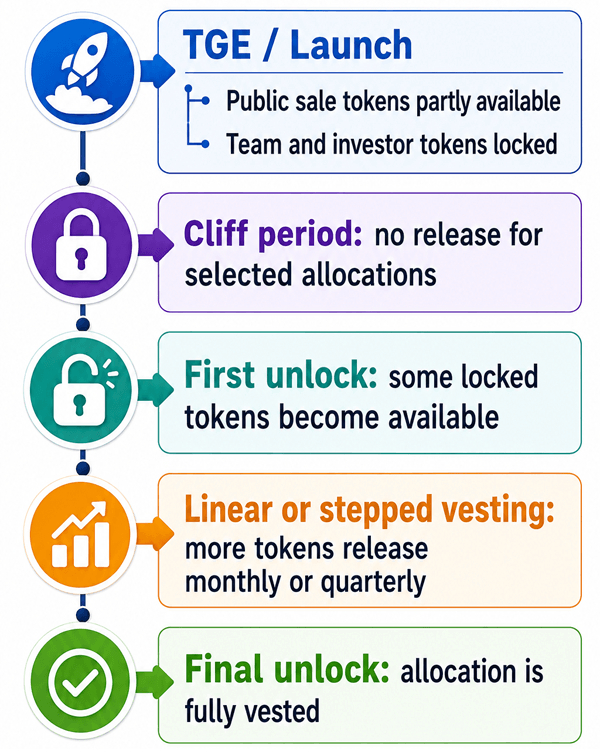
18. Token Unlock Calendar Diagram
The diagram below shows how a typical vesting timeline works:
 <
<
19. Token Unlock Calendar vs Tokenomics Review
| Question | Unlock calendar answers | Full tokenomics review answers |
|---|---|---|
| When are tokens released? | Yes. | Yes, with deeper context. |
| Who receives tokens? | Usually. | Yes, including incentives and governance rights. |
| Will price fall? | No. It only shows supply events. | Still uncertain, but provides better context. |
| Is valuation reasonable? | Partly, through market cap and FDV. | Better, by combining supply, demand, revenue, users, and utility. |
| Is the project healthy? | No. | Requires fundamentals, security, adoption, and team research. |
20. Red Flags to Watch
- A very low circulating supply with a very high FDV.
- Large private investor unlocks soon after listing.
- Vague or missing vesting information.
- Frequent changes to unlock schedules without clear communication.
- A large team or advisor allocation with short vesting.
- Thin liquidity before a large unlock.
- Heavy marketing before insider unlocks.
- Repeated token emissions with weak user demand.
21. Green Flags to Watch
- Transparent tokenomics documents with clear allocation categories.
- Longer vesting for founders, teams, and early investors.
- Gradual linear vesting instead of sudden large cliffs.
- Reasonable circulating supply at launch.
- Strong liquidity and broad exchange access.
- Clear treasury reporting and governance oversight.
- Evidence that new supply supports ecosystem growth rather than only insider exits.
- Project growth that can realistically absorb future supply.
22. FAQs About Token Unlock Calendars
22.1 What is a token unlock calendar?
It is a schedule that shows when locked crypto tokens will become available. It usually includes unlock date, amount, value, allocation category, and vesting type.
22.2 Are token unlocks bad?
Not always. Unlocks are a normal part of many tokenomics plans. They become risky when the amount is large, recipients have strong reasons to sell, liquidity is weak, or demand is not growing.
22.3 Do token unlocks always make price go down?
No. Some unlocks cause selling pressure, but others are already priced in or absorbed by demand. Price reaction depends on market conditions, liquidity, expectations, and recipient behavior.
22.4 What is a cliff unlock?
A cliff unlock happens after a waiting period during which no tokens are released. When the cliff ends, a chunk of tokens unlocks at once.
22.5 What is linear vesting?
Linear vesting releases tokens gradually over time, such as daily or monthly. It can reduce sudden supply shocks, although it still adds supply over time.
22.6 What is the difference between market cap and FDV?
Market cap uses circulating supply. FDV uses total supply. A large gap between market cap and FDV can indicate significant future dilution.
22.7 Who usually receives unlocked tokens?
Common recipients include founders, team members, advisors, early investors, ecosystem funds, treasuries, liquidity providers, and community reward programs.
22.8 How far ahead should I check unlock calendars?
For active investing, check at least the next 30 to 90 days. For long-term holding, review the full vesting schedule and remaining locked supply.
22.9 Can projects change unlock schedules?
Yes, depending on governance, contracts, legal agreements, and project decisions. Always check official announcements and governance updates.
22.10 Is an exchange deposit after an unlock always bearish?
Not always, but it can be a warning sign. Tokens may be moved for market-making, custody, liquidity, or sale. Context matters.
23. Final Takeaway
Token unlock calendars are one of the most practical tools for understanding crypto supply risk. They help beginners see when locked tokens may enter circulation, who receives them, and how much future dilution may still exist. The most important lesson is simple: do not look at price alone. A token can look cheap on a chart while carrying heavy future unlock pressure.
At the same time, do not treat every unlock as a guaranteed crash. A good investor studies unlock size, recipient incentives, liquidity, FDV, market sentiment, wallet movements, and project fundamentals together. Used correctly, a token unlock calendar is not a crystal ball. It is a research map that helps you avoid surprises and make more informed decisions.
Reader Advice
This article is provided for educational and informational purposes only and is not personalized financial, investment, legal, tax, or other professional advice or a recommendation to buy, sell, or hold any crypto asset. Token unlock data, project rules, platform policies, laws, regulations, prices, and statistics can change over time and may vary by country or region, so verify important details through current official project documents, governance notices, blockchain records, and applicable authorities before making a decision. Crypto assets can be highly volatile and may involve liquidity, dilution, technology, regulatory, and loss-of-capital risks. Consider your circumstances, conduct independent research, and seek advice from a qualified professional where appropriate.
Sources Consulted and Checked
These sources were consulted and checked while preparing this article to support clarity and accuracy.
- Binance Academy - What Is Tokenomics and Why Does It Matter?
- CoinMarketCap - Token Unlocks and Vesting Schedules
- CoinGecko - Token Unlocks & Vesting Schedules
- Tokenomist / TokenUnlocks - Vesting Schedules & Release Data
- CryptoRank - Token Unlocks and Vesting FAQ
- CoinTracker - Vesting Period in Crypto