What Is a SPAC? How Special Purpose Acquisition Companies Work
1. Quick answer: What is a SPAC?
A SPAC, short for special purpose acquisition company, is a publicly traded shell company created to raise money first and find a business to buy later. People often call it a blank-check company because investors put money into the SPAC before knowing exactly which private company it will merge with.
The simple version is this: a sponsor forms a SPAC, the SPAC raises cash in an IPO, the money is placed in a trust account, and the sponsor then searches for a private company to merge with. If the merger closes, the private company effectively becomes a public company. That final merger is called a de-SPAC transaction.
2. Key takeaways
- A SPAC is not an operating business at first; it is a deal vehicle.
- Investors usually buy units at the IPO stage, often including a common share plus a fraction of a warrant.
- The IPO cash is generally held in a trust account until a merger, redemption, or liquidation.
- Shareholders usually get a vote and a redemption right before the merger closes.
- The biggest beginner mistake is treating every SPAC like a normal stock before understanding dilution, sponsor incentives, and post-merger business quality.
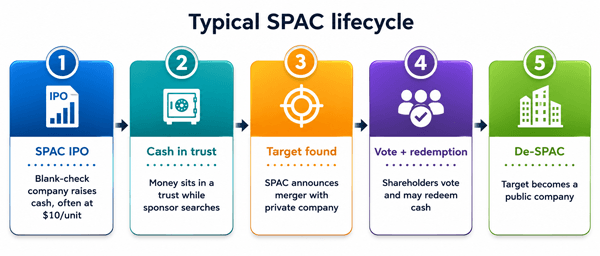
Figure 1: Original diagram showing the typical SPAC lifecycle from IPO to de-SPAC merger.
3. How a SPAC works step by step
3.1 The sponsor creates the SPAC
A sponsor is the person, investment firm, private equity group, venture investor, or executive team that forms the SPAC. The sponsor usually has a target sector in mind, such as fintech, healthcare, artificial intelligence, energy transition, defense technology, or consumer brands, but it normally does not identify a specific target company at the IPO stage.
3.2 The SPAC raises money in an IPO
The SPAC sells units to public investors. A unit commonly includes one common share and a portion of a warrant. Warrants can give investors the right to buy additional shares later at a fixed exercise price, usually after a merger. The exact terms vary and must be checked in the prospectus.
3.3 IPO proceeds go into a trust account
Most of the IPO money is placed in a trust account. This is one reason pre-merger SPACs can feel safer than ordinary speculative stocks, but safer does not mean risk-free. The market price can move above or below trust value, and warrants can be volatile.
3.4 The sponsor searches for a target
The sponsor usually has a limited period, often around 18 to 24 months, to announce and complete a business combination. If no deal is completed in time, the SPAC normally liquidates and returns trust cash to shareholders, subject to the specific terms in the SPAC documents.
3.5 The SPAC announces a merger
When a target is found, the SPAC announces a proposed merger. The announcement often includes a company presentation, valuation, revenue forecasts, risk factors, PIPE financing if any, and a timeline. This is where hype often enters the story, so investors should slow down and read the filing instead of relying on headlines.
3.6 Shareholders vote and choose whether to redeem
Before the merger closes, shareholders generally decide whether to vote for the deal and whether to redeem their shares for their portion of trust cash. In many SPACs, redemption is economically separate from the vote, meaning an investor may be able to vote and still redeem, depending on the terms.
3.7 The de-SPAC transaction closes
If approved and completed, the target becomes a publicly traded operating company. The SPAC ticker often changes to the new company ticker. At that point, investors no longer own a mostly cash-backed SPAC; they own a public company with business, valuation, execution, and market risks.
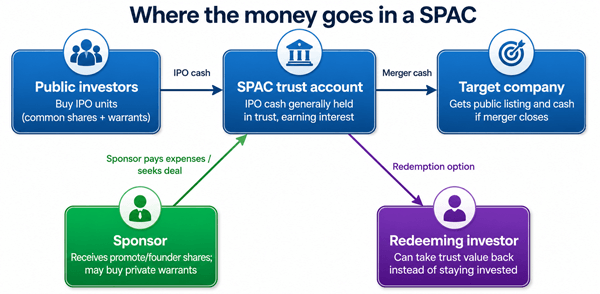
Figure 2: Original diagram showing simplified SPAC money flows.
4. A simple SPAC example for beginners
Imagine a SPAC called Clean Future Acquisition Corp. It raises $200 million by selling 20 million units at $10 each. The sponsor says it wants to acquire a clean energy software business, but it has not selected one yet.
| Stage | What happens | What a beginner should notice |
|---|---|---|
| IPO | Investors buy units at $10. Each unit includes one share and one-third of a warrant. | Read the prospectus. A warrant is not the same as a share. |
| Trust period | The $200 million is placed in trust while the sponsor searches for a target. | Trust value can provide downside support for shares near $10, but not for warrants. |
| Deal announcement | The SPAC agrees to merge with SolarGrid Analytics at a $900 million valuation. | Ask whether the valuation is reasonable compared with revenue, margins, competitors, and growth. |
| Redemption window | Shareholders can redeem shares for about trust value plus interest, or stay invested. | Redemption is a powerful investor protection, but missing the deadline can be costly. |
| After merger | Ticker changes. SolarGrid becomes public. Shares trade based on business performance. | Now it behaves more like a normal growth stock, with full downside risk. |
5. SPAC vs IPO vs direct listing: beginner comparison
| Feature | SPAC | Traditional IPO | Direct listing |
|---|---|---|---|
| Main idea | A public shell company merges with a private business. | A private company sells new shares to public investors through underwriters. | Existing shareholders sell shares directly on an exchange; often no new capital is raised. |
| Speed and certainty | Can be faster and negotiated with one SPAC sponsor, but still needs filings and shareholder approval. | Can be slower and more market-dependent. | Can be efficient for well-known companies with enough investor demand. |
| Price discovery | Negotiated merger valuation, often supported by PIPE investors. | Book-building process led by investment banks. | Opening auction and market demand drive pricing. |
| Investor risk | Dilution, sponsor promote, redemptions, warrants, forecast risk, target quality. | IPO pricing risk, lockup expiration, limited history as a public company. | Volatility and limited new capital for growth. |
| Best suited for | Companies that want a negotiated public-market path and can handle public-company obligations. | Companies ready for broad institutional marketing and public scrutiny. | Companies with strong brand recognition and existing shareholder liquidity needs. |
6. Important SPAC terms explained in plain English
| Term | Easy meaning |
|---|---|
| Blank-check company | A company with no operating business that raises money to acquire or merge with another company later. |
| Sponsor | The team or firm that creates the SPAC, searches for a target, negotiates the deal, and usually receives founder shares or other economics. |
| Unit | The IPO security investors buy. It often includes one common share plus a fraction of a warrant. |
| Warrant | A contract that may allow the holder to buy stock later at a fixed price. Warrants can be valuable but are usually much riskier than shares. |
| Trust account | The account where IPO proceeds are generally held until a merger, redemption, or liquidation. |
| Redemption right | The right to get back roughly your share of trust cash before the merger closes, subject to deadlines and terms. |
| PIPE financing | Private investment in public equity. Institutional investors may agree to buy shares alongside the SPAC deal to add cash or credibility. |
| De-SPAC | The merger or business combination that turns the target private company into a public company. |
| Sponsor promote | Founder-share economics that can reward the sponsor if a deal closes. It can create conflicts if the sponsor benefits from completing a deal even when public investors do not. |
| Liquidation | If no deal is completed by the deadline, the SPAC typically winds down and returns trust cash to shareholders. |
7. What beginners should know before buying a SPAC
A SPAC can look simple because many trade around $10 before a merger. The reality is more nuanced. The risk profile changes dramatically depending on where the SPAC is in its life cycle.
| SPAC stage | Risk level | Main question to ask |
|---|---|---|
| Pre-deal SPAC trading near trust value | Lower business risk, but not risk-free | Am I buying near trust value, and do I understand the deadline and redemption process? |
| Pre-deal SPAC trading far above trust value | Speculative | What justifies paying a premium for an unknown future deal? |
| Deal announced, before vote | Medium to high | Is the target business good enough to own after redemptions, dilution, and warrants? |
| Post-merger de-SPAC company | High business and market risk | Would I buy this company if it had gone public through a normal IPO? |
Practical investor rule
Do not evaluate a SPAC only by the sponsor name, celebrity involvement, or headline sector. Evaluate the actual economics: trust value, redemption deadline, dilution, target financials, valuation, cash remaining after redemptions, and whether the merged company has a credible path to profitability.
8. Why companies use SPACs
A private company may consider a SPAC because it wants a negotiated route to the public market. For some companies, especially those in emerging industries, a SPAC can provide capital, visibility, and a public listing faster than a traditional IPO. But the benefit depends heavily on market conditions, sponsor quality, redemption levels, and the target company’s readiness to operate as a public company.
| Potential benefit | Reality check |
|---|---|
| Faster path to public markets | Faster does not mean easier. The company still needs audited financials, disclosure controls, investor relations, and public-company governance. |
| Negotiated valuation | A negotiated valuation can be too high. Overvaluation is one reason many de-SPAC stocks later disappoint. |
| Access to capital | High redemptions can sharply reduce the cash delivered to the target. PIPE financing may be needed. |
| Experienced sponsor support | Sponsor reputation helps, but investors should verify operational experience and prior deal outcomes. |
| Marketing story | A compelling growth story is useful, but projections must be realistic and supported by evidence. |
9. Main risks of SPAC investing
| Risk | What it means in real life |
|---|---|
| Dilution risk | Public shareholders may be diluted by sponsor founder shares, warrants, PIPE shares, transaction fees, and earnouts. A company that sounds cheap at announcement may be less attractive after fully diluted share count is considered. |
| Sponsor incentive conflict | Sponsors may lose their upfront investment if no deal closes, but may profit if a deal closes. This can create pressure to complete a deal even when the target is not ideal. |
| Redemption and cash risk | If many shareholders redeem, the target may receive much less cash than expected. This can weaken the post-merger company unless replacement financing is found. |
| Forecast risk | SPAC deals often highlight future projections. Beginners should treat aggressive multi-year revenue forecasts as assumptions, not promises. |
| Post-merger execution risk | After the de-SPAC, the company must perform like any public company. Many early-stage companies face losses, product delays, customer concentration, or funding needs. |
| Liquidity and volatility risk | Warrants and small de-SPAC stocks can be volatile. Prices can move sharply around deal votes, ticker changes, lockup expirations, and earnings reports. |
| Regulatory and disclosure risk | The SEC adopted enhanced SPAC and de-SPAC disclosure rules in 2024 to improve investor protection and align disclosures more closely with traditional IPOs. |
10. How to analyze a SPAC like an investment analyst
Use this practical checklist before buying a SPAC share, warrant, or post-merger de-SPAC stock.
| Checklist item | Actionable question |
|---|---|
| Trust value | Find the approximate cash-per-share in trust. Avoid paying a large premium unless you have a strong, researched reason. |
| Deadline | Know when the SPAC must complete a deal or liquidate. Extensions can change economics. |
| Redemption mechanics | Read the proxy or tender offer documents. Put the redemption deadline on your calendar if you own shares. |
| Sponsor track record | Look at prior SPAC outcomes, not just resumes. Did past de-SPACs create shareholder value? |
| Target quality | Study revenue, margins, customers, debt, competition, management, and cash burn. |
| Valuation | Compare enterprise value to sales, EBITDA, free cash flow, and public peers. Avoid relying only on management’s forecast year. |
| Dilution | Include founder shares, warrants, earnouts, PIPE shares, and transaction fees in your mental model. |
| Cash after redemptions | Ask how much cash the company will actually receive if redemptions are high. |
| Lockups | Check when insiders, sponsors, and PIPE investors can sell. |
| SEC filings | Read the S-1, proxy/S-4/F-4, 8-Ks, risk factors, audited financials, and redemption instructions. |
11. Shareholders, warrants, and redemption rights
Beginners often confuse SPAC shares with SPAC warrants. They are different securities with different risk profiles.
| Security | What you own | Typical beginner mistake |
|---|---|---|
| Common share | A share of the SPAC or post-merger public company. Pre-merger, it may be backed by trust value and may have redemption rights. | Assuming the share is always protected by $10. The protection depends on timing, terms, and whether you redeem correctly. |
| Warrant | A right to buy shares later at a set price if conditions are met. | Assuming warrants have the same downside protection as shares. They usually do not. |
| Unit | A package sold in the SPAC IPO, often share plus warrant fraction. Units later split into shares and warrants. | Not knowing when or how units split, or what fraction of a warrant is included. |
11.1 A practical redemption example
Suppose you bought 100 SPAC shares at $10.20. Before the merger vote, the trust value is about $10.35 per share. If you redeem correctly, you may receive about $1,035 for your shares, subject to the exact trust value and procedures. If you do not redeem and the merger closes, your shares become shares of the new public company. If the stock later falls to $6, you bear that loss. The key lesson is simple: redemption rights can be useful only if you understand and act before the deadline.
12. What happened to the SPAC market?
SPACs became extremely popular in 2020 and 2021, then cooled sharply as interest rates rose, speculative growth stocks sold off, redemptions increased, and many de-SPAC companies underperformed. More recently, the market has shown signs of selective recovery, but it remains very different from the 2021 boom.
| Period | Market character | Investor lesson |
|---|---|---|
| 2020-2021 boom | High issuance, strong risk appetite, celebrity sponsors, aggressive growth stories. | Easy money can hide weak structures and unrealistic projections. |
| 2022-2023 downturn | Fewer deals, higher redemptions, many liquidations, poor post-merger performance. | Trust value and redemption rights mattered more than hype. |
| 2024-2026 selective rebound | More focus on experienced sponsors, better alignment, stronger disclosure, and higher-quality targets. | The structure can still work, but only careful deal selection matters. |
13. Good SPAC vs bad SPAC: signs to look for
| Better signs | Warning signs |
|---|---|
| Experienced sponsor with relevant operating or deal experience | Celebrity sponsor with little relevant industry or public-company experience |
| Reasonable valuation compared with public peers | Valuation based mainly on far-future revenue projections |
| Clear use of cash and enough capital after redemptions | Deal depends on perfect assumptions or large uncertain financing |
| Strong target governance, audited numbers, and transparent risk factors | Complex structure, vague disclosures, or promotional language |
| Sponsor economics tied to long-term performance | Sponsor can do well even if public shareholders do poorly |
| Target already has revenue, customers, and financial controls | Pre-revenue story with large capital needs and weak evidence |
14. Can beginners use SPACs in an investment strategy?
A beginner can study SPACs, but should be cautious about using them as a major portfolio strategy. SPACs sit at the intersection of IPO investing, merger arbitrage, private equity-style dealmaking, and speculative growth-stock investing. That mix can be educational, but it can also be dangerous when investors chase headlines.
| Beginner approach | Practical use | Main caution |
|---|---|---|
| Learning only | Follow filings and deal terms to understand capital markets. | Do not confuse learning with needing to invest. |
| Pre-merger share strategy | Some investors buy near trust value and rely on redemption rights. | Requires careful deadline tracking and understanding of trust value. |
| Warrant speculation | Warrants can provide leveraged upside if a strong deal emerges. | Warrants can lose most or all value and are not protected by trust cash. |
| Post-merger investing | Analyze the new company like any stock. | Ignore the SPAC label and focus on fundamentals, valuation, cash runway, and execution. |
Honest investing practice
Never buy a SPAC because someone online says it is “guaranteed,” “the next Tesla,” or “free money.” There is no free money in public markets. There are only risks you understand and risks you have not noticed yet.
15. Common SPAC myths
| Myth | Reality |
|---|---|
| A SPAC is always safer than a normal stock. | Only some pre-merger shares near trust value may have a lower-risk profile. Post-merger shares can fall like any other stock. |
| The $10 IPO price means fair value is $10. | $10 is simply the IPO unit price and trust reference point. It does not mean the post-merger company is worth $10 per share. |
| A famous sponsor guarantees a good deal. | Sponsor reputation is useful, but incentives, valuation, and target quality matter more. |
| Warrants are cheap shares. | Warrants are derivative-like instruments with different terms, expiration, redemption features, and downside risk. |
| A SPAC merger is easier than an IPO, so the company must be good. | Some strong companies use SPACs, but weak companies can use them too. Always analyze the business. |
16. SPAC due diligence questions readers should ask
16.1 Questions about the sponsor
- What is the sponsor’s prior SPAC track record?
- Does the sponsor have real experience in the target industry?
- How much money has the sponsor personally risked?
- When can the sponsor sell or monetize its shares?
16.2 Questions about the deal
- What valuation is being paid?
- How much cash will remain if redemptions are high?
- Is there PIPE financing, and who is providing it?
- Are projections conservative, realistic, or promotional?
16.3 Questions about the target company
- Does the company have real revenue and customers?
- Is it profitable, or how much cash does it burn?
- Who are the competitors?
- What are the biggest execution risks over the next two years?
16.4 Questions about your own portfolio
- Am I speculating or investing?
- What percentage of my portfolio is at risk?
- What would make me sell?
- Do I understand the tax treatment and deadlines?
17. Frequently asked questions about SPACs
17.1 Is a SPAC the same as an IPO?
No. A SPAC has its own IPO first, but the private target becomes public later through a merger. A traditional IPO is the operating company going public directly by selling shares to investors.
17.2 Why are SPACs called blank-check companies?
Because investors initially give money to a company that has no operating business and no identified acquisition target. They are trusting the sponsor to find a good deal.
17.3 Can I lose money in a SPAC?
Yes. You can lose money if you buy above trust value, miss redemption deadlines, buy warrants that decline, or hold post-merger shares that fall.
17.4 What happens if a SPAC finds no target?
It usually liquidates and returns trust cash to shareholders, subject to the specific terms in its filings. Warrants may expire worthless.
17.5 What is a de-SPAC transaction?
It is the merger between the SPAC and the target private company. After it closes, the target becomes a public operating company.
17.6 Are SPACs good for long-term investors?
Some may be, but many de-SPACs have performed poorly. Long-term investors should focus on business quality, valuation, cash flow, governance, and dilution rather than the SPAC label.
17.7 How do I find SPAC filings?
Use the SEC EDGAR database and search the SPAC name or ticker. Important filings include the S-1 prospectus, merger proxy or registration statement, 8-Ks, and final super 8-K after closing.
17.8 What is the biggest beginner mistake?
The biggest mistake is buying a SPAC based on hype without understanding redemption rights, sponsor incentives, dilution, warrants, and the target company’s fundamentals.
18. Conclusion: the plain-English bottom line
A SPAC is a public shell company that raises money first and looks for a private company to merge with later. Used well, it can help a company reach public markets and give investors access to an unusual deal structure. Used poorly, it can transfer risk to public shareholders through overvaluation, dilution, weak projections, and misaligned sponsor incentives.
For beginners, the safest mindset is not “SPACs are good” or “SPACs are bad.” The better mindset is: “What stage is this SPAC in, what are the exact terms, what is the target worth, how much dilution exists, and what happens if I am wrong?” That is how serious investors approach SPAC investing.
Sources Consulted and Checked
The following sources were consulted and checked while preparing this article to support accuracy, clarity, and regulatory context.
- U.S. Securities and Exchange Commission (SEC), final rules on SPACs, shell companies, and projections, adopted January 2024; page accessed June 2026. https://www.sec.gov/rules-regulations/2024/01/s7-13-22
- Investor.gov, “What You Need to Know About SPACs,” updated August 21, 2024. https://www.investor.gov/introduction-investing/general-resources/news-alerts/alerts-bulletins/investor-bulletins/what-you
- Investor.gov glossary entry on SPACs. https://www.investor.gov/introduction-investing/investing-basics/glossary/spacs
- FINRA Investor Insights, “Investing in a SPAC.” https://www.finra.org/investors/insights/spacs
- SPAC Analytics, SPAC and U.S. IPO activity statistics, accessed June 2026. https://www.spacanalytics.com/
- Jay R. Ritter, University of Florida, “Special Purpose Acquisition Company (SPAC) IPOs,” updated April 2026. https://site.warrington.ufl.edu/ritter/files/IPOs-SPACs.pdf
Reader Advice
This article is provided solely for educational and informational purposes. It does not constitute personal financial, investment, legal, tax, or other professional advice, and it should not be treated as a recommendation to buy, sell, or hold any security. SPAC structures, redemption procedures, warrant terms, filing requirements, market conditions, tax treatment, and regulatory rules can vary by transaction and may change over time.
Before making any decision, readers should review the applicable prospectus, proxy statement, registration statement, exchange notices, and other official filings; verify current facts, figures, dates, deadlines, and terms through authoritative sources; consider their own objectives, risk tolerance, and circumstances; and consult appropriately qualified financial, legal, or tax professionals where needed. Past market outcomes do not guarantee future results, and all investments can involve loss.