1. How Do IPOs Work? A Beginner's Guide to Initial Public Offerings
2. Quick Answer: What Is an IPO?
An IPO, or initial public offering, is the first time a private company sells its shares to the public on a stock exchange. Before an IPO, ownership is usually limited to founders, employees, venture capital funds, private investors, and early backers. After an IPO, everyday investors can buy and sell the company’s stock through a brokerage account.
Think of it like this: a private company is like a restaurant owned by a small group of partners. An IPO is the moment the restaurant lets the public buy small ownership pieces. The company raises money, early owners may get a path to sell some shares, and the business becomes more transparent because it must report financial results publicly.
Important: buying an IPO is not the same as buying a guaranteed bargain. An IPO is simply a new public stock. It can rise, fall, or trade sideways just like any other stock, often with more volatility because the market is still discovering what the company is worth.
3. Why Companies Go Public
Companies usually go public for practical business reasons, not because the stock is automatically a “hot opportunity” for retail investors. The common reasons include:
- Raising growth capital for hiring, product development, acquisitions, debt repayment, or expansion.
- Creating liquidity for early investors and employees, often after years of holding private shares.
- Building credibility with customers, lenders, suppliers, and future employees.
- Creating a public market value that can be used for stock-based compensation or acquisitions.
- Improving access to future financing, including follow-on stock offerings or convertible debt.
The trade-off is that public companies face higher compliance costs, quarterly reporting pressure, public scrutiny, and more legal responsibility for what they disclose.
4. How the IPO Process Works, Step by Step
A traditional IPO is a coordinated process involving the company, investment banks, lawyers, accountants, regulators, stock exchanges, institutional investors, and brokerages. The exact timeline varies, but the beginner-friendly version looks like this:
| Step | What happens |
|---|---|
| 1. Company prepares internally | The company upgrades accounting, governance, risk controls, financial reporting, board structure, and investor communications. Good IPO candidates usually need audited financials and a credible growth story. |
| 2. Underwriters are selected | Investment banks act as underwriters. They help with due diligence, valuation work, marketing, share distribution, and often aftermarket stabilization. |
| 3. Registration statement is filed | In the U.S., the S-1 registration statement is the key IPO filing. It includes the prospectus, business description, financial statements, risk factors, ownership, use of proceeds, and management discussion. |
| 4. SEC review and revisions | The SEC reviews the filing for disclosure quality. The SEC does not approve the investment merit of the stock; it reviews whether required information is disclosed. |
| 5. Roadshow and book-building | Management and underwriters meet potential investors. Investors indicate demand and price sensitivity. This helps the banks build an order book. |
| 6. Final pricing and allocation | The night before trading, the company and underwriters usually set the IPO price and decide which investors receive shares. |
| 7. Stock opens for trading | On IPO day, the exchange runs a price discovery process. The first public trade can be above, below, or near the IPO price. |
| 8. Post-IPO reporting begins | The company now files public reports, holds earnings calls, faces analyst coverage, and must communicate with a much broader investor base. |
5. IPO Price vs. Opening Price: The Difference Beginners Must Know
One of the biggest beginner mistakes is assuming “the IPO price” is the price everyone gets. It is not. The IPO price is the offering price paid by investors who receive shares in the initial allocation. The opening price is the first price at which the stock actually trades on the exchange. Retail investors who buy after trading starts usually pay the market price, not the IPO price.
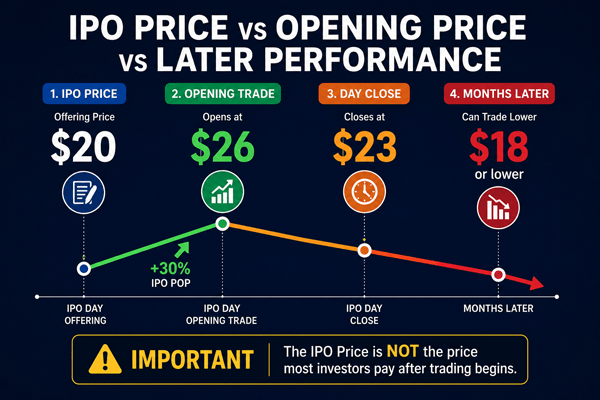
Example only: IPO shares priced at $20 may open at $26, close at $23, and trade lower months later.
This matters because the “IPO pop” that appears in headlines may mainly benefit investors who received shares at the offering price. A beginner buying at the opening trade may be paying after much of the early upside has already happened.
6. How IPO Shares Are Allocated
IPO allocation is not usually first-come, first-served. In many large IPOs, institutional investors such as mutual funds, pension funds, hedge funds, and asset managers receive most of the shares because they can place large orders and may be long-term holders. Some brokerages offer IPO access to eligible retail customers, but allocation can be small or uncertain.
A practical reality: Requesting 100 shares does not mean you will receive 100 shares. You might receive none, a small partial allocation, or the full amount depending on demand, brokerage rules, account eligibility, and the offering structure.
6.1 Common reasons beginners do not receive IPO shares
- The IPO is oversubscribed, meaning demand is greater than available shares.
- The brokerage reserves shares for larger or more active clients.
- The investor does not meet account size, trading history, suitability, or eligibility requirements.
- The company and underwriters prefer investors expected to hold shares rather than immediately sell.
- The retail platform receives only a small piece of the total IPO allocation.
7. The Main Types of IPO Investors
| Investor type | Access to IPO price | Typical advantage | Typical risk |
|---|---|---|---|
| Institutional investors | High | Often receive larger allocations and direct roadshow access | Still face valuation risk and position-size risk |
| High-net-worth clients | Medium | May access selected deals through full-service brokers | Allocation can depend on relationship and suitability |
| Retail investors through IPO platforms | Low to medium | Can sometimes buy at the IPO price with no large banking relationship | May receive tiny allocation or face flipping restrictions |
| Retail buyers after trading opens | High market access, not IPO allocation | Can buy anytime once public trading starts | May pay inflated price during first-day excitement |
8. How Is the IPO Price Set?
IPO pricing is part finance, part negotiation, and part market psychology. The company wants to raise capital at a strong valuation. Underwriters want a successful deal that trades well and satisfies investor clients. Investors want enough upside to justify the risk of buying a company with limited public trading history.
The final IPO price is usually influenced by company fundamentals, revenue growth, profitability, margins, market size, comparable public companies, market conditions, investor demand during the roadshow, and the amount of stock being sold.
8.1 Simple example of IPO math
Suppose a company sells 20 million new shares at $25 each. It raises $500 million before underwriting fees and expenses. If the company has 200 million total shares outstanding after the IPO, the IPO price implies a market capitalization of about $5 billion. That number is not automatically cheap or expensive; it must be compared with revenue, profits, growth, cash flow, debt, and similar companies.
| Item | Example |
|---|---|
| IPO shares sold | 20 million |
| IPO price | $25 |
| Gross proceeds | 20 million x $25 = $500 million |
| Post-IPO shares outstanding | 200 million |
| Implied market capitalization | 200 million x $25 = $5 billion |
9. What Beginners Should Read Before Buying an IPO
The most useful document is the prospectus, usually part of the S-1 filing in the U.S. It may look long, but beginners do not need to read it like a lawyer. Read it like an owner who wants to know what could go right and what could go wrong.
9.1 Fast prospectus checklist
| Section | Question to ask | Why it matters |
|---|---|---|
| Risk factors | What could seriously damage the business? | Risks are often specific: customer concentration, debt, regulation, lawsuits, losses, supply chain, cybersecurity, competition. |
| Use of proceeds | Where will IPO money go? | Growth investment is different from paying debt or letting insiders sell. |
| Revenue and profitability | Is the company growing and can it make money? | Fast revenue growth can still hide weak margins or heavy cash burn. |
| Cash flow | Does the business generate cash? | Profits and cash flow can tell different stories. |
| Customer concentration | Does one customer drive too much revenue? | Losing one major customer could hurt future results. |
| Share structure | Do insiders keep voting control? | Dual-class shares can limit public shareholder influence. |
| Lock-up expiration | When can insiders sell? | Extra share supply after lock-up expiry can pressure the stock. |
| Valuation | How does it compare with similar public companies? | A great business can still be a poor investment if the price is too high. |
10. IPO Risks Beginners Often Underestimate
IPOs can be exciting because they involve new brands, fast-growing companies, and media attention. But the risks are real. Beginners should treat IPO investing as a high-uncertainty decision, not a shortcut to quick gains.
10.1 Limited public track record
A newly public company has little trading history and may have limited operating history at public-company scale. Investors have fewer quarterly reports, fewer management earnings calls, and less long-term evidence of how the company behaves under pressure.
10.2 Valuation can already price in perfection
Many IPOs come public after private investors have already funded years of growth. By the time retail investors can buy, the valuation may already assume strong future execution. If growth slows even slightly, the stock can fall sharply.
10.3 First-day hype can distort judgment
The opening day can be driven by scarcity, headlines, momentum traders, and emotional fear of missing out. A strong brand does not automatically mean a strong stock investment at any price.
10.4 Lock-up expiration can add selling pressure
IPO insiders and early investors are often restricted from selling for a period after the IPO. When those restrictions expire or are waived, more shares may become available for sale. That does not always make the stock fall, but it is a date beginners should know.
10.5 Flipping rules may affect retail investors
Some platforms discourage or penalize very quick selling of allocated IPO shares. FINRA defines flipping in its IPO rule context as the initial sale of new issue shares within 30 days after the offering date. Brokerages may have their own policies, so beginners should read platform terms before requesting shares.
10.6 The company may be unprofitable
Many IPO companies are growth-focused and may report losses. That is not automatically bad, but beginners should understand how the company plans to become profitable and whether it has enough cash to reach that point.
11. How Beginners Can Use IPOs Wisely
A practical beginner approach is not “avoid all IPOs” or “buy every famous IPO.” A better approach is to use a simple process that protects you from hype and forces you to compare risk and reward.
11.1 A sensible IPO investing process
- Decide whether this is a long-term investment or a short-term trade before you buy.
- Read at least the prospectus summary, risk factors, use of proceeds, selected financial data, and management discussion.
- Compare valuation with similar public companies instead of judging the IPO in isolation.
- Avoid using money needed for bills, emergency savings, taxes, or near-term goals.
- Use limit orders after trading opens to avoid paying far above the price you intended.
- Size the position small enough that a 30% to 50% decline would not damage your financial plan.
- Write down why you are buying, what would make you sell, and what evidence would prove your thesis wrong.
- Track the first two or three earnings reports after the IPO; they often reveal how management handles public-market expectations.
12. IPO Buying Methods: Practical Options
| Method | How it works | Best for | Beginner caution |
|---|---|---|---|
| IPO allocation through brokerage | You request shares before the IPO and may receive an allocation at the offering price. | Investors with eligible brokerage access. | Allocation is uncertain; read flipping and cancellation rules. |
| Buy after trading opens | You buy shares like any listed stock once public trading begins. | Most retail investors. | Use limit orders; first-day prices can move fast. |
| Wait for first earnings reports | You avoid first-day hype and evaluate real public-company performance. | Patient beginners. | You may miss early upside, but you reduce information risk. |
| Invest through funds or ETFs | You own IPO exposure indirectly through diversified funds. | Investors who want diversification. | Fees, fund strategy, and concentration vary. |
13. IPO vs. Direct Listing vs. SPAC: Easy Comparison
| Feature | Traditional IPO | Direct listing | SPAC merger | Secondary offering |
|---|---|---|---|---|
| Main idea | Company sells new shares to public investors. | Existing shares begin trading publicly without a typical underwritten sale. | Private company goes public by merging with a public shell company. | Already-public company sells more shares. |
| Raises new money? | Usually yes. | Not always; depends on structure. | Usually yes, depending on cash and redemptions. | Yes, for the already-public company or selling holders. |
| Underwriters | Central role. | Smaller or different role. | Sponsors, advisers, and PIPE investors often matter. | Investment banks usually involved. |
| Beginner risk | Pricing hype and limited public history. | Potential volatility due to less traditional stabilization. | Complex terms, dilution, sponsor incentives. | Dilution and signal risk. |
14. A Practical Beginner Example
Imagine a cloud software company called BrightCloud plans an IPO. It sells subscription software to small businesses. Revenue is growing 35% per year, but the company is still losing money because it spends heavily on sales and product development.
The IPO is priced at $30 per share. It opens at $42 because demand is strong. A beginner sees the stock trending on social media and buys at $45 without reading the filing. Six months later, growth slows from 35% to 24%, the lock-up expires, and the stock trades at $28. The business may still be promising, but the beginner overpaid for excitement.
A more disciplined investor would ask: What is BrightCloud worth compared with similar software companies? How much cash does it burn? What customer churn does it have? Are insiders selling? How long until profitability? At what price would the risk-reward be attractive?
15. Red Flags That Should Make You Slow Down
- The company cannot explain how it will become profitable.
- Revenue depends heavily on one customer, one supplier, one country, or one product.
- Insiders are selling a large amount while the company receives little new capital.
- The valuation is much higher than similar public companies without a clear reason.
- The business uses adjusted metrics that hide large stock-based compensation or recurring costs.
- The prospectus risk factors read like real current problems, not remote possibilities.
- Management has weak governance, related-party transactions, or a complex share structure.
- You feel rushed because of headlines, influencers, or fear of missing out.
16. Helpful Facts About IPOs
- The SEC review process focuses on disclosure, not whether the IPO is a good investment.
- The IPO price is usually set before public trading begins; the opening trade can be materially different.
- IPO access at the offering price is often limited, especially for popular deals.
- A famous company can still be an overpriced stock.
- A weak first-day performance does not always mean a bad company; it may mean the IPO was priced aggressively or market conditions changed.
- The first earnings report after an IPO can be more informative than the first trading day.
- Lock-up expiration dates matter because new supply can enter the market.
17. Beginner IPO Checklist Before You Buy
| Checklist item | Yes/No | Notes |
|---|---|---|
| Do I understand how the company makes money? | ||
| Have I read the prospectus summary and risk factors? | ||
| Is the company profitable or moving toward profitability? | ||
| How does valuation compare with peers? | ||
| Am I buying at the IPO price or after the stock opened? | ||
| Do I know the lock-up expiration date? | ||
| Is my position size small enough for high volatility? | ||
| Am I using a limit order? | ||
| Do I have a sell plan? | ||
| Would I still buy this stock if it were not trending? |
18. Frequently Asked Questions
18.1 Is an IPO a good investment for beginners?
Sometimes, but beginners should be cautious. IPOs can be volatile and information is limited. A beginner should only invest after reading the prospectus, understanding valuation, and limiting position size.
18.2 Can I buy an IPO before it starts trading?
Only if your brokerage offers access and you meet its eligibility rules. Even then, allocation is not guaranteed.
18.3 Why do IPOs pop on the first day?
A first-day pop can happen when demand is stronger than the supply sold at the offering price. It can also reflect conservative pricing, scarcity, momentum, or market excitement.
18.4 Why do some IPOs fall after listing?
They may have been overpriced, market conditions may worsen, growth expectations may fall, insiders may sell after lock-up expiration, or investors may reassess the business after earnings.
18.5 What is a prospectus?
A prospectus is the formal document that explains the company, its financials, risks, share offering, management, use of proceeds, and other information investors need.
18.6 Should I sell IPO shares on day one?
That depends on your plan, brokerage rules, tax situation, and investment thesis. Some brokerages may restrict future IPO access if allocated shares are sold very quickly.
18.7 What is an IPO lock-up?
A lock-up is a restriction that prevents certain insiders and early investors from selling shares for a period after the IPO. When it expires, more shares may be available for sale.
18.8 What is underwriting?
Underwriting is the role investment banks play in preparing, marketing, pricing, distributing, and supporting the IPO.
18.9 What is book-building?
Book-building is the process where underwriters collect investor demand to help set the IPO price and allocations.
18.10 What is a good first step for a beginner?
Start by reading the prospectus summary, risk factors, use of proceeds, and financial statements. Then compare valuation with established public competitors.
19. Final Takeaway
An IPO is not magic. It is a financing event where a private company becomes publicly traded. For companies, it can raise capital and create liquidity. For investors, it can create opportunity, but also real risk. The best beginner mindset is simple: do not buy the story until you understand the numbers, the valuation, the risks, and the price you are actually paying.
A disciplined investor treats an IPO like any other investment: read the filing, compare alternatives, use sensible position sizing, avoid hype, and make decisions based on evidence rather than excitement.
Sources Consulted and Checked
These sources were consulted and checked while preparing this article to support accuracy, clarity, and reliable explanations.
- Investor.gov / SEC glossary: Initial Public Offering (IPO): https://www.investor.gov/introduction-investing/investing-basics/glossary/initial-public-offering-ipo
- SEC Investor Bulletin: Investing in an IPO: https://www.sec.gov/files/ipo-investorbulletin.pdf
- FINRA Rule 5131: New Issue Allocations and Distributions: https://www.finra.org/rules-guidance/rulebooks/finra-rules/5131
- Nasdaq: How Nasdaq supports the IPO process: https://www.nasdaq.com/newsroom/how-nasdaq-supports-ipo-process
- J.P. Morgan Workplace Solutions: IPO process guide: https://www.jpmorganworkplacesolutions.com/insights/step-by-step-guide-ipo/
- Latham & Watkins: US IPO Guide: https://www.lw.com/admin/upload/SiteAttachments/lw-us-ipo-guide.pdf
Reader Advice
This article is provided solely for educational and informational purposes. It does not constitute personalized financial, investment, legal, accounting, or tax advice, and it is not a recommendation to buy, sell, or hold any security. IPOs involve substantial risk, including rapid price changes and the possible loss of part or all of the money invested. Before making a decision, readers should review the latest prospectus and official regulatory filings, consider their objectives, financial circumstances, risk tolerance, and time horizon, and seek advice from appropriately qualified professionals where necessary.
Rules, brokerage eligibility requirements, allocation practices, fees, tax treatment, market conditions, company information, and regulatory guidance may change or differ by country, exchange, broker, account type, and individual circumstances. Readers should therefore verify current facts, figures, dates, terms, and requirements through official sources before acting.