What Is an IPO? How Companies Go Public and What Investors Should Know
An IPO, or initial public offering, is the first time a private company sells its shares to the general public on a stock exchange. Before an IPO, ownership is usually limited to founders, employees, venture capital funds, private equity investors, and a small group of early backers. After an IPO, ordinary investors can buy and sell the company’s stock through an online brokerage account or stock trading platform.
Think of an IPO as the moment a company moves from a private room into a public marketplace. The company gets access to a much larger pool of capital. Early investors may get a way to sell some of their shares. Public investors get a chance to own a piece of the business. But that opportunity comes with real risk, especially because newly listed companies often have limited public trading history.
This guide explains IPOs in plain English. It covers how companies go public, how IPO pricing works, what a beginner should read in the IPO prospectus, how to compare IPOs with normal stocks, and how to avoid common mistakes.
1. Quick answer: what does IPO mean?
IPO stands for initial public offering. “Initial” means first. “Public offering” means the company is offering shares to public investors. Once the IPO is complete, the company becomes publicly traded, usually on an exchange such as Nasdaq, the New York Stock Exchange, or another regulated market depending on the country.
| Simple term | Plain-English meaning |
|---|---|
| Company | The business selling shares. |
| Share | A small ownership unit in the company. |
| IPO price | The price at which IPO shares are sold before trading starts. |
| Ticker symbol | The short stock code used on an exchange. |
| Prospectus / S-1 | The official document explaining the business, risks, financials, and offering terms. |
| Underwriter | The investment bank helping plan, price, market, and distribute the IPO. |
Important beginner point: Buying at the IPO price and buying on the first trading day are not always the same thing. Many retail investors cannot get IPO shares at the original offering price. They often buy only after trading begins, when the stock may already be much higher or lower than the IPO price.
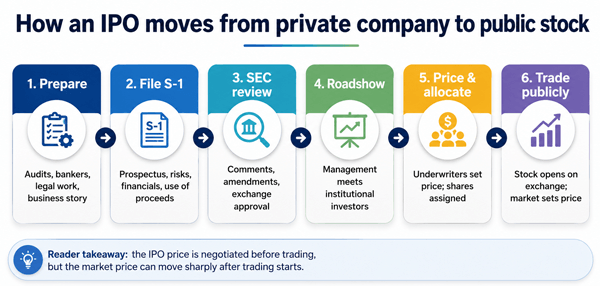
Step-by-step diagram showing a company preparing, filing, undergoing regulatory review, conducting a roadshow, pricing shares, and beginning public trading after an IPO.
2. Why do companies go public?
A company usually goes public because it wants capital, credibility, liquidity, or a mix of all three. IPO proceeds can fund expansion, research, hiring, acquisitions, debt repayment, or balance-sheet strengthening. A public listing can also make it easier to use stock as employee compensation or acquisition currency.
| Reason | What it means | Investor question to ask |
|---|---|---|
| Raise growth capital | The company sells new shares and receives cash. | Will the money create future revenue and profits? |
| Give early investors liquidity | Some pre-IPO holders may sell part of their stake. | How much of the IPO is new money for the company versus existing holders cashing out? |
| Increase visibility | Public companies often get more media, analyst, and customer attention. | Is the company going public from strength or because private funding became harder? |
| Reward employees | Public shares can make stock compensation more liquid. | Will employee share sales after lock-up create pressure? |
| Create acquisition currency | Public stock can be used in deals. | Does management have a disciplined acquisition strategy? |
A good IPO is not simply a famous brand coming to market. A better test is whether the company has a clear business model, improving economics, honest disclosure, capable management, and a fair price compared with future cash flows.
3. How the IPO process works, step by step
The exact rules vary by country, but the core IPO process is similar in many major markets. In the United States, a company typically files a registration statement such as Form S-1 with the Securities and Exchange Commission. The prospectus is the main document investors use to understand the offer, including the business, risk factors, use of proceeds, management, financial statements, and dilution.
- IPO readiness: The company prepares audited financial statements, improves governance, hires legal advisers, selects investment banks, and builds an investor story.
- Underwriter selection: Investment banks help structure the deal, test investor demand, advise on valuation, and distribute shares.
- Filing the prospectus: The company submits detailed disclosures. In the U.S., the Form S-1 is the key filing for many IPOs.
- Regulatory review and amendments: Regulators may ask questions. The company responds and updates the filing.
- Roadshow and bookbuilding: Management presents the company to institutional investors. Underwriters collect indications of interest.
- Pricing and allocation: The IPO price is set, usually near the night before trading. Shares are allocated to eligible investors.
- Listing day: Shares begin trading publicly. From that point, supply and demand can move the stock above or below the IPO price.
- Post-IPO life: The company reports quarterly/annual results, follows public-company rules, and faces constant market scrutiny.
Practical point: The first day pop can look exciting, but it often benefits investors who received shares at the IPO price. If a retail investor buys after the pop, the risk/reward may be very different.
4. IPO price vs opening price vs market price
| Price type | Who sets it? | When it matters | Beginner mistake to avoid |
|---|---|---|---|
| IPO offer price | Company and underwriters after measuring demand. | Before the stock begins trading. | Assuming you can always buy at this price. |
| Opening price | Exchange auction and market orders. | When public trading starts. | Chasing a big opening gap without checking valuation. |
| Market price | Buyers and sellers in the open market. | Every trading day after listing. | Thinking the IPO price is a guaranteed floor. |
Example: Suppose a company prices its IPO at $20. When trading opens, strong demand pushes the first public trade to $32. A retail investor buying at $32 is not buying at the IPO valuation. They are paying 60% more than the original offer price. If the business later disappoints, the stock can fall below both $32 and $20.
5. How can beginner investors buy IPO stocks?
There are two common ways to invest in an IPO: request shares before the listing through a brokerage that has access to the deal, or buy shares in the open market after the stock starts trading. Many beginners only have the second option.
| Method | How it works | Pros | Cons |
|---|---|---|---|
| Pre-IPO allocation through broker | You request IPO shares before trading starts. Broker decides eligibility and allocation. | Possible access to offer price. | Allocation may be small, unavailable, or limited to eligible clients. IPOs are often considered speculative. |
| Buy after listing | You buy the stock through your brokerage after public trading starts. | Easy access and transparent market price. | Price may already include hype or first-day volatility. |
| IPO ETF or fund | You buy a fund that owns a basket of recent IPOs. | Diversifies single-company risk. | Fees, fund rules, and performance may differ from buying one IPO. |
| Wait for earnings history | You wait for 2-4 quarterly reports before deciding. | More data, less emotion. | You may miss early gains if the company performs well. |
A beginner-friendly approach is to treat IPO stocks as a small, high-risk part of an investment portfolio, not as a core retirement account strategy. Many experienced investors wait until the first few earnings reports because real public-company behavior is more useful than launch-day excitement.
6. What should investors read in an IPO prospectus?
The IPO prospectus is long, but beginners do not need to read it randomly. Focus on sections that answer the most important investor questions.
| Prospectus section | What to look for | Red flag example |
|---|---|---|
| Business overview | How the company makes money, who customers are, and why it can grow. | Buzzwords with no clear revenue model. |
| Risk factors | Company-specific risks, not just generic warnings. | Dependence on one customer, supplier, product, or regulator. |
| Use of proceeds | Where IPO cash will go. | Large proceeds used mainly to repay insiders or vague “general purposes.” |
| Management discussion | Revenue drivers, costs, margins, cash flow, and future pressures. | Growth slowing while losses and cash burn rise. |
| Financial statements | Revenue, gross margin, operating loss/profit, debt, cash flow. | Revenue growth bought through unsustainable spending. |
| Dilution | How much new investors pay compared with book value and insider cost basis. | Public investors paying far more than pre-IPO holders. |
| Principal shareholders | Who owns the company before and after the IPO. | Heavy insider selling with little ownership retained. |
The U.S. SEC’s investor education materials specifically highlight prospectus sections such as the prospectus summary, risk factors, use of proceeds, dividend policy, and dilution as important reading areas for IPO investors. Investor.gov also notes that IPO investing is risky and speculative, and brokerage firms must consider suitability before selling IPO shares to a customer.
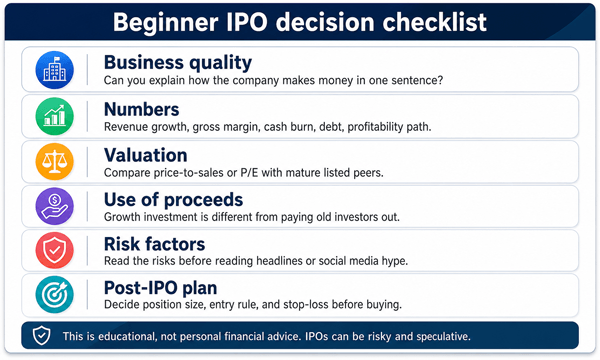
Beginner IPO decision checklist covering business quality, financial figures, valuation, use of proceeds, risk factors, and a post-IPO plan.
7. The most important IPO risks beginners should know
IPOs can create wealth, but they can also destroy capital quickly. The main risk is not just that the stock price moves. The real risk is paying a high price for a business whose future is still uncertain.
| Risk | Why it matters | Practical way to reduce it |
|---|---|---|
| Limited public history | Private-company information may be less familiar to public investors. | Read the prospectus and wait for public earnings if unsure. |
| High valuation | Popular IPOs can be priced for perfection. | Compare valuation with listed peers and realistic growth. |
| Lock-up expiration | Insiders may be allowed to sell after a set period, often around 180 days in many U.S. deals, though terms vary. | Check the prospectus for lock-up terms and calendar dates. |
| Small float | A limited number of tradable shares can increase volatility. | Avoid oversized positions and market orders. |
| Hype cycle | Media attention can separate price from fundamentals. | Write down your buy reason before placing an order. |
| Profitability uncertainty | Many IPO companies are still scaling and may lose money. | Study gross margin, operating losses, cash burn, and cash runway. |
| Share dilution | Future stock issuance can reduce your ownership percentage. | Look for employee stock options, convertible securities, and future funding needs. |
Honest investing practice: Never buy an IPO only because it is trending on social media, mentioned by an influencer, or connected to a hot theme such as artificial intelligence, fintech, crypto, cloud software, or electric vehicles. Themes can help growth, but valuation and execution still matter.
8. How to evaluate an IPO in 15 minutes
A full IPO analysis can take hours, but a beginner can run a useful first screen in 15 minutes. This will not replace proper research, but it can stop many bad decisions.
- Explain the company: Write one sentence explaining how it makes money. If you cannot, skip it for now.
- Check growth quality: Is revenue growing because customers love the product, or because the company is spending heavily to buy growth?
- Look at losses and cash flow: Fast growth is not enough if the company burns cash with no clear path to profitability.
- Compare valuation: Use price-to-sales for unprofitable companies and P/E or EV/EBITDA for profitable companies, then compare with public peers.
- Read the top five risk factors: If one risk could break the business, treat the stock as very high risk.
- Check use of proceeds: Prefer funding for growth, product, balance sheet, or strategic expansion over unclear purposes.
- Plan the trade or investment: Decide position size, maximum loss, and whether you are buying for months, years, or a quick trade.
9. Practical IPO valuation example
Imagine CloudCart, a fictional e-commerce software company, is going public. It reports $500 million in annual revenue, growing 35% year over year. It is not profitable yet and has a proposed market value of $7.5 billion at the IPO price.
| Metric | CloudCart IPO | How to think about it |
|---|---|---|
| Annual revenue | $500 million | Useful starting point for size. |
| Revenue growth | 35% | Strong, but check if growth is slowing. |
| Net income | -$120 million | Losses may be acceptable if margins are improving. |
| Market value | $7.5 billion | Investors are paying 15x sales. |
| Peer valuation | 8x to 12x sales | CloudCart is priced above peers, so expectations are high. |
| Use of proceeds | Product development and international expansion | Potentially positive if management has a record of execution. |
At 15x sales, CloudCart needs strong growth and improving margins to justify the price. If growth falls to 15% and losses remain high, the stock may decline even if the company is still growing. This is one of the biggest lessons in IPO investing: a good company is not always a good stock at any price.
10. IPO vs direct listing vs SPAC
| Path to public market | Simple explanation | Best for | Key investor concern |
|---|---|---|---|
| Traditional IPO | Company sells shares with underwriters and raises capital. | Companies that want new money and structured investor marketing. | Pricing, allocation, dilution, and first-day volatility. |
| Direct listing | Existing shares begin trading publicly, often without raising new capital in the traditional IPO style. | Companies with strong brand recognition and less need for new cash. | No traditional underwriting support; price discovery can be volatile. |
| SPAC merger | A private company merges with a publicly listed blank-check company. | Companies seeking an alternative route to public markets. | Dilution, sponsor incentives, projections, and deal quality. |
For beginners, the label matters less than the disclosure, valuation, incentives, and post-listing performance. A weak company does not become safe because it uses a trendy listing method. A strong company can still be overpriced.
11. Should beginners invest in IPOs?
Beginners can learn a lot from IPOs, but they should be careful with actual money. IPO stocks are often volatile because the market is still discovering the right price. There may be limited analyst coverage, limited trading history, and emotional demand from people who know the brand but have not studied the business.
A sensible beginner rule is to separate curiosity from capital. It is fine to study every interesting IPO. It is not fine to put a large part of your savings into a newly listed stock without understanding the business, valuation, risks, and your own exit plan.
| Investor profile | Possible IPO approach |
|---|---|
| Complete beginner | Watch IPOs, read prospectuses, and paper-trade before using real money. |
| Long-term investor | Wait for 2-4 earnings reports and buy only if valuation and fundamentals make sense. |
| Active trader | Use strict risk management, avoid market orders, and respect volatility. |
| Retirement-focused investor | Keep IPO exposure small or use diversified funds if suitable. |
12. Common IPO mistakes and better habits
| Mistake | Why it hurts | Better habit |
|---|---|---|
| Buying because the brand is famous | Customers and shareholders are not the same thing. | Ask whether profits and valuation support the stock price. |
| Ignoring the prospectus | Marketing headlines leave out risks. | Read risk factors, use of proceeds, financials, and dilution. |
| Using market orders on listing day | Opening trades can be extremely volatile. | Use limit orders or wait for calmer trading. |
| Oversizing the position | One IPO can fall sharply. | Cap IPO exposure to a small percentage of your portfolio. |
| Forgetting lock-up expiration | New supply can pressure the stock. | Check lock-up dates and insider selling rules. |
| Confusing growth with quality | Some companies grow while losing more money each year. | Track unit economics, margins, and cash burn. |
13. How IPOs fit into an investment portfolio
IPOs should usually sit in the higher-risk part of a portfolio. A diversified portfolio may include broad-market index funds, bonds or cash reserves, dividend stocks, growth stocks, and a smaller allocation to speculative opportunities. IPO investing belongs closer to speculative growth than to capital preservation.
Before buying an IPO stock, ask: Would I still want this company if it were not new? Would I buy it at this valuation if it had been public for five years? Do I understand how it could lose money? These questions reduce the emotional pull of launch-day excitement.
14. Current IPO market context for readers
IPO markets open and close with investor appetite, interest rates, volatility, sector trends, and economic conditions. As of mid-July 2026, Renaissance Capital’s U.S. IPO statistics showed 83 IPOs priced year-to-date and $141.2 billion in proceeds, while EY described the global IPO market as open but selective, with capital gravitating toward larger issuers with resilient fundamentals and a clear path to value creation. This matters because a selective IPO market can punish weak stories quickly, even when headline demand looks strong.
Practical takeaway: In hot IPO markets, investors should be more valuation-conscious, not less. More excitement often means higher prices. Higher prices leave less room for mistakes.
15. Beginner IPO checklist before buying
- I understand how the company makes money.
- I read the risk factors and found the risks specific, not just generic.
- I know whether the company is profitable or burning cash.
- I compared valuation with public peers.
- I checked use of proceeds and dilution.
- I know whether insiders are selling and when lock-up expires.
- I decided my position size before buying.
- I am using a limit order if buying during volatile trading.
- I can afford the loss if the investment performs badly.
- I am not buying because of hype, fear of missing out, or social media pressure.
16. Frequently asked questions about IPOs
16.1. Is an IPO good or bad?
An IPO is neither automatically good nor bad. It is simply a way for a company to become publicly traded. The investment quality depends on the business, price, risks, management, financials, and your own goals.
16.2. Can anyone buy IPO shares?
Anyone with a brokerage account may be able to buy shares after public trading begins. Getting shares at the IPO offer price is harder and depends on broker access, investor eligibility, demand, and allocation rules.
16.3. Do IPO stocks usually go up on the first day?
Some IPOs rise on the first day, some fall, and some rise first but decline later. A first-day pop is not proof of long-term value. It often reflects short-term supply and demand.
16.4. What is a lock-up period?
A lock-up period is a restriction that prevents certain insiders or early investors from selling shares for a period after the IPO. Terms vary by deal. When lock-up expires, more shares may become available for sale.
16.5. What is IPO dilution?
Dilution happens when new shares are issued, reducing existing ownership percentages. IPO investors should read the dilution section because public buyers may pay much more per share than earlier investors.
16.6. Is it better to buy on IPO day or wait?
Many beginners are better served by waiting. Waiting gives you more trading history, public earnings reports, analyst questions, and evidence of how management communicates with investors.
16.7. Can IPO investing be part of a retirement account?
It can be, depending on account rules and broker availability, but IPOs are typically risky and speculative. Retirement-focused investors should be careful about concentration and suitability.
16.8. What is the biggest thing to remember?
Do not confuse a great company with a great investment. Price matters. Risk matters. Your plan matters.
Sources Consulted and Checked
The following sources were consulted and checked while preparing this article and verifying its accuracy.
- U.S. Securities and Exchange Commission, Investor Bulletin: Investing in an IPO: Explains prospectus sections such as risk factors, use of proceeds, dividend policy, and dilution.
- Investor.gov, Initial Public Offerings: Eligibility to Get Shares at Broker-Dealers: Notes that IPO investing is risky and speculative and discusses suitability considerations.
- SEC.gov and Investor.gov, Role of the SEC: States the SEC mission to protect investors, maintain fair and efficient markets, and facilitate capital formation.
- Cornell Law School Wex, Initial Public Offering: Summarizes the Form S-1 as a common registration statement used for IPOs.
- Deloitte, Roadmap: Initial Public Offerings: Describes registration statement effectiveness, exchange approval, and IPO timeline concepts.
- Renaissance Capital IPO Center, 2026 U.S. IPO Market Stats: Used for the mid-July 2026 U.S. IPO pricing and proceeds context.
- EY Global IPO Trends Q1 2026: Used for market context: IPO access is open but selective, favoring resilient issuers with clear value creation.
- Vanguard, IPOs: What to Know: Current investor education reference on IPOs from filing to trading day.
- J.P. Morgan Workplace Solutions, Step-by-Step IPO Guide: Reference for IPO process and differences between IPOs and direct listings.
- Charles Schwab, IPO Basics: What to Know Before Investing: Investor education reference on IPO basics and considerations.
Reader Advice
This article is provided solely for educational and informational purposes. It does not constitute personalized investment, financial, tax, legal, or brokerage advice, and it should not be treated as a recommendation to buy, sell, or hold any security. Investing involves risk, including the possible loss of principal, and IPO shares may be especially volatile and speculative.
Rules, market conditions, offering terms, eligibility requirements, fees, tax treatment, and regulatory guidance may change and may vary by country, broker, account type, and individual circumstances. Before making any decision, readers should review the company’s latest official prospectus and regulatory filings, verify facts and figures through official sources, consider their objectives and risk tolerance, and seek advice from an appropriately qualified professional where necessary.