Business Loan Interest Rates: Average Rates and What Affects Them
Business loan interest rates can make the difference between financing that helps your company grow and financing that quietly drains your cash flow. A loan with a slightly lower rate may save thousands of dollars over time, but the interest rate alone does not tell the full story. Fees, repayment frequency, loan term, collateral, credit quality, and whether the rate is fixed or variable all affect the true cost.
This guide is for business owners, startup founders, freelancers, and managers who want a clear explanation before comparing loan offers. You may be looking for working capital, equipment financing, inventory money, a line of credit, or a real estate loan. Whatever the purpose, the goal is the same: understand what lenders charge, why they charge it, and how to avoid choosing the wrong offer.
Rates change with the broader economy, lender policies, and borrower risk. For that reason, the best way to use this article is not as a promise of the exact rate you will receive, but as a practical framework for understanding what is reasonable, what is expensive, and what questions to ask before signing. Borrowers should confirm current terms directly with lenders, the SBA, and qualified financial professionals before signing a loan agreement.
1. What Are Business Loan Interest Rates?
A business loan interest rate is the price a lender charges for letting your business borrow money. It is usually expressed as a percentage of the loan balance. The rate may be fixed, meaning it stays the same, or variable, meaning it can change when a benchmark rate changes.
In plain English: if your business borrows money, interest is the lender’s charge for risk, time, and opportunity cost. The higher the lender believes the risk is, the higher the rate usually becomes.
Business loan interest rates are commonly attached to financing products such as:
- Bank term loans
- SBA 7(a) loans
- SBA 504 loans
- Business lines of credit
- Equipment financing
- Invoice financing
- Commercial real estate loans
- Online business loans
- Merchant cash advances, which are often priced with factor rates rather than normal interest rates
1.1 Interest Rate vs APR vs Factor Rate
| Term | What it means | Why it matters |
|---|---|---|
| Interest rate | The percentage charged on the loan balance, excluding many fees. | Useful, but incomplete if fees are high. |
| APR | Annual percentage rate; combines interest and many required finance charges into an annualized cost. | Usually better for comparing loans with similar repayment terms. |
| Factor rate | A multiplier used by some short-term financing and merchant cash advance providers. Example: 1.25 factor rate on $20,000 means total payback of $25,000. | Can look simple but may hide a very high annualized cost. |
| Total repayment | Principal plus interest plus fees paid over the full loan term. | Shows actual dollars leaving the business. |
2. Average Business Loan Interest Rates in 2026
Average business loan rates vary widely because “business loan” includes many products. A well-qualified borrower seeking a bank loan may see a much lower rate than a young business using a fast online lender. SBA-backed loans often have regulated or formula-based maximums, while online loans and merchant cash advances can be far more expensive.
The SBA states that 7(a) interest rates are negotiated between borrower and lender but must stay within SBA maximums. SBA variable 7(a) maximums are tied to a base rate plus a spread based on loan size: base rate plus 6.5% for loans of $50,000 or less, plus 6.0% for $50,001 to $250,000, plus 4.5% for $250,001 to $350,000, and plus 3.0% for loans above $350,000. Source: U.S. Small Business Administration, Terms, Conditions, and Eligibility, lines 287-298.
For SBA 504 loans, the SBA says rates are pegged to an increment above the current market rate for 10-year U.S. Treasury issues, and 10-, 20-, and 25-year maturity terms are available. Source: U.S. Small Business Administration, 504 Loans, lines 299-306.
The Federal Reserve’s H.15 release is a useful benchmark because many business rates move with broader market rates. The June 24, 2026 release shows the effective federal funds rate at 3.63% for recent listed days. Source: Federal Reserve H.15 Selected Interest Rates, release dated June 24, 2026, lines 297-314.
| Financing type | Typical 2026 range | Best for | Important note |
|---|---|---|---|
| Bank term loan | About 8% to 13% | Established businesses with strong credit and financials | Rates depend heavily on bank, collateral, relationship, and cash flow. |
| SBA 7(a) loan | Often around 9.75% to 14.75% based on market ranges and SBA caps | Working capital, acquisition, expansion, equipment, refinancing | Rates are negotiated but subject to SBA maximums. |
| SBA 504 loan | Often around 5% to 7.5%; June 2026 effective 504 rates were near 6% in published CDC rate tables | Owner-occupied commercial real estate and major fixed assets | Usually includes a bank portion plus a CDC/SBA debenture portion. |
| Business line of credit | Often variable; may be similar to or higher than term loans | Flexible working capital and seasonal needs | You usually pay interest only on what you draw. |
| Equipment financing | Often moderate; can be lower when equipment is strong collateral | Vehicles, machinery, technology, tools | Equipment itself often secures the loan. |
| Online term loan | About 10% to 40% or more | Speed and access when banks are difficult | Convenience may come with higher cost. |
| Invoice financing | Fee-based; cost depends on invoice quality, customer strength, and time outstanding | Businesses waiting on unpaid invoices | Compare fees as an annualized cost if possible. |
| Merchant cash advance | Can annualize very high, sometimes far above normal loan APRs | Businesses with card sales needing fast cash | Not a traditional loan; daily/weekly repayment can strain cash flow. |
Note: These are educational ranges, not guaranteed offers. Your actual rate can be lower or higher depending on credit, revenue, profitability, collateral, lender type, loan amount, repayment term, and market conditions.
2.1 Visual Comparison: Estimated Cost Ranges
The chart below uses approximate midpoints from common market ranges. It is meant to show relative cost differences, not to predict your exact offer.
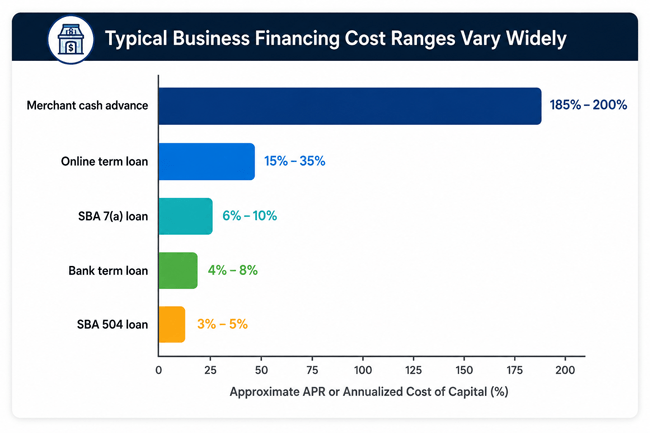
Chart takeaway: The cheapest financing is usually not the fastest financing. The fastest financing is often not the cheapest.
3. How Business Loan Interest Rates Work
Most business loans are priced using a simple idea: the lender starts with a benchmark cost of money, then adds a margin for risk, operating costs, profit, and loan structure. The final rate reflects both the outside economy and your business profile.
A simplified pricing formula looks like this:
Business loan rate = benchmark/base rate + lender margin + risk adjustments + product-specific costs
For example, an SBA 7(a) variable loan may be tied to prime or another permitted base rate plus a spread. A bank term loan may be priced from the bank’s internal cost of funds. An online loan may use automated risk models that weigh revenue trends, credit history, bank deposits, industry, and repayment history.
3.1 Fixed vs Variable Business Loan Rates
| Feature | Fixed rate | Variable rate |
|---|---|---|
| How it behaves | Stays the same for the agreed period. | Can rise or fall when the benchmark changes. |
| Payment predictability | Higher predictability. | Less predictable if rates move. |
| Best for | Businesses that need stable budgeting. | Businesses comfortable with rate changes or expecting rates to fall. |
| Main risk | May start higher than a variable rate. | Payment can increase and reduce cash flow. |
3.2 Simple Interest Example
Suppose a bakery borrows $100,000 for equipment at a 10% annual interest rate over five years. The exact payment depends on amortization, fees, and repayment schedule, but the main idea is simple: the borrower pays back the $100,000 principal plus interest over time. A longer term may reduce monthly payments but increase total interest paid. A shorter term may save interest but require larger monthly payments.
4. Why Business Loan Interest Rates Matter
Interest rates matter because they affect affordability, approval strategy, cash flow, profit margins, and business risk. A loan can be approved and still be a bad fit if the payment is too large or the repayment schedule does not match your revenue cycle.
- Monthly payment: Higher rates usually mean higher payments.
- Cash flow: Daily or weekly repayments can hurt businesses with uneven income.
- Total cost: A low payment over a long term can still be expensive.
- Growth return: Borrowed money should support a purpose that can reasonably improve revenue, efficiency, or stability.
- Approval strength: Lower-risk borrowers usually receive better pricing.
5. What Affects Business Loan Interest Rates?
Lenders do not price every business the same way. Two companies can apply for the same loan amount and receive very different offers. These are the biggest factors.
5.1 Credit Score and Credit History
Both personal and business credit can matter. Many small businesses rely heavily on the owner’s personal credit, especially if the business is young. A stronger credit history suggests the borrower has managed debt responsibly, which can help lower the rate.
5.2 Time in Business
A business with several years of operating history is easier for lenders to evaluate. Startups often face higher rates because they have limited financial records, uncertain revenue, and higher failure risk.
5.3 Annual Revenue and Cash Flow
Revenue shows money coming in, but cash flow shows whether the business can actually make payments. Lenders often care more about consistent cash flow than impressive sales numbers. A business with stable deposits and healthy margins may receive better terms.
5.4 Profitability and Debt Service Coverage
Debt service coverage compares cash available to debt payments. If a business barely has enough cash to cover existing obligations, a lender may charge more or decline the application. Strong coverage can support a lower rate.
5.5 Loan Amount
Very small loans can carry higher rates because lenders still have underwriting and servicing costs. Under SBA 7(a) rules, smaller variable loans can have higher allowed spreads than larger loans.
5.6 Loan Term
Longer terms often reduce monthly payments, but they can increase total interest paid. Shorter terms may have lower total cost but larger payments. The best term is the one your cash flow can support without creating stress.
5.7 Collateral
Collateral gives the lender a secondary way to recover money if the borrower defaults. Real estate, equipment, vehicles, inventory, receivables, or cash savings may reduce lender risk and sometimes improve pricing.
5.8 Personal Guarantee
Many small business loans require a personal guarantee. This means the owner agrees to be personally responsible if the business does not repay. A guarantee can help approval but increases personal financial risk.
5.9 Industry Risk
Some industries are considered riskier because of seasonality, regulation, thin margins, high failure rates, or economic sensitivity. Restaurants, construction, transportation, and retail may be evaluated differently from professional services or essential B2B companies.
5.10 Lender Type
Banks and credit unions often offer lower rates but may require stronger qualifications and more paperwork. Online lenders may approve faster and accept weaker profiles, but the rate and fees may be higher. SBA lenders sit in the middle: they follow program rules and may offer longer terms, but documentation can be more involved.
5.11 Economic Conditions
Business loan rates tend to move with the broader interest-rate environment. When benchmark rates rise, variable-rate business loans usually become more expensive. When benchmark rates fall, some variable rates may decline, although lender margins and credit standards still matter.
6. Common Business Loan Fees That Affect Total Cost
A loan with a low interest rate can still be expensive if fees are high. Always compare APR, total repayment, and payment schedule, not just the advertised rate.
| Fee | What it is | How to evaluate it |
|---|---|---|
| Origination fee | A fee for processing or funding the loan. | Ask whether it is deducted from proceeds or added to the balance. |
| SBA guaranty fee | A fee connected with certain SBA-guaranteed loans; lenders may pass it to borrowers. | Ask how much it is and whether it is financed. |
| Packaging fee | A fee for preparing an SBA or complex loan file. | Confirm it is reasonable and disclosed. |
| Appraisal or valuation fee | Cost to value real estate, equipment, or business assets. | Common for secured loans. |
| UCC filing fee | Cost to record a lender’s security interest. | Usually small but should be disclosed. |
| Prepayment penalty | A fee for paying off early. | Important if you expect to refinance or repay quickly. |
| Late payment fee | Charged when payment is missed or late. | Review grace period and default terms. |
| Maintenance or draw fee | Common on lines of credit. | Compare annual cost if you do not use the line often. |
7. Step-by-Step Process to Compare Business Loan Rates
- Define the loan purpose. Decide whether the money is for working capital, equipment, inventory, payroll, expansion, refinancing, or real estate.
- Estimate how much you truly need. Borrowing too little can leave a project underfunded; borrowing too much raises cost and risk.
- Review your credit and financials. Check personal credit, business credit, bank statements, tax returns, profit and loss statements, balance sheet, and existing debt.
- Calculate affordable payment. Use conservative revenue assumptions and leave room for taxes, payroll, rent, inventory, emergencies, and seasonal slowdowns.
- Match the loan type to the need. Use short-term financing for short-term needs and longer-term financing for long-lived assets.
- Request multiple quotes. Compare banks, credit unions, SBA lenders, and online lenders where appropriate.
- Compare APR, total repayment, and payment frequency. A weekly payment loan may feel very different from a monthly payment loan even if the dollar amount looks manageable.
- Read the fee schedule and default terms. Look for origination fees, prepayment penalties, automatic withdrawals, late fees, confessions of judgment where applicable, and collateral claims.
- Negotiate before signing. Strong borrowers may negotiate rate, fees, collateral, repayment term, or prepayment flexibility.
- Choose the offer that protects cash flow. The best loan is not always the biggest loan or the fastest approval; it is the one your business can repay while still operating comfortably.
8. Real-World Examples
8.1 Example 1: Established contractor choosing between speed and cost
A contractor needs $80,000 to buy materials for a confirmed project. An online lender can fund quickly but charges a high short-term cost. The contractor’s bank offers a lower-rate line of credit but needs more documentation. If the project timeline allows, the bank line may be safer. If materials must be purchased immediately, the contractor should calculate whether project profit still remains after the higher financing cost.
8.2 Example 2: Restaurant owner comparing monthly payment and total cost
A restaurant wants $150,000 for renovations. A longer loan term creates a lower monthly payment, which helps during slower months. However, it may increase total interest. The owner should compare both monthly affordability and total repayment, then decide whether the renovation is likely to generate enough added revenue to justify the cost.
8.3 Example 3: Manufacturer using equipment as collateral
A manufacturer needs a new machine that will increase production capacity. Because the equipment has resale value, equipment financing may offer better pricing than an unsecured working capital loan. The key question is whether the machine’s expected additional profit exceeds the loan payment and maintenance cost.
9. Pros and Cons of Business Loans
| Pros | Cons |
|---|---|
| Can fund growth, inventory, equipment, hiring, or expansion. | Creates a fixed repayment obligation even if revenue falls. |
| May help preserve ownership compared with selling equity. | Interest and fees reduce profit. |
| Can build business credit when repaid responsibly. | Late or missed payments can damage credit and relationships. |
| Longer-term loans can match the life of major assets. | Collateral and personal guarantees can put assets at risk. |
| SBA and bank loans may offer competitive terms for qualified borrowers. | Application paperwork can be time-consuming. |
10. Business Loan Rate Comparison: Bank Loan vs SBA Loan vs Online Loan
| Feature | Bank loan | SBA loan | Online loan |
|---|---|---|---|
| Typical cost | Often lower for strong borrowers. | Often competitive, with program rules and caps. | Often higher, especially for riskier borrowers. |
| Speed | Slower to moderate. | Moderate to slow. | Fastest in many cases. |
| Documentation | Detailed. | Detailed and program-specific. | Often lighter, but varies. |
| Best for | Established businesses with strong financials. | Businesses that qualify but need longer terms or government-backed structure. | Businesses that need speed or cannot qualify with banks. |
| Main caution | Harder qualification. | More paperwork and eligibility rules. | Higher APR, fees, or frequent repayments. |
11. How to Qualify for a Lower Business Loan Interest Rate
- Improve personal and business credit before applying.
- Reduce existing high-interest debt when possible.
- Keep clean accounting records and updated financial statements.
- Separate business and personal bank accounts.
- Show consistent revenue deposits.
- Prepare tax returns, bank statements, profit and loss statements, balance sheet, debt schedule, and business plan if needed.
- Offer strong collateral when appropriate.
- Choose the right loan type for the purpose.
- Apply before you are desperate for cash; urgent borrowing often leads to weaker negotiating power.
- Build relationships with banks or credit unions before you need funding.
12. Common Mistakes to Avoid
12.1 Mistake 1: Comparing only the interest rate
A lower interest rate does not always mean a cheaper loan. Fees, repayment term, and payment frequency can change the total cost. Compare APR and total repayment when available.
12.2 Mistake 2: Ignoring cash flow timing
A daily repayment loan can be difficult for a seasonal business. Match repayment frequency to how cash enters your business.
12.3 Mistake 3: Borrowing for losses without a turnaround plan
Using debt to cover ongoing losses can make the problem worse. If the business model is not profitable, new debt may delay rather than solve the issue.
12.4 Mistake 4: Not reading personal guarantee terms
A personal guarantee can put personal savings, income, or assets at risk. Understand exactly what you are agreeing to.
12.5 Mistake 5: Taking the fastest offer without shopping
Fast funding can be valuable, but it can also be expensive. Even one additional quote can help you see whether the first offer is reasonable.
12.6 Mistake 6: Using short-term debt for long-term assets
If a truck, machine, or renovation will benefit the business for years, a very short repayment term may create unnecessary cash pressure.
13. Quick Action Checklist
- Write down the exact loan purpose and amount needed.
- Check whether the need is short-term or long-term.
- Estimate the maximum monthly payment your business can safely afford.
- Collect recent bank statements, tax returns, profit and loss statements, balance sheet, and debt schedule.
- Check personal and business credit reports where available.
- Compare at least three offers if possible.
- Ask each lender for APR, total repayment, fees, repayment frequency, collateral requirements, and prepayment rules.
- Avoid loans where the payment depends on unrealistic revenue growth.
- Review the contract before signing, ideally with an accountant, attorney, or trusted financial adviser.
- Choose the loan that supports business stability, not just quick approval.
14. Expert Tips for Smarter Borrowing
- Ask for the “all-in cost” in dollars, not just the rate.
- Compare the loan payment to expected gross profit, not just revenue.
- Use debt for clear business purposes with measurable returns.
- Keep a cash reserve after borrowing; do not spend every dollar immediately unless the plan requires it.
- For variable-rate loans, stress-test payments at a higher rate.
- Do not assume SBA means free or automatically cheap; SBA loans still have underwriting, fees, and eligibility requirements.
- Be cautious with financing that does not clearly disclose APR or total repayment.
- If a lender pressures you to sign immediately, slow down and review the offer carefully.
15. Frequently Asked Questions About Business Loan Interest Rates
15.1 What is a good interest rate on a business loan?
A good rate is one your business can afford and that is competitive for your credit profile, loan type, collateral, and market conditions. Strong borrowers using banks or SBA programs usually receive better pricing than newer or riskier businesses using fast online funding.
15.2 What is the average business loan interest rate?
There is no single average because business loan products vary widely. Bank loans may be relatively moderate, SBA loans are often tied to program rules and benchmarks, and online loans or merchant cash advances can be much more expensive.
15.3 Why are business loan rates higher than mortgage rates?
Business loans are often riskier for lenders than owner-occupied residential mortgages. Businesses may have unstable revenue, limited collateral, shorter operating history, and higher default risk.
15.4 Do SBA loans have lower interest rates?
SBA loans can be competitive, but they are not always the lowest-cost option for every borrower. SBA 7(a) rates are negotiated with lenders but subject to SBA maximums, while SBA 504 rates follow a different structure tied to Treasury-related pricing.
15.5 Are business loan rates fixed or variable?
They can be either. Fixed rates stay the same for the agreed period. Variable rates can change when a benchmark rate changes.
15.6 How does my credit score affect my business loan rate?
A stronger credit profile usually lowers perceived risk, which can help you qualify for better rates. Weak credit may lead to higher rates, more collateral requirements, smaller loan amounts, or denial.
15.7 Can a startup get a low business loan rate?
It is possible but harder. Startups have limited financial history, so lenders may rely on the owner’s credit, collateral, outside income, business plan, industry experience, and cash reserves.
15.8 Is APR more important than the interest rate?
APR is often more useful because it includes interest and many required financing charges. However, also review total repayment, payment frequency, and prepayment terms.
15.9 What is a factor rate?
A factor rate is a multiplier used by some short-term financing products. For example, a 1.20 factor rate on $50,000 means total repayment of $60,000 before considering other fees. It is not the same as APR.
15.10 Can I negotiate a business loan interest rate?
Sometimes. Borrowers with strong credit, strong cash flow, collateral, competing offers, or an existing banking relationship may have room to negotiate rate, fees, term, or collateral requirements.
15.11 Do business lines of credit have higher rates than term loans?
They can. Lines of credit offer flexibility, and flexibility may come with higher rates or fees. The advantage is that you generally pay interest only on the amount drawn.
15.12 What fees should I watch for besides interest?
Watch for origination fees, SBA guaranty fees, packaging fees, appraisal fees, UCC filing fees, maintenance fees, draw fees, late fees, and prepayment penalties.
15.13 How can I lower my business loan rate before applying?
Improve credit, reduce debt, strengthen cash flow, prepare accurate financial statements, offer collateral, choose the right loan product, and compare lenders.
15.14 Is the lowest-rate business loan always the best?
Not always. A low-rate loan with a long term, high fees, strict collateral requirements, or a poor repayment structure may not be best. Choose the offer that balances cost, flexibility, and cash-flow safety.
15.15 How often do business loan rates change?
Variable rates can change whenever the contract allows, often when the benchmark rate changes. Fixed rates generally stay the same for the fixed-rate period.
16. Conclusion: Use the Rate as a Starting Point, Not the Whole Decision
Business loan interest rates are important, but they are only one part of the borrowing decision. A smart borrower compares APR, total repayment, fees, payment schedule, collateral, personal guarantee terms, and the realistic return on the borrowed money.
The best financing is not simply the lowest advertised rate. It is the loan your business can repay comfortably while using the funds for a clear, productive purpose. Before accepting an offer, slow down, compare options, ask direct questions, and make sure the payment fits your actual cash flow.
Practical takeaway: borrow when the loan supports a specific business goal, the cost is clear, and the repayment plan leaves your business stronger—not more fragile.
16.1 Sources Consulted
- U.S. Small Business Administration: 7(a) Terms, Conditions, and Eligibility. The SBA explains that 7(a) rates are negotiated but subject to maximums, and lists variable-rate maximum spreads by loan amount.
- U.S. Small Business Administration: 504 Loans. The SBA explains 504 maturity terms and that rates are pegged to an increment above the 10-year U.S. Treasury market rate.
- Federal Reserve: H.15 Selected Interest Rates, June 24, 2026. Used as a benchmark context for current market rates.
- Federal Register: 7(a) Alternative Base Rate Options, published February 10, 2026. Used for context on permitted alternative base rates for variable SBA 7(a) loans effective March 1, 2026.
- Federal Reserve: Survey of Terms of Business Lending. Used for understanding how commercial and industrial loan terms are reported and why rates vary by loan characteristics.
Reader Advice: This article is for general educational and informational purposes only and does not constitute individualized financial, legal, tax, accounting, or investment advice. Loan rates, APRs, fees, eligibility, underwriting standards, credit reporting practices, and applicable laws may vary by lender, loan type, borrower profile, location, and current regulations.
Always review the official loan agreement and disclosures, compare offers based on APR, fees, monthly payments, and total repayment cost, and verify current terms with the lender, loan servicer, StudentAid.gov, the SBA, or other relevant official sources when applicable.
If you need advice for your specific situation, especially involving debt disputes, lawsuits, foreclosure, wage garnishment, bankruptcy, or tax matters, consult a qualified financial professional, nonprofit credit counselor, tax adviser, accountant, consumer attorney, or legal aid organization.